
The Gwacheon National Science Museum (director Lee Chung-won) will hold a special event titled ‘A Hangeul Day Worth Seeing the Stars’ across the museum grounds on October 9, marking the 100th anniversary of the establishment of Hangeul Day and the proclamation of Hunmaeng-jeongeum, the Korean Braille system. From reading, writing, and hands-on Hangeul activities to a writing contest under the night sky, the program is designed to let visitors experience the creative principles of Hangeul and the value of communication through the museum’s exhibitions and hands-on activities.
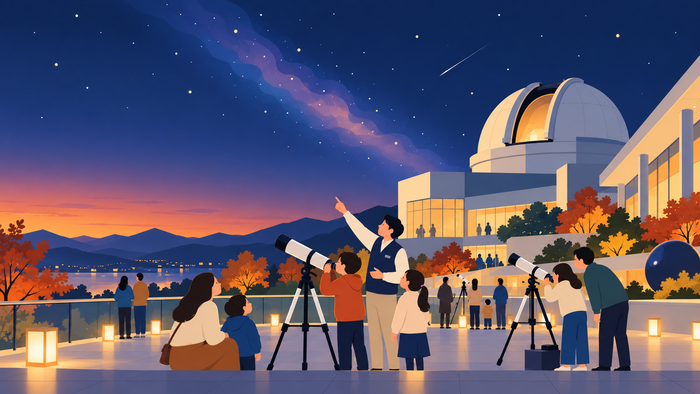 [코리안투데이] Promotional image for the Gwacheon National Science Museum event ‘A Hangeul Day Worth Seeing the Stars’ © 장형임 기자 |
On October 9, the Gwacheon National Science Museum will run the event ‘A Hangeul Day Worth Seeing the Stars’ for family visitors on the first and second floors of the Central Hall, at the Korean Science and Civilization Hall, and at the Planetarium. In keeping with the fact that this year marks the 100th anniversary of the establishment of Hangeul Day and the proclamation of Hunmaeng-jeongeum, the program centers on the question ‘How do thoughts become writing and reach one another?’, inviting visitors to examine Hangeul as a technology of civilization that connects expression, record, delivery, and communication.
The event is divided into four strands: ‘Something to Read and Write’, ‘Something to Make and Draw’, ‘Something to Find’, and ‘Something to See the Stars’. In the ‘Study Where Words Become Writing’ on the second floor of the Central Hall, visitors can enjoy the ‘October Bookshelf’, a space to freely read science books and take a rest, as well as the ‘First Snow Mailbox’, which delivers postcards written on Hangeul Day on the day of the first snowfall.
On the first floor of the Central Hall, hands-on activities in which visitors touch and make Hangeul directly will continue. To commemorate the 100th anniversary of the proclamation of Hunmaeng-jeongeum, there will be ‘A Name Read with the Fingertips’, in which participants make a keyring expressing their own name in Braille; ‘A Face Drawn with Hangeul’, in which faces are drawn using the shapes of consonants and vowels; and ‘Drawing Hangeul with the Body Together with Syuki’, in which participants express Hangeul with their bodies alongside the museum character Syuki. The educational content ‘Mallang Hangeul’, developed in cooperation with the National Hangeul Museum, will also be presented. Participants can create their own Hangeul ‘mallang’ (squishy) pieces, sensing the formative qualities of Hangeul, and photograph and share their work. This content will continue to run at the Korean Science and Civilization Hall until December 23, even after Hangeul Day.
At the Korean Science and Civilization Hall, an exhibition-linked mission, ‘Syuki, Find the Missing Letters!’, will take place. Visitors search for clues related to the creation of Hunminjeongeum throughout the exhibition hall and complete a crossword puzzle, tracing the process by which Hangeul was created, recorded, and delivered. At the Planetarium, just as the event’s name suggests, there will indeed be an occasion to ‘see the stars’. ‘Moonlight Writing Contest: An Inevitable Story’ is a program in which participants write and recite their own stories based on science-related prompts under the night sky of the Planetarium, experiencing scientific observation and linguistic expression together.
This event is run in cooperation with the Gwacheon Family Center, and multicultural families residing in Gwacheon will also take part. It is expected to become an occasion in which families of diverse languages and cultural backgrounds express their thoughts and communicate with one another through Hangeul. Beyond a simple commemorative event, in letting participants directly experience the principles and uses of Hangeul across generational and linguistic boundaries, it is expected to serve local residents as a venue for everyday-oriented science and culture that families can enjoy together.
Lee Chung-won, director of the Gwacheon National Science Museum, said, ‘Hangeul is a technology of communication that has expressed speech as writing and recorded people’s thoughts to convey them to one another’, adding, ‘I hope that this Hangeul Day, visitors will encounter the principles and value of Hangeul anew through the museum’s various hands-on experiences.’
‘Moonlight Writing Contest: An Inevitable Story’ is open to 200 visitors aged 7 and older (born in 2019 or earlier), with a participation fee of 5,000 won. Applications can be made starting October 2 through the reservation link posted on the Gwacheon National Science Museum website. Further details are available on the Gwacheon National Science Museum website (www.sciencecenter.go.kr).


답글 남기기