
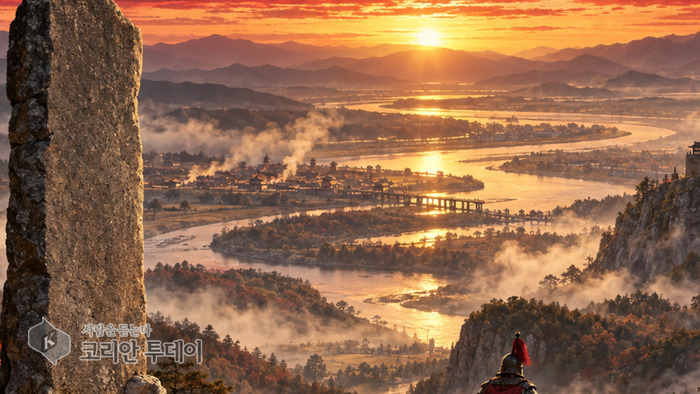
A boy crowned at the age of seven redrew the map of the Korean peninsula before he died at forty-two.
In 540 CE, Jinheung became the 24th king of Silla. His mother, the Queen Dowager Jiso, held real power, and Silla was still seen as a backward periphery wedged between the stronger kingdoms of Goguryeo and Baekje. By his death in 576, Silla controlled the lower Han River, had absorbed the Gaya confederacy of the Nakdong valley, and had pushed up the east coast into what is now South Hamgyeong Province in North Korea. A stele on a granite ridge above modern Seoul still testifies to it.
Plenty of kings expanded their realms. Why is Jinheung called Silla’s Alexander? And was he right to break an alliance that had lasted roughly 120 years? Think of the way Justinian’s reconquests reshaped the Mediterranean in the very same decades, and you will see why this question reaches well beyond Korea.
🌍 Western Historical Parallel
While Jinheung seized the Han River, the Byzantine emperor Justinian (r. 527-565) was reclaiming Italy and North Africa, and the Lombards were about to cross the Alps into Italy (568). Both rulers expanded by exploiting rivals’ weakness, but Jinheung’s gains were more durable: Silla kept what it took and went on to unify the peninsula, while Justinian’s Italian gains largely slipped away within a few years of his death. The “Alexander” label is a metaphor, though. Alexander conquered a continent in about a decade, and Jinheung’s campaigns were regional and spread over decades.
◆ The Ancient Landscape
In the mid-6th century the Korean peninsula was a three-way contest for the Han River basin, the region around today’s Seoul. It was breadbasket, river highway and gateway to the Yellow Sea, and so the door to diplomacy and trade with Chinese courts. Goguryeo had held it since seizing Baekje’s capital Hanseong in 475, but in the 6th century it was weakened by succession struggles and pressure from the Turkic steppe.
In 551, the year Jinheung adopted his own era name, “Gaeguk” (Founding of the State), Silla and Baekje attacked Goguryeo together. According to the Samguk Sagi, Silla took the upper Han region and Baekje the lower. In 553 Silla seized the lower Han from Baekje and set up a new province (Sinju) there. In 554 Baekje’s King Seong, striking back, was killed near Gwansan Fortress (modern Okcheon). Compare this with the Franks of the same era: Gregory of Tours records a Merovingian world full of broken oaths and sudden betrayals, and 6th-century Korea was no gentler.
“They chose handsome young men, adorned them, named them Hwarang and had them honored; their followers gathered like clouds.” (paraphrased translation of the entry for the 37th year of Jinheung, 576, on the founding of the Hwarang corps)
◆ Same Era, Different Worlds
🏛️ China
The tail end of the Northern and Southern Dynasties. Northern Qi and Northern Zhou fought in the north, and the Sui reunified China in 581. Jinheung sent envoys to both north and south, keeping his options open.
🗿 Byzantine Empire
Justinian completed Hagia Sophia in 537 and waged costly wars to reclaim the western Mediterranean, then faced plague in the 540s. Heraclius came much later, in the 7th century.
⚔️ Western Europe
The Frankish kingdoms were divided among Clovis’s heirs, and the Anglo-Saxons were carving out small kingdoms in Britain. The Lombards entered Italy in 568.
🕌 Islamic World
The Caliphate did not yet exist. Muhammad was born around 570, a generation before the early Arab conquests began.
[Image: Schematic of Silla’s expansion on the peninsula (551-568 CE)]
⚔️ Scene from That Day
“Autumn, 554, a misty valley near Gwansan Fortress. King Seong of Baekje rides out with a small escort to rally the army led by his son Chang, later King Wideok. Somewhere along the mountain road, Silla ambushers rise from the trees.”
“The king is captured and killed. The Samguk Sagi and Japan’s Nihon Shoki differ on details, but agree that a once-allied king died in enemy hands. It is a Teutoburg Forest in miniature, an ambush in rough terrain that decided far more than a single battle.”
◆ Uncovering Historical Truth
Jinheung’s expansion ran along three axes. First, the Han River: from 553 Silla had its own ports on the Yellow Sea and a direct route to Chinese courts, much as Venice’s lagoon later gave it a gateway to the East. Second, Gaya: after Geumgwan Gaya was absorbed in 532, Silla crushed Daegaya (modern Goryeong) in 562 under the general Isabu, with the young hwarang Sadaham reportedly at the vanguard. Third, the northeast coast: stelae at Hwangchoryeong and Maunryeong, set up around 568, show Silla’s reach far up the east coast.
These monuments are the best physical evidence of the conquests. Four are known: Bukhansan, Changnyeong (561), Hwangchoryeong and Maunryeong (both 568). Like Roman imperial inscriptions, they announce that the king inspected the new land. The Bukhansan stele was deciphered around 1816 by the Joseon scholar Kim Jeong-hui. The original has been kept at the National Museum of Korea since 1972, and the monument is National Treasure No. 3. In 545, Jinheung also ordered Geochilbu to compile a national history, the Guksa, which is now lost. That is a bit like Charlemagne’s court later commissioning chronicles to legitimise its rule.
Politically, kingship and Buddhism advanced together. The Samguk Sagi says a palace planned in 553 was turned into the Hwangnyongsa temple, and Buddhism, legalised in the previous reign after the martyrdom of Ichadon, became a state ideology. In 576, by the Samguk Sagi’s reckoning, the Hwarang youth corps was formally organised, a pipeline of aristocratic young officers. Where Silla had no feudal manorial system like Frankish Europe’s, it built a rank-based aristocracy, the “bone-rank” system, which tied status to birth and loyalty to the crown. We will look at the Hwarang in the next episode.
Period
Mid-6th century CE (r. 540-576)
Key Figure
King Jinheung, with the generals Isabu and Geochilbu
Territory
Lower Han River, Nakdong valley, northeast coast
Military
Surprise attacks, ambush, cavalry, elite youth corps
🔍 International Academic Perspectives
Korean/Asian Scholars
The Bukhansan stele is generally dated between the Changnyeong (561) and Hwangchoryeong (568) steles or later, though some argue for 555, right after the Han River campaign. The Hwarang existed informally before 576, which the state then organised.
Western Historians
English-language surveys often present 6th-century Silla as a late-developing but disciplined state, and stress that the Samguk Sagi was compiled in 1145, six centuries later. Some Korean studies also note the 554 conflict was a months-long international war involving Goguryeo, not one clean Silla victory.
📖 Key Terms Explained
- Silla (신라)
- Ancient Korean kingdom (traditionally founded 57 BCE, ended 935 CE), one of the Three Kingdoms.
- Sunsubi (순수비)
- Royal “tour of inspection” stele, commemorating a king’s visit to newly acquired territory.
- Hwarang (화랑)
- Elite youth corps of Silla, combining military training, Buddhist ethics and poetry; a loose parallel to knightly orders, but state-run.
- Gaya (가야)
- A confederation of city-states in the Nakdong River valley, famed for iron production; absorbed by Silla by 562.
◆ Lessons for Today’s World
Jinheung started from the weakest position of the three kingdoms and ended in the strongest. He allied with Baekje when Silla was weak and broke the alliance when an opening appeared. It worked, but it left Baekje with a lasting distrust. Today’s middle powers, from Poland within NATO to Southeast Asian states between Beijing and Washington, face the same trade-off between short-term advantage and long-term trust.
The other lesson is about young people. Jinheung did not conquer alone: reportedly teenage hwarang like Sadaham led the charge at Daegaya. Societies facing ageing populations might ask what it means to give younger people real responsibility rather than just training.
| Aspect | Silla Era | Modern Parallel |
|---|---|---|
| Geopolitics | Shifting alliances between Goguryeo and Baekje to win the Han River | Middle powers balancing US-China competition and managing alliances |
| Military | Surprise attack, ambush, envoys to both Chinese courts | High-tech deterrence combined with economic and technology diplomacy |
| Culture | Hwarang martial spirit, Buddhist ideology, chronicle writing | K-culture soft power, K-defense exports, youth talent programs |
[Image: From an ancient kingdom to modern Korea’s strategic position]
📚 Diving Deeper
- The original Bukhansan stele (National Treasure No. 3) is at the National Museum of Korea in Seoul. A replica stands on Bibong peak, and you can hike there in Bukhansan National Park.
- The Jisan-dong tomb cluster in Goryeong holds Daegaya’s royal-scale burial mounds, comparable in spirit to the Sutton Hoo burials of East Anglia as a window into a vanished kingdom.
- For context, read the Samguk Sagi’s Silla Annals and the biographies of Isabu, Geochilbu and Sadaham, and consult the Cambridge History of China volumes covering the Northern and Southern Dynasties.
The Voice of Living History
Jinheung expanded more than territory. He cultivated people, kept records and built an ideology. Land can be won in a single campaign, but holding it takes institutions and talent, and that is what carried Silla toward unifying the peninsula.
“A few lines cut into stone cross fifteen centuries to ask us: what will you extend, and what will you leave behind?”
Previous Episode
Episode 6: King Beopheung and Ichadon – Buddhism Recognized in Blood
Next Episode
Episode 8: The Hwarang – Silla’s Young Warriors
The Korean Today “History Lives On” Series
The Silla Chronicle (35 Episodes)
Bridging Ancient East Asia and the Modern World
© 2025 The Korean Today. All rights reserved.
This content is based on historical facts and presents balanced academic perspectives
for international readers.
THE KOREAN TODAY × WIA CODE
이 기사의 WIA Code

WIA Code 스캐너로 비추면 인터넷 없이 발행 사실과 위·변조 여부를 확인할 수 있습니다.
휴대폰 기본 카메라로 찍으면 스캐너 안내 페이지가 열립니다 — 기사 바로 열기
움직이는 코드(스트림) 한 장에 기사 전문(사진 포함)이 담겨 있습니다 — WIA Code 스캐너로 약 31초 비추면 폰에 저장되어 인터넷 없이도 읽을 수 있습니다. Stream.mp4 도 여기서 받습니다.
WIA Code · 코리안투데이


답글 남기기