
Power rarely changes hands in a single dramatic moment. More often, the quietest seven years of a reign decide everything that follows.
In the first month of 647, the Silla capital of Geumseong (modern Gyeongju) was split between rebels and royal loyalists, and Queen Seondeok died in the midst of it. Her cousin Seungman, who became Queen Jindeok, took the throne and held it until the third month of 654. Her reign has no famous conquest and no sweeping decree, so historians often call her a bridge monarch. Yet in those seven years the architecture of Silla’s power was rebuilt. Rule by sacred bloodline gave way to rule by capability and alliance.
Think of the way Rome’s Senate had once yielded to a new kind of ruler, or how modern dynasties and companies hand over to the next generation. Why would the last queen of the “sacred bone” line pave the road for a successor from another branch? And how did Kim Chunchu reach the throne in the middle of rebellion and war?
🌍 Western Historical Parallel
While Jindeok ruled, the Byzantine emperor Constans II (r. 641-668) was holding together a shrinking empire after Egypt and Syria fell to the Rashidun Caliphate. Like Constans, Jindeok governed in a crisis, but Silla’s crisis ended in consolidation rather than retreat. A closer analogy is the Carolingian “mayors of the palace”: in both cases, the officials who actually wielded power eventually took the crown, as Pippin would in 751. Chunchu, however, took it with the consent of the council and in his own lifetime.
◆ The Ancient Landscape
In 642, Baekje forces took the fortress of Daeya (near modern Hapcheon in South Gyeongsang). The commander Kim Pumseok and his wife, Kim Chunchu’s daughter, were killed. The loss turned Chunchu into the kingdom’s most determined diplomat. He even traveled to Goguryeo seeking help and was detained for his trouble. To the east of Silla there was nothing but sea. Help would have to come from the west.
In the first month of 647, the chief minister Bidam and his ally Yeomjong rose in arms, arguing that a queen could not rule well. Seondeok died during the revolt, and the general Kim Yushin crushed the rebels and executed their leaders. Jindeok then took the throne. In 648 Chunchu sailed to the Tang court and met Emperor Taizong. In 649 Silla adopted Chinese-style court dress, and in 650 it began using the Tang reign-era name, a clear declaration of alignment.
“The great Tang has opened a mighty enterprise; the emperor’s grand design flourishes high and bright. Weapons are laid down and armies set in order to pacify the realm; letters and rites are cultivated to continue the line of a hundred kings.”
◆ Same Era, Different Worlds
🏛️ China
Emperor Taizong of Tang died in 649 and Gaozong succeeded him. Tang campaigns against Goguryeo reshaped the region and gave Silla an opening for alliance.
🗿 Byzantine Empire
Constans II inherited an empire that had lost Egypt and Syria. Heraclius’s costly victory over Persia had been undone by the new Arab power within a generation.
⚔️ Western Europe
The Frankish kingdoms were drifting into rule by powerful palace mayors, while Anglo-Saxon kingdoms competed in a patchwork of small realms.
🕌 Islamic World
The Rashidun Caliphate had conquered Egypt and shattered Sasanian Persia at Nahavand in 642, and was ruled by Caliph Uthman from 644.
[Image: Key events of Queen Jindeok’s reign (647-654 CE)]
⚔️ Scene from That Day
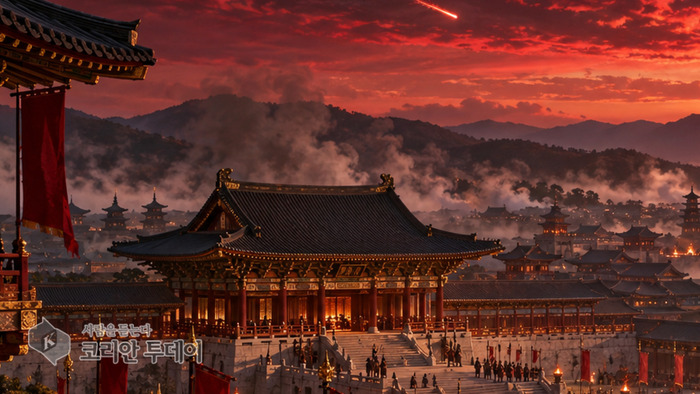
“On a winter night in 647, a great star fell over Wolseong Palace. The rebels roared that it was an omen of the queen’s defeat, and inside the walls the loyal soldiers fell silent.”
“Kim Yushin had a straw effigy set alight and lofted on a kite, so the star seemed to rise back into the sky. As the rumor spread, morale returned and the loyalists turned the fight around. It is a psychological stratagem worthy of a Roman general reading the omens, as recounted in the biography of Kim Yushin in the Samguk Sagi.”
◆ Uncovering Historical Truth
The Bidam Rebellion was not a random riot but a clash between two models of rule. Bidam headed the council of nobles and opposed both a female ruler and the rise of the Kim Chunchu and Kim Yushin faction. After the revolt was crushed, the aristocratic coalition was weakened and the political space was filled by the two Kims. The Samguk Sagi devotes a long account to the suppression, which also serves to justify the new regime’s legitimacy, much as Roman chroniclers justified the victors of civil wars.
Institution-building marks Jindeok’s reign. In 651 the old treasury office was reorganized into the Jipsabu (Chancellery), an organ that carried out the royal will directly and checked the noble council. Adopting Tang dress in 649 and the Tang era name in 650 belong to the same effort. Using another empire’s calendar was a diplomatic statement, and it laid the groundwork for the later Silla-Tang alliance. This resembles the Byzantine habit of using the language of law and ceremony to bind allies.
When the queen died in 654 without an heir, the Hwabaek (council of nobles) is said to have offered the regency to the senior statesman Alcheon, who declined and backed Chunchu. Chunchu was a grandson of King Jinji, and the Samguk Sagi treats him as the first king of the jingol (“true bone”) rank. Known posthumously as King Taejong Muyeol, he ruled until 661, and in his reign Baekje fell in 660. Many scholars see the transfer less as a gracious abdication than as the formalization of power already held by Chunchu and Yushin. Unlike feudal Europe, where kingdoms were split among heirs, Silla’s council could select a successor by consensus.
Period
Mid-7th century CE (647-654)
Key Figures
Queen Jindeok, Kim Chunchu, Kim Yushin
Key Events
Rebellion crushed, Tang diplomacy, Chancellery founded
Legacy
New royal line, preparation for the unification war
🔍 International Academic Perspectives
Korean/Asian Scholars
The standard account holds that “sacred bone” was the highest rank, eligible for the throne, and that when no male member remained, a jingol noble, Chunchu, rose. The Chunchu-Yushin partnership is credited with strengthening kingship.
Western Historians
English-language surveys generally follow the Korean chronicle tradition but caution that the Samguk Sagi was compiled in 1145 from earlier sources. Some Korean scholars go further and doubt that “sacred bone” was ever a distinct legal rank, suggesting the succession was above all a change of ruling faction. Treat this as an open question.
📖 Key Terms Explained
- Silla (신라)
- Ancient Korean kingdom (traditionally founded 57 BCE, ended 935 CE), one of the Three Kingdoms
- Seonggol / Jingol (성골 / 진골)
- “Sacred bone” and “true bone,” the two top ranks of Silla’s bone-rank system, roughly comparable to a royal house versus the high nobility
- Hwabaek (화백)
- A council of nobles that deliberated key decisions by consensus, loosely like a senate
- Tang Dynasty
- Chinese empire (618-907 CE), contemporary with the Byzantine Empire and the early caliphates
◆ Lessons for Today’s World
Jindeok’s seven years are a case study in managed transition. Rather than cling to the stage in a crisis, she created room for capable successors, and Silla avoided the civil collapse that often follows a succession gap. Any institution facing a generational handover, from a ruling party to a family company, faces the same test.
Chunchu also understood that security rests on alliances plus compatible institutions. By adopting the shared standards of the day, Silla became a partner others could trust, a logic visible in how modern states anchor themselves in NATO, the EU, or regional compacts.
| Aspect | Silla Era | Modern Parallel |
|---|---|---|
| Geopolitics | Three Kingdoms rivalry; alliance with Tang | Middle powers balancing among US-China-Russia dynamics |
| Military | Fortress defense plus external ally | Alliance-based deterrence |
| Culture | Absorbing foreign institutions and making them Silla’s own | K-Culture absorbing and re-exporting global influences |
[Image: From Silla’s succession to modern organizational handover]
📚 Diving Deeper
- In Gyeongju, visit the tomb of King Taejong Muyeol at Seoak-dong (a designated Historic Site); the turtle-base stele before it is a National Treasure. Gyeongju’s Historic Areas are a UNESCO World Heritage Site.
- Queen Jindeok’s traditional tomb in Gyeongju’s Hyeongok area is notable for the zodiac figures carved around its base, a worthy counterpart to the great burial finds at places like Sutton Hoo.
- For context, see the Silla chapters of The Cambridge History of China and Korean-history surveys in English; compare the Samguk Sagi Silla Annals, Volume 5, with the biography of Kim Yushin.
The Voice of Living History
Queen Jindeok was no conqueror, yet the bridge she held let Kim Chunchu cross to the throne and brought Silla to the threshold of unification. The best transfers of power are the ones nobody notices.
“The courage to hand over travels farther than the courage to hold on.”
Previous Episode
Episode 9: Queen Seondeok – East Asia’s First Queen
Next Episode
Episode 11: Hwangnyongsa – The Heart of Silla Buddhism
The Korean Today “History Lives On” Series
The Silla Chronicle (35 Episodes)
Bridging Ancient East Asia and the Modern World
© 2025 The Korean Today. All rights reserved.
This content is based on historical facts and presents balanced academic perspectives
for international readers.



답글 남기기