
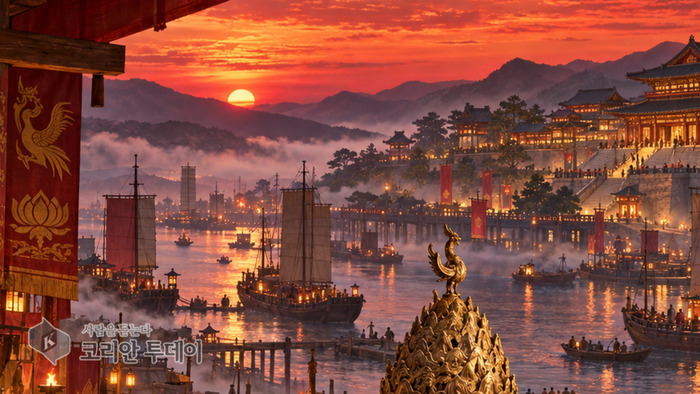
A closed door can protect a kingdom, but it cannot make anything new. Baekje kept its doors open, and that is why it could create beauty.
Today, K-pop, Korean dramas and Korean food reach audiences on every continent. Many call it a sudden phenomenon, but the habit behind it is old. About 1,500 years ago, on the Geum River plains of the Korean peninsula, one kingdom absorbed the cultures around it, reshaped them into something its own, and passed them on to its neighbors. The kingdom fell in 660 CE, yet its incense burner, its stone pagodas, its brick tombs and the craftsmen it sent across the sea outlasted it.
Western readers know how Byzantium preserved and transformed Greco-Roman learning, and how monasteries in Ireland carried Latin letters through turbulent centuries. Baekje played a comparable role in East Asia. What did a small kingdom, repeatedly pressed by stronger neighbors, leave the world? In this last main episode, the answer is not an army but an attitude.
🌍 Western Historical Parallel
In 537 CE, Emperor Justinian dedicated the Hagia Sophia in Constantinople. One year later, in 538, King Seong of Baekje moved his capital to Sabi (modern Buyeo). Byzantium expressed power through a soaring dome. Baekje expressed refinement through compact, intricate craftsmanship. Both courts were cosmopolitan crossroads that turned borrowed ideas into distinctive art.
◆ The Ancient Landscape
Baekje arose in the Han River basin, in what is now the Seoul area, and later moved south to Ungjin (Gongju) and then Sabi (Buyeo). On land it faced constant pressure from Goguryeo to the north. But the Yellow Sea gave it sea lanes to the Southern Dynasties of China, and further routes to the Japanese archipelago. Geography made openness a strategy.
The Samguk Sagi records that in 375 CE, under King Geunchogo, the scholar Go Heung compiled Baekje’s first written history. The Nihon Shoki, a Japanese chronicle that must be read critically, reports that Baekje sent Confucian “Doctors of the Five Classics” to Japan in the early sixth century. Around 500 CE King Muryeong traded actively with Liang China, and the brick tomb built for him shows it. Knowledge entered Baekje through many doors, but it never stayed in its original form.
“The palace was built to be frugal without being shabby, and splendid without being extravagant.”
(The Samguk Sagi’s description of the early palace, a phrase Koreans often cite as a summary of the Baekje aesthetic.)
◆ Same Era, Different Worlds
🏛️ China
After the divided Northern and Southern Dynasties, the Sui (581-618) reunified China and the Tang (from 618) followed. Southern Dynasty court culture and Buddhist art were Baekje’s favorite sources.
🗿 Byzantine Empire
Justinian (r. 527-565) rebuilt the capital and dedicated the Hagia Sophia in 537, codifying law and projecting imperial grandeur.
⚔️ Western Europe
Frankish and Anglo-Saxon kingdoms were forming. The royal ship burial at Sutton Hoo, dated to the early 600s, shows a comparable taste for gold and garnet craftsmanship.
🕌 Islamic World
Within a few decades of Muhammad’s death in 632, the early caliphates had begun a rapid expansion, only a few years before Baekje fell in 660.
[Image: Conceptual diagram of cultural absorption, fusion and transmission centered on Baekje]
⚔️ Scene from That Day
“December 12, 1993, at the Neungsan-ri temple site in Buyeo. At the bottom of a waterlogged pit, thought to be part of a workshop area, the excavators’ fingers touched gold in the mud. As they brushed the clay away, a phoenix with spread wings emerged from the lid. An object that had slept for nearly fourteen centuries was waking up.”
“Layers of mountain peaks rose from a lotus blossom, with musicians, animals and immortals hidden among them. Scholars have long suspected that someone buried it in haste around the time Sabi fell in 660. Like a monk hiding a gilded reliquary from raiders, or a Byzantine family burying silver before an invasion, they could not save the city, but they tried to save its most beautiful object.”
◆ Uncovering Historical Truth
Openness was the ability to receive. The Tomb of King Muryeong, discovered in 1971, is an arched brick chamber of a type used in Southern Dynasties China. Yet its epitaph stones record the king under his native name, Sama, and the tomb held 2,906 artifacts, including the royal family’s gold ornaments. The structure was borrowed; the contents were unmistakably Baekje. Compare this with Frankish rulers who adopted Roman titles and Christianity while keeping their own Germanic goldwork traditions.
Fusion was the ability to create. The Baekje Gilt-bronze Incense Burner, found in 1993, descends from the Han Chinese “Boshan” mountain censer, yet it packs a phoenix, a lotus, five musicians with five instruments, and a landscape of peaks and beasts into one form, blending Daoist paradise with the Buddhist world. No exact counterpart is known elsewhere. Mireuksa, a vast temple in Iksan, was consecrated in 639 CE, and its stone pagoda translates timber-building techniques into stone. When a gold reliquary plaque was found inside in 2009, it confirmed the construction date, an event archaeologists compare in excitement to the Sutton Hoo discovery.
Transmission was the ability to share. The Nihon Shoki records Baekje sending Confucian scholars in 513 and 516, and four musicians in 554. The date Buddhism reached Japan is debated, 538 or 552, but Baekje stood at the center of both accounts, and Baekje artisans contributed to early Asuka-period temples. The political structure was unlike Western feudalism: a centralized monarchy with offices and ranks, closer to a small Byzantine-style court than to a patchwork of manors. Chronicle dates and figures should be treated with caution, but the direction of the flow is clear from several independent sources.
Period
Late 5th to mid-7th century CE (Ungjin and Sabi eras)
Key Figures
Kings Muryeong, Seong and Mu
Key Artifacts
Incense burner, Muryeong’s tomb, Mireuksa pagoda
Legacy
East Asian exchange; UNESCO listing in 2015
🔍 International Academic Perspectives
Korean/Asian Scholars
Most see Baekje as selectively absorbing Southern Chinese, northern and Central Asian elements into a distinct style that strongly shaped Japan. UNESCO recognized the sites as evidence of exchange among China, Korea and Japan.
Western Historians
Many Western and Japanese specialists warn against a one-way “Baekje taught Japan” model and stress two-way exchange. The Mireuksa plaque names the queen as a member of the Sataek family, contradicting the folk tale of Princess Seonhwa in the Samguk Yusa, which shows how legend and record can diverge.
📖 Key Terms Explained
- Baekje (百濟, 백제)
- Ancient Korean kingdom (traditionally founded 18 BCE, fell 660 CE), one of the Three Kingdoms of Korea
- Geumdong Daehyangno (금동대향로)
- The Baekje Gilt-bronze Incense Burner, a 6th to 7th century masterpiece unearthed in 1993
- Tang Dynasty
- Chinese empire (618-907 CE), contemporary with the later Byzantine Empire and the rise of the early caliphates
- Hallyu (한류)
- “Korean Wave,” the global popularity of Korean pop culture
◆ Lessons for Today’s World
Soft power works the way Baekje’s did: not by command but by attraction. K-pop took the grammar of Western pop and hip-hop and added its own training system, synchronized choreography and fan engagement. Korean dramas layered local emotion over borrowed genres. Copying alone would have produced imitations; reinvention made them universal.
It would be too neat to call Hallyu a descendant of Baekje. The lesson is not genealogy but attitude: stay open to the unfamiliar, refine what you receive with your own eyes, and share what you make. The EU’s cultural exchange programs and global universities rely on the same cycle of receiving, shaping and giving back.
| Aspect | Baekje Era | Modern Parallel |
|---|---|---|
| Absorbing | Southern Chinese Buddhism and brick tombs, northern and Central Asian styles | Learning Western pop music and film grammar |
| Creating | Incense burner and stone pagoda as original forms | K-pop and K-drama as new genre hybrids |
| Sharing | Scholars, musicians and artisans sent to Japan | Streaming and social media spreading worldwide at once |
[Image: Conceptual diagram of resonance between Baekje’s spirit and modern Korean culture]
📚 Diving Deeper
- The Baekje Historic Areas, inscribed on the UNESCO World Heritage List on July 4, 2015, comprise eight sites in Gongju, Buyeo and Iksan: Gongsanseong Fortress, Songsan-ri Tombs, Gwanbuk-ri and Busosanseong, Neungsan-ri Tombs, Jeongnimsa Temple Site, Naseong Wall, Wanggung-ri and Mireuksa Temple Site.
- Like Sutton Hoo in England, the Tomb of King Muryeong was a sealed royal burial whose contents rewrote what scholars knew of its era. The Muryeong tomb, found by accident in 1971 during drainage work, was unlooted.
- Visit the national museums in Buyeo, Gongju and Iksan to follow Baekje’s story from Ungjin to Sabi to Iksan. For general background, consult the Cambridge History of Korea volumes on early Korea and period surveys of East Asian Buddhist art.
The Voice of Living History
Baekje is remembered less for the land it held than for the doors it opened. Receive, refine, share: that cycle is another name for creativity, and it belongs to every culture that chooses to learn from its neighbors.
“A kingdom may vanish, but the urge to make beautiful things does not. The spirit of Baekje still breathes among us.”
Previous Episode
Episode 28: Studying Baekje – Contrasts with the Nihon Shoki
Next Episode
Episode 30: Epilogue – The Revival of a Forgotten Kingdom
The Korean Today “History Lives On” Series
The Baekje Chronicle (30 Episodes)
Bridging Ancient East Asia and the Modern World
© 2025 The Korean Today. All rights reserved.
This content is based on historical facts and presents balanced academic perspectives
for international readers.
THE KOREAN TODAY × WIA CODE
이 기사의 WIA Code

WIA Code 스캐너로 비추면 인터넷 없이 발행 사실과 위·변조 여부를 확인할 수 있습니다.
휴대폰 기본 카메라로 찍으면 스캐너 안내 페이지가 열립니다 — 기사 바로 열기
움직이는 코드(스트림) 한 장에 기사 전문(사진 포함)이 담겨 있습니다 — WIA Code 스캐너로 약 31초 비추면 폰에 저장되어 인터넷 없이도 읽을 수 있습니다. Stream.mp4 도 여기서 받습니다.
WIA Code · 코리안투데이


Leave a Reply