
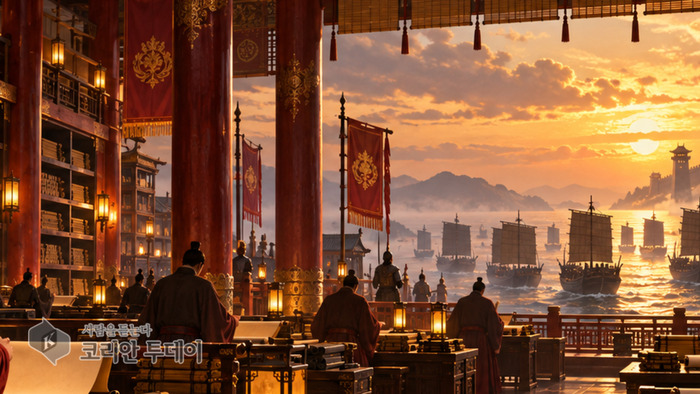
Baekje vanished in 660 CE, yet fragments of its own history books survived, quoted inside the chronicle of a neighbouring state.
Baekje is said to have kept its own histories, but none survives intact. Even the Samguk Sagi, the main Korean source, was compiled centuries later under Goryeo. So one of the few windows onto Baekje through contemporaneous-era material is the Nihon Shoki, Japan’s court chronicle completed in 720, which quotes three lost Baekje works: the Baekje-gi, the Baekje Sinchan and the Baekje Bongi, together called the “Three Books of Baekje.”
It is a tinted window. Many passages portray Baekje as a tributary of the Yamato court. Historians face a question familiar to anyone who has read Gildas, Bede or the Frankish annals: how do you use a source whose author had a political agenda?
🌍 Western Historical Parallel
Reconstructing Baekje resembles reconstructing the Goths or the Lombards: much of what we know comes from outsiders, such as Jordanes on the Goths and Paul the Deacon on the Lombards, writing for their own audiences. Historians there too cross-check texts against archaeology, coins and inscriptions. The Nihon Shoki plays a role comparable to a court chronicle that absorbed older foreign records and reshaped them.
◆ The Ancient Landscape
The Nihon Shoki was begun under Emperor Tenmu, with compilation starting in 681, and was completed in 720. That is after Baekje’s fall in 660 and the Battle of Baekgang in 663, which sent many Baekje refugees to the Japanese archipelago. Scholars debate how far literate Baekje émigrés shaped the written record.
Of the three books, the Baekje Bongi is the most heavily quoted and is understood to have covered three reigns, from King Muryeong to King Wideok (roughly 501-557). The Baekje-gi and Baekje Sinchan are more fragmentary and mostly concern relations with Wa, the Japanese polity of the period. None of the originals survives; all exist only as quotations (itsubun).
“The Baekje Sinchan says that in the gihae year, Gonji, younger brother of King Gaero, crossed over to Wa…” (paraphrase of the gist, not a verbatim translation; it concerns a Baekje prince sent to Wa)
◆ Same Era, Different Worlds
🏛️ China
Under the Tang (618-907), compiling the previous dynasty’s history became a state project. Japan’s Nihon Shoki imitated this model.
🗿 Byzantine Empire
Court historians such as Procopius wrote under Justinian, shaping imperial memory much as Yamato scribes shaped theirs.
⚔️ Western Europe
Frankish and Anglo-Saxon chroniclers, such as Bede (finished 731), recorded histories partly to legitimise ruling houses.
🕌 Islamic World
After the 7th-century conquests, the early caliphates began building their own written historical tradition.
[Image: Transmission path of the Baekje books and the web of cross-verification]
⚔️ Scene from That Day
“(Imagined reconstruction) Years after Baekje’s fall, in an office of the Yamato court that smells of ink. An exiled Baekje scholar unrolls a worn scroll, the last record he carried from home.”
“(Imagined reconstruction) A Japanese official, brush in hand, says: ‘Write that this king sent tribute to us.’ The scholar studies the brush tip. Between fact and flattery lay one sentence that would travel a thousand years, a dilemma any court historian from Constantinople to Aachen would have known.”
◆ Uncovering Historical Truth
The first obstacle is chronology. Dates in the Nihon Shoki’s Baekje entries are sometimes off by about 120 years, two full cycles of the 60-year sexagenary calendar. Scholars call this the “two-cycle adjustment.” The leading interpretation is that compilers pushed events earlier to magnify Wa’s seniority. It is as if a medieval chronicler dated a treaty a century too early to claim precedence. The dates therefore cannot be taken at face value and must be matched against other sources.
The second help comes from archaeology and inscriptions. The epitaph stone found in 1971 in King Muryeong’s tomb at Gongju states that he died in 523 at the age of 62, which implies a birth in 462. That matches the Nihon Shoki’s story of his birth on Kakara Island, in present-day Saga Prefecture in Japan. Like Sutton Hoo for the Anglo-Saxons, a tomb with a datable inscription anchors the written sources. Only where independent evidence agrees can the Nihon Shoki be used with confidence.
The third issue is the vantage point. The Three Books were probably submitted by Baekje elites to the Yamato court and may already have been embellished, then refined again by the Nihon Shoki’s editors. Unlike a feudal charter that records one lord’s claim, these texts stack layers of perspective. Reconstructing Baekje today means placing the Samguk Sagi, Chinese histories, inscriptions and excavations side by side and peeling those layers apart.
Period
Compiled 7th-8th c. CE; events 5th-7th c.
Key Sources
Three Books of Baekje, Nihon Shoki
Key Problem
120-year dating shift, political embellishment
Legacy
A model of cross-verification
🔍 International Academic Perspectives
Korean/Asian Scholars
The Nihon Shoki was shaped by Yamato-centred political aims, so its Baekje entries need critical filtering for both dates and framing. The Three Books remain valuable as Baekje-derived material.
Western and Japanese Historians
Opinions range widely. Some Japanese scholars accept a broader scope of Wa military and diplomatic involvement on the peninsula, while many Western historians stress textual layering and demand archaeological corroboration before accepting any claim.
📖 Key Terms Explained
- Baekje (百濟)
- Ancient Korean kingdom (traditionally founded 18 BCE, fell 660 CE), one of the Three Kingdoms
- Nihon Shoki
- “Chronicles of Japan,” the court history completed in 720 CE, the second oldest surviving Japanese chronicle after the Kojiki (712)
- Three Books of Baekje (百濟三書)
- The lost Baekje-gi, Baekje Sinchan and Baekje Bongi, preserved only as quotations in the Nihon Shoki
- Two-cycle adjustment (二周甲引上)
- The scholarly term for the roughly 120-year upward shift of dates in some Nihon Shoki entries
- Wa (倭)
- The Chinese and Korean name for the polity of the Japanese archipelago in this period
◆ Lessons for Today’s World
What do you do when a nation’s history survives mainly in a neighbour’s records? Baekje scholarship answers: neither discard nor swallow it, but cross-examine it. This is the same discipline behind modern fact-checking and the joint history commissions Europe has used, such as the Franco-German textbook project.
Korean and Japanese researchers have debated the Muryeong tomb, the Seven-Branched Sword and similar objects for decades, testing each other’s readings. Asking who wrote a source, why and for whom, and then seeking independent confirmation, is a habit well suited to today’s contested information environment.
| Aspect | Baekje Era | Modern Parallel |
|---|---|---|
| Geopolitics | History written to legitimise royal power | Historical memory as a diplomatic issue |
| Diplomacy | Baekje-Wa exchange shaping each other’s records | Joint Korea-Japan research and scholarly exchange |
| Culture | The drive to record and transmit knowledge | Digital archives and open access to sources |
[Image: Source-criticism method and its modern echo]
📚 Diving Deeper
- Visit Gongju and Buyeo: the Baekje Historic Areas are a UNESCO World Heritage Site (inscribed 2015), and the Muryeong tomb epitaph is a rare datable inscription.
- Like the Sutton Hoo burial, the Muryeong tomb gives a fixed point against which written chronicles can be tested. The name “Sama” (斯麻) appears in both the epitaph and Japanese sources, and also in an inscription on a mirror in Wakayama whose date and reading remain debated.
- For further reading, see overviews of early Korea and Japan in the Cambridge History of Japan and the Cambridge History of Korea series, and the Northeast Asian History Foundation’s introductions to the Nihon Shoki.
The Voice of Living History
Baekje lost most of its own voice, yet it speaks again through scholars who piece together scattered fragments. To doubt a source without abandoning the pursuit of fact is the discipline that restores the past, in East Asia and everywhere else.
“Records may vanish, but as long as someone keeps asking questions, Baekje is not finished.”
Previous Episode
Episode 27: Rediscovering Baekje’s Heritage – Gongju and Buyeo
Next Episode
Episode 29: The Spirit of Baekje – Openness and Creation
The Korean Today “History Lives On” Series
The Baekje Chronicle (30 Episodes)
Bridging Ancient East Asia and the Modern World
© 2025 The Korean Today. All rights reserved.
This content is based on historical facts and presents balanced academic perspectives
for international readers.
THE KOREAN TODAY × WIA CODE
이 기사의 WIA Code

WIA Code 스캐너로 비추면 인터넷 없이 발행 사실과 위·변조 여부를 확인할 수 있습니다.
휴대폰 기본 카메라로 찍으면 스캐너 안내 페이지가 열립니다 — 기사 바로 열기
움직이는 코드(스트림) 한 장에 기사 전문(사진 포함)이 담겨 있습니다 — WIA Code 스캐너로 약 31초 비추면 폰에 저장되어 인터넷 없이도 읽을 수 있습니다. Stream.mp4 도 여기서 받습니다.
WIA Code · 코리안투데이


Leave a Reply