
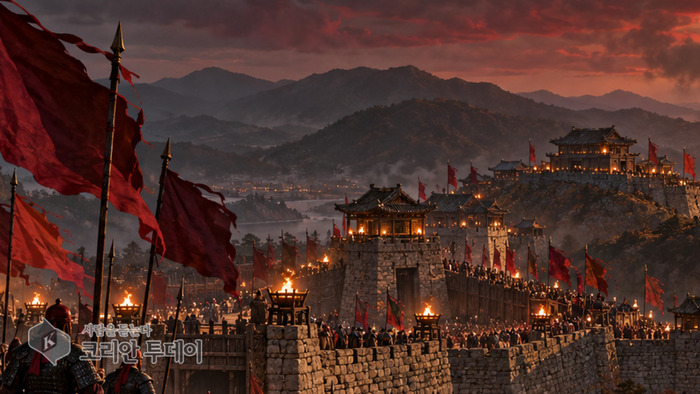
The capital had fallen and the king was in chains, yet some people refused to stop fighting. For three more years, a kingdom that no longer officially existed kept resisting.
On 18 July 660 CE, King Uija of Baekje surrendered to the combined armies of Tang China and Silla. Textbooks usually treat that date as the end of the kingdom. But from about September of that year, resistance flared again across Baekje’s former lands. A royal kinsman named Boksin, a Buddhist monk named Dochim, and the general Heukchi Sangji gathered followers at the fortresses of Juryuseong and Imjonseong. Tradition says they won back around two hundred towns. This was resistance organized by people themselves after the institutions of the state had disappeared.
Think of the Britons after Rome’s withdrawal, or Byzantine loyalists in lands overrun by new powers: how does a community fight on without a state? And why did this movement burn out in only three years? The answer lies as much in its internal fractures as in its battles.
🌍 Western Historical Parallel
While Baekje’s loyalists fought on in 661-663, the Byzantine emperor Constans II was visiting Rome (663) and the Umayyad Caliphate was being founded (661). A closer analogy to Baekje’s story is the Byzantine Empire’s own struggle to hold territory against fast-moving rivals. Like Byzantine commanders who relied on fortified strongholds and allies abroad, Baekje’s restorers pinned their hopes on mountain fortresses and a relief force from Yamato Japan. In both cases, outside help proved decisive, and its failure was fatal.
◆ The Ancient Landscape
East Asia in the mid-seventh century was a continent at war. Emperor Gaozong of Tang planned to conquer Goguryeo and attacked Baekje first as part of that strategy. Silla used the Tang alliance to gain the upper hand in the Three Kingdoms rivalry, while Yamato Japan, Baekje’s long-time ally, could not stand by as it collapsed. The fall of the capital Sabi in 660 marked the beginning of a reshuffling of the regional order.
In September 660, Boksin and Dochim raised an army at Juryuseong, while Heukchi Sangji answered the call from Imjonseong. By early 661 the restoration forces were besieging Sabi and blocking the mouth of the Geum River to stop Tang reinforcements. At Duryangyun fortress (thought to be modern Gyebongsanseong in Cheongyang) they reportedly fought Silla troops for thirty-six days and prevailed. In September 661, Prince Buyeo Pung, a son of King Uija who had been living in Japan, returned and was enthroned. For the first time the movement had a king.
“The royal kinsman Boksin and the monk Dochim held Juryu fortress, welcomed the former prince Pung and raised him as king, and stood against the Tang camps.” (Paraphrase of the sources’ gist, not a verbatim translation)
◆ Same Era, Different Worlds
🏛️ China
Emperor Gaozong’s Tang. After toppling Baekje, Tang turned to Goguryeo and set up the Ungjin Commandery to rule Baekje’s old territory directly.
🗿 Byzantine Empire
Constans II’s reign. Having lost Syria, Palestine and Egypt after Heraclius’s era, Byzantium was fighting for survival, and the emperor visited Rome in 663.
⚔️ Western Europe
Frankish kings ruled with powerful nobles in the Merovingian age, and in 664 the Synod of Whitby settled the Easter question in Anglo-Saxon England.
🕌 Islamic World
The Umayyad Caliphate began in 661 after the Rashidun era, continuing the rapid expansion that reshaped the Mediterranean.
[Image: Restoration strongholds and external forces on the Korean peninsula’s southwest]
⚔️ Scene from That Day
“The sun sinks behind the mountain wall. Fires have burned below the ramparts for days, and inside stand farmers, monks and stragglers from broken units. None of them holds an official commission.”
“The monk Dochim unclasps his hands and steps to the battlements. Boksin silently presses a finger to the river mouth on the map. As they wait for a prince to return from across the sea, both know that if this place falls, everything ends. Like the defenders of a besieged Byzantine hill-fort waiting for a relief fleet, they have only time to bargain with.” (A reconstructed scene)
◆ Uncovering Historical Truth
The movement can be divided into three phases. The first, from the uprising in September 660 to early 661, was one of expansion: scattered refugees and local strongmen rallied, with Juryuseong and Imjonseong as hubs. The second began in September 661 with the enthronement of Pung, when the movement acquired the machinery of a state in exile. The third was breakdown. Dochim was eliminated by Boksin around 661-662, and in June 663 Boksin was killed by Pung. This is widely seen as the decisive blow to the movement’s cohesion. Unlike Rome’s late legions, which were professional armies, these forces were improvised, closer to the militias of post-Roman Gaul than to an imperial field army.
The sources are limited. The Samguk Sagi, compiled in the twelfth century from a Silla-centered perspective, mentions the movement only in scattered passages. Reconstructing the sequence means cross-checking the Japanese Nihon Shoki and Chinese records such as the Old Book of Tang. Archaeologically, Ugeumsanseong in Buan shows extensive fortification remains and a cave traditionally called Boksin’s Cave. Yet no inscription has been found to identify it conclusively as Juryuseong. It is a little like the search for Camelot or Mons Badonicus: strong candidates, no definitive proof.
What followed was swift. In August 663, the Battle of Baekgang destroyed the Yamato relief fleet, and in September Juryuseong fell. Pung is recorded as fleeing to Goguryeo. Heukchi Sangji surrendered to Tang around 663, and Jisusin, who held Imjonseong to the end, left for Goguryeo when the fortress fell in 664. External support was cut and the leadership was divided. A Baekje loyalist’s feudal-style network of local lords had no mechanism to survive both. Baekgang itself is the subject of the next episode.
Period
Sept 660 – 664 CE
Key Figures
Boksin, Dochim, Heukchi Sangji, Buyeo Pung, Jisusin
Key Events
Siege of Sabi, Pung’s return (Sept 661), leadership feud
Outcome
Restoration failed; East Asian order reshaped
🔍 International Academic Perspectives
Korean/Asian Scholars
Many Korean scholars now favor Ugeumsanseong in Buan as Juryuseong, citing the fortress’s size, evidence that the nearby area was once sea, and local tradition. The older Seocheon (Hansan) theory lost ground after a 2001 excavation dated that site to the late Goryeo period. Other candidates, such as Hongseong and Jeongeup, remain unproven.
Western and Japanese Readings
English-language scholarship usually treats the movement within the wider story of Tang expansion and Yamato’s first major overseas war, and tends to stress the Nihon Shoki and Chinese records over the Samguk Sagi. Specialists stress that the exact location of Juryuseong remains open.
📖 Key Terms Explained
- Baekje (百濟)
- Ancient Korean kingdom (traditionally founded 18 BCE, fell in 660 CE), one of the Three Kingdoms of Korea.
- Tang Dynasty
- Chinese empire (618-907 CE), contemporary with Byzantine Emperors Heraclius and Constans II and the early Caliphates.
- Seong (城)
- Korean word for fortress. Korean mountain fortresses (sanseong) enclose a ridge and its slopes, serving as refuges, closer to a Celtic hillfort than to a castle.
- Samguk Sagi
- “History of the Three Kingdoms,” compiled in 1145 by Kim Busik under the Goryeo dynasty; the oldest surviving Korean-compiled history.
◆ Lessons for Today’s World
The first lesson is community resilience. After state institutions collapsed, local networks, religious organizations and personal ties became the backbone of resistance, as the role of a monk like Dochim shows. Modern parallels include occupied European societies in the 1940s, where civic and religious networks kept national identity alive. The second lesson is the cost of divided leadership. The story shows that internal distrust can destroy an organization faster than outside pressure.
Alliances matter, and so does self-reliance. NATO and other modern pacts show that outside help can multiply strength, but Baekje’s restorers staked their survival on a single relief fleet. Contemporary strategists would call that a dangerous dependency. Korea’s own twentieth-century independence movement, split across different factions yet never quite dissolved, shows what the Baekje movement could not manage.
| Aspect | Baekje Era | Modern Parallel |
|---|---|---|
| Geopolitics | Tang, Silla and Yamato each pursued their own interests on the peninsula | Great-power rivalry in which smaller states must balance alignments |
| Military | Fortress defense dependent on an overseas relief force | Deterrence that combines alliances with self-reliant defense |
| Culture | Monks and refugees resisting together | Civic resilience and memory culture, including K-culture’s global reach |
[Image: From an ancient resistance to modern Korea’s memory of it]
📚 Diving Deeper
- Visit the UNESCO-listed Baekje Historic Areas (Gongju, Buyeo, Iksan), including Busosanseong in Buyeo, the setting of Sabi’s last days.
- The Tang victory monument of Yu Inwon in Buyeo shows the victors’ view of the conquest, a bit like a Roman triumphal inscription, while Sutton Hoo offers a comparison for how elite material culture survives in the archaeological record.
- For further reading, consult general surveys of early Korea in the Cambridge History series and Korean scholarship on Imjonseong (Bongsusanseong) in Yesan.
The Voice of Living History
The three years of Boksin and Dochim are not a record of victory. But the fact that people tried to stand together where a state had vanished is something every society facing collapse can recognize.
“Fortresses fall, but as long as someone remembers, the name of Baekje is not extinguished.”
Previous Episode
Episode 23: The Fall of Sabi – 18 July 660
Next Episode
Episode 25: The Battle of Baekgang – East Asia’s Great Naval Clash
The Korean Today “History Lives On” Series
The Baekje Chronicle (30 Episodes)
Bridging Ancient East Asia and the Modern World
© 2025 The Korean Today. All rights reserved.
This content is based on historical facts and presents balanced academic perspectives
for international readers.
THE KOREAN TODAY × WIA CODE
이 기사의 WIA Code

WIA Code 스캐너로 비추면 인터넷 없이 발행 사실과 위·변조 여부를 확인할 수 있습니다.
휴대폰 기본 카메라로 찍으면 스캐너 안내 페이지가 열립니다 — 기사 바로 열기
움직이는 코드(스트림) 한 장에 기사 전문(사진 포함)이 담겨 있습니다 — WIA Code 스캐너로 약 26초 비추면 폰에 저장되어 인터넷 없이도 읽을 수 있습니다. Stream.mp4 도 여기서 받습니다.
WIA Code · 코리안투데이


Leave a Reply