
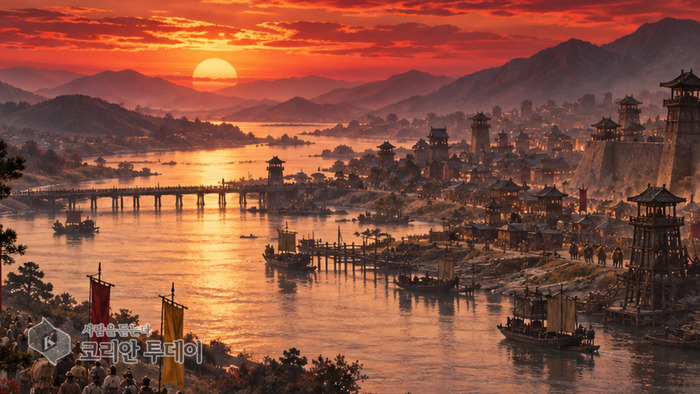
Two kingdoms born of the same root killed each other’s kings and burned each other’s capitals. In the end, they shook hands anyway.
Baekje’s royal house honored a founder called Dongmyeong, the same name attached to the founder of Goguryeo. The Samguk Sagi (History of the Three Kingdoms) makes Baekje’s founder Onjo a son of Jumong, Goguryeo’s founder, and it also preserves traditions that the royal line came from Buyeo. The two peoples shared language, customs and a founding myth. Yet in 371 Baekje troops killed a Goguryeo king beneath the walls of Pyongyang, and in 475 Goguryeo troops captured and killed a Baekje king. Kinship made the rift deeper, not shallower.
Does a shared origin secure peace, or does it intensify rivalry? Think of the Wars of the Roses, or of the Franks and Burgundians, both from Germanic peoples who were close relatives. Ancient Korea asked the same question with the Han River at stake.
🌍 Western Historical Parallel
Baekje’s capital Hanseong fell in 475. In 476, one year later, the last Western Roman emperor was deposed. Both events show a settled, sophisticated state collapsing under pressure from a rising power. The difference is that Baekje did not vanish. It moved south to Ungjin and rebuilt, much as the Eastern Roman Empire endured after the West fell.
◆ The Ancient Landscape
In the 4th century, China was divided and the peninsula’s northern half was open to ambitious neighbors. Goguryeo, based in today’s northern Korea and Manchuria, pushed south. Baekje, centered on the Han River around modern Seoul, pushed north. Both wanted the river valleys and the sea routes to China. In 371, King Geunchogo of Baekje ambushed Goguryeo forces at the Paeha River and then besieged Pyongyang with about 30,000 troops. Goguryeo’s King Gogugwon died in the fighting.
Goguryeo answered. In 396, King Gwanggaeto led a campaign, including naval forces, up to Hanseong, and Baekje’s King Asin submitted (as recorded on Gwanggaeto’s stele). Baekje then sought partners. In 433 it made peace with Silla, forming the Nasa Alliance (Silla-Baekje Alliance), which became a barrier against Goguryeo’s southward advance. The decisive blow came in 475, when King Jangsu’s army of about 30,000 took Hanseong and killed King Gaero. His son Munju moved the capital south to Ungjin (modern Gongju) and rebuilt the state.
“In winter, in the tenth month, the king of Baekje led thirty thousand soldiers to attack Pyongyang. The king sent out his army to resist, was struck by a stray arrow, and died on the twenty-third of that month.” (paraphrased translation) – the only recorded battle in which a Goguryeo king fell in combat.
◆ Same Era, Different Worlds
🏛️ China
The Northern and Southern Dynasties era. In 472 Gaero asked the Northern Wei court to attack Goguryeo and was refused. After Sui reunified China in 589 and Tang followed in 618, all three Korean kingdoms faced a single superpower.
🗿 Byzantine Empire
Justinian (527-565) reconquered much of Italy from the Ostrogoths, ending the main war there by the early 550s, the same decade Baekje’s King Seong fell at Gwansanseong (554).
⚔️ Western Europe
Successor kingdoms of Franks and Goths formed on Roman ground. The Sutton Hoo ship burial in England dates to around 625, close in time to Baekje’s peak as a maritime power.
🕌 Islamic World
In 642, the year Baekje and Goguryeo drew together, Arab armies defeated the Sasanian Empire at Nihavand, opening the way to Persia’s collapse.
[Image: Goguryeo’s southward push and the Baekje-Silla response (371-475 CE), shown against the modern peninsula]
⚔️ Scene from That Day
“Autumn, 475. Beyond the walls north of the Han River, Goguryeo banners stretched to the horizon. Smoke rose over the city, and inside it, peasants worn out by palace construction looked at one another in silence.”
“King Gaero called his son Munju and sent him to Silla for help. The chronicles say ten thousand Silla troops set out, but Hanseong fell before they arrived, a story as grim as a besieged Constantinople waiting for allies who come too late. The king was captured trying to flee. Munju led the survivors south.” (Reconstruction based on the sources)
◆ Uncovering Historical Truth
The fall of Hanseong was no accident. According to the Samguk Sagi, King Gaero asked Northern Wei in 472 to attack Goguryeo, was refused, and the request reached Goguryeo’s ears. Goguryeo then sent a monk, Dorim, as a spy who won the king’s trust through the board game baduk (go) and encouraged lavish construction that drained Baekje’s resources. Later embellishment may be present, much like the tale of the Trojan Horse, but historians generally accept the outline: diplomatic failure plus internal exhaustion made the 475 defeat possible.
Archaeology shows the two peoples’ roots were intertwined. The stone-mound tombs at Seokchon-dong in Seoul resemble Goguryeo tomb styles and are often cited as evidence of a Goguryeo-Buyeo origin for Baekje’s ruling class. Conversely, the Achasan fortresses in Seoul are Goguryeo military outposts from the period when it held the Han River valley. The same river changed hands, and both sides left their marks.
Politically, the two states were centralizing aristocratic monarchies, closer to late Roman provincial-aristocratic empires than to medieval feudalism. In 551, King Seong of Baekje allied with Silla to retake the Han valley, but in 553 Silla seized the lower Han for itself, shattering the alliance. Seong died at Gwansanseong in 554. Then in 642, after Baekje’s King Uija took Silla’s Daeya Fortress, he agreed a rapprochement with Goguryeo’s strongman Yeon Gaesomun, called the Yeo-Je (Goguryeo-Baekje) Alliance. Former enemies aligned against Silla and its patron, Tang China. It was a loose, transactional arrangement and could not prevent the fall of Baekje in 660 and Goguryeo in 668.
Period
Late 4th to mid-7th century CE
Key Figures
Geunchogo, Gwanggaeto, Jangsu, Gaero, Uija
Key Events
Pyongyang (371), Hanseong (475), Yeo-Je Alliance (642)
Military
Mounted archers and fortress warfare, comparable to Roman frontier defense
🔍 International Academic Perspectives
Korean/Asian Scholars
Most see Baekje’s ruling class as Buyeo/Goguryeo migrants who fused with local elites. Some argue the Onjo-son-of-Jumong lineage is a later political construct and that the real founders came from the Buyeo line (Utae, Gutae). The Yeo-Je Alliance is sometimes judged to have had little real military coordination.
Western Historians
English-language scholarship generally treats the conflict as competition between emerging states over trade routes and the Han River basin, comparable to rivalries among post-Roman successor kingdoms, and pays close attention to the Northern Wei and Tang diplomatic context.
📖 Key Terms Explained
- Baekje (百濟)
- Ancient Korean kingdom (traditionally founded 18 BCE, fell 660 CE), one of the Three Kingdoms
- Goguryeo (高句麗)
- Northern Korean kingdom (traditionally 37 BCE – 668 CE) that dominated Manchuria and the northern peninsula
- Nasa Alliance (羅濟同盟)
- The Silla-Baekje alliance of 433, aimed at resisting Goguryeo; it broke down in 553
- Yeo-Je Alliance (麗濟同盟)
- The Goguryeo-Baekje alliance of 642, directed at Silla and its ties to Tang China
- Tang Dynasty
- Chinese empire (618-907 CE), contemporary with the Byzantine Empire
◆ Lessons for Today’s World
Baekje and Goguryeo show how easily “we are the same people” fails to keep the peace. Shared identity is a starting point; when security and interests diverge, the closest relative can be the fiercest rival. Yet even bitter enemies allied when a common threat loomed, a pattern familiar from European history, where France and Germany moved from centuries of war to the core of the European Union.
Korea’s own modern record, from the 1972 Joint Communique and the 1991 Basic Agreement to summits in 2000, 2007 and 2018, has swung between reconciliation and tension. The Yeo-Je Alliance was a bargain built on exploiting each other’s security needs. Real reconciliation needs the opposite: steps that lower mutual fear. The 553 betrayal of the Nasa Alliance is a reminder that a broken promise is ultimately paid for by all sides.
| Aspect | Baekje Era | Modern Parallel |
|---|---|---|
| Geopolitics | Contest for the Han River basin and trade routes, with Chinese dynasties as outside arbiters | A divided peninsula shaped by US, Chinese and Russian interests |
| Military | Alliances (Nasa, Yeo-Je) and balancing between Northern Wei and Tang | Modern deterrence, military agreements and summit diplomacy |
| Culture | Shared founder worship (Dongmyeong) and common origin myths | Shared language, history and holidays, now amplified by K-Culture |
[Image: From ancient rivalry and alliance to modern Korea’s strategic position]
📚 Diving Deeper
- Visit the Baekje Historic Areas (UNESCO World Heritage, 2015) in Gongju, Buyeo and Iksan to see the world Baekje rebuilt after Hanseong fell; in Seoul, see the Seokchon-dong stone-mound tombs and the Achasan fortresses.
- The Sutton Hoo ship burial in England (c. 625) is a fitting comparison for Baekje’s tomb of King Muryeong, both revealing elite maritime cultures through their grave goods.
- Read Gwanggaeto’s stele inscription alongside the Samguk Sagi Annals of Baekje and Goguryeo to compare two sides of the same events; for wider context, consult the Cambridge History of Korea and studies of Northern Wei diplomacy.
The Voice of Living History
Kinship guarantees nothing, whether in ancient Korea, post-Roman Europe or today’s world. But the same record shows that even the fiercest enemies can rewrite their relationship when they choose to.
“The Han River remembers the blood of two kingdoms, and it remembers the bridges that may yet be built.”
Previous Episode
Episode 20: King Uija – Sage of the East or Ruler of a Fallen Kingdom?
Next Episode
Episode 22: Battle of Hwangsanbeol – Gyebaek’s 5,000 Last Stand
The Korean Today “History Lives On” Series
The Baekje Chronicle (30 Episodes)
Bridging Ancient East Asia and the Modern World
© 2025 The Korean Today. All rights reserved.
This content is based on historical facts and presents balanced academic perspectives
for international readers.
THE KOREAN TODAY × WIA CODE
이 기사의 WIA Code

WIA Code 스캐너로 비추면 인터넷 없이 발행 사실과 위·변조 여부를 확인할 수 있습니다.
휴대폰 기본 카메라로 찍으면 스캐너 안내 페이지가 열립니다 — 기사 바로 열기
움직이는 코드(스트림) 한 장에 기사 전문(사진 포함)이 담겨 있습니다 — WIA Code 스캐너로 약 30초 비추면 폰에 저장되어 인터넷 없이도 읽을 수 있습니다. Stream.mp4 도 여기서 받습니다.
WIA Code · 코리안투데이


Leave a Reply