
The First Munyemaru Online Convergence Art Exhibition 2026, showcasing new artistic possibilities through the convergence of literature and advanced digital technologies, opened on October 5 and will continue through December 31, 2026.
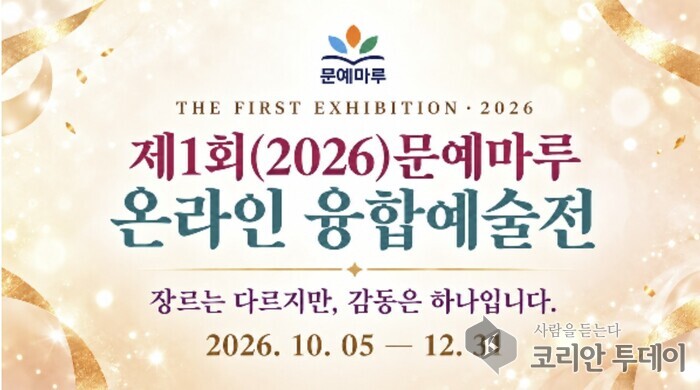 [The Korean Today] Promotional poster for the First Munyemaru Online Convergence Art Exhibition © Reporter Baek Chang-hee |
Under the theme “Different Genres, One Shared Emotion,” the exhibition seeks to transcend traditional artistic boundaries and provide an online platform where audiences can experience the creative worlds of artists working across a wide range of disciplines, including literature.
Of particular interest is the integration of artificial intelligence (AI) into filmmaking, expanding literature beyond the written word into immersive visual and auditory experiences.
Among the participating artists is author Kim Jin-myeong, who presents two films that reinterpret his own literary works: “He Loved Two Islands” and “LET THEM REST (Ssiggimgut).”
Exploring the universal human experiences of love, devotion, death, and grief, the two films transform literary imagination into new forms of visual storytelling.
Two Forms of Love: “He Loved Two Islands”
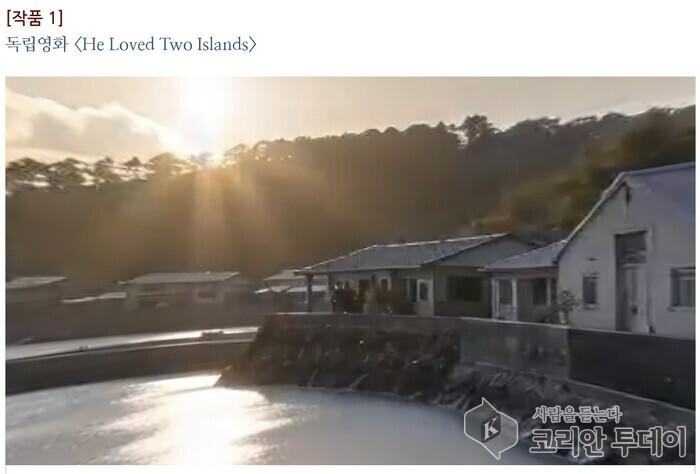 [The Korean Today] “He Loved Two Islands,” an independent film adapted from a short story by author Kim Jin-myeong © Reporter Baek Chang-hee |
The first featured film, “He Loved Two Islands,” is an independent production adapted from Kim Jin-myeong’s short story “You Are My Island.”
The story follows Father Pierre, a French priest who dedicates his life to caring for people suffering from illness on Sorokdo Island while carrying the memory of his first love, Elodie, deep within his heart.
For Father Pierre, Elodie remains an unforgettable love from his past. Yet another form of love gradually takes shape through his lifelong commitment to those living with suffering and hardship on Sorokdo Island.
One woman represents the love preserved in his memory, while one island embodies the love he chooses to practice through his life.
The “two islands” in the film’s title symbolize more than geographical locations. They represent the contrast between an unfulfilled personal romance and a life devoted to compassion, service, and selfless dedication.
Set against the emotionally significant backdrop of Sorokdo Island, the film explores loneliness, suffering, empathy, and sacrifice with sensitivity.
By contrasting a love that must be left behind with a love faithfully sustained until the end, Kim conveys a powerful message: one human being can become an island of comfort, refuge, and hope for another.
Emotions originally expressed through literary narration and the inner thoughts of characters are transformed into a visual experience through facial expressions, the passage of time, and the atmosphere of each scene.
Death, Mourning, and Spiritual Release in “LET THEM REST (Ssiggimgut)”
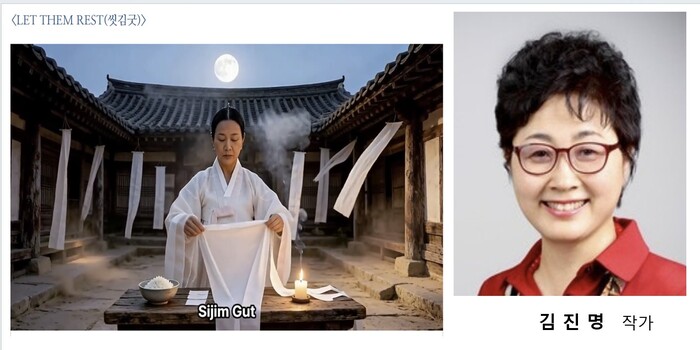 [The Korean Today] “LET THEM REST (Ssiggimgut),” a film adaptation of Kim Jin-myeong’s poem “Ssiggimgut” © Reporter Baek Chang-hee |
The second featured work, “LET THEM REST (Ssiggimgut),” is a visual interpretation of Kim Jin-myeong’s poem “Ssiggimgut.”
Ssiggimgut is a traditional Korean shamanic purification ritual performed to release the unresolved sorrows of the deceased and guide their spirits toward peace.
Drawing upon this traditional cultural practice, the film explores the grief, longing, and emotional attachments that remain between the living and those who have passed away.
White cloth, candlelight, and expressive human movements serve as powerful visual symbols, revealing the emotional journey of confronting death and gradually learning to let go.
The transition from darkness to dawn reflects a movement beyond despair, suggesting that mourning and spiritual reconciliation can eventually lead to emotional healing and a renewed embrace of life.
In this interpretation, Ssiggimgut is not simply a ritual intended to erase memories of the deceased.
Rather, it represents an inner process of acknowledging loss, accepting sorrow, releasing unresolved emotions, and rediscovering the strength to continue living despite enduring grief.
The film approaches death not merely as an absolute ending but as a profound experience of separation, emphasizing the importance of emotional consolation for those who remain.
By combining the symbolic language of Korean traditional culture with contemporary filmmaking techniques, the work introduces deeply rooted Korean sentiments to audiences through a modern artistic medium.
Expanding Literary Expression Through AI-Powered Visual Storytelling
Kim Jin-myeong’s participation in the exhibition is particularly notable for his use of artificial intelligence as a creative tool to connect literature with moving-image art.
The production process incorporated various AI-based programs, including MagicLight, Vrew, Higgsfield, Seedance, and Kling.
These technologies were used to translate literary narratives, emotional landscapes, and symbolic imagery into cinematic sequences.
Rather than emphasizing technological innovation for its own sake, the films focus on preserving and visually communicating the emotional depth and artistic intentions of the original literary works.
While literature invites readers to complete a story through their imagination, film allows audiences to experience emotions through movement, imagery, sound, and atmosphere.
The convergence of these artistic forms offers readers fresh interpretations of familiar stories while creating accessible new pathways for audiences encountering literary works for the first time.
By integrating AI technologies into a creative process grounded in an author’s literary vision, the exhibition highlights emerging possibilities for artistic expression in the digital era.
Kim Jin-myeong: A Literary Career Spanning Poetry and Fiction
Kim Jin-myeong made his literary debut through Monthly Literature’s New Writer Award with “Ice Wall” in 2017 and the novel “Molting” in 2021.
He earned a master’s degree in Creative Writing from Dongguk University and is an active member of the Korean Writers’ Association, the Korean Poets Association, the Korean Novelists Association, and PEN International.
His published works include six poetry collections, among them “Yes, I Am Here,” as well as the short story collection “Flower of Resurrection.”
Throughout his literary career, Kim has received several honors, including the Yun Dong-ju Literary Award, Tagore Literary Award, Asan Literary Award for Fiction, and Korean Life Literature Grand Prize.
His creative activities span poetry, fiction, literary recitation, and other artistic disciplines, reflecting a diverse and continually evolving literary world.
Through his participation in the First Munyemaru Online Convergence Art Exhibition, Kim extends his artistic practice into filmmaking, exploring new possibilities for presenting literature in the age of artificial intelligence.
At the heart of both films lies a profound compassion for humanity.
While “He Loved Two Islands” explores a life dedicated to serving others through selfless love, “LET THEM REST (Ssiggimgut)” portrays the emotional journey of releasing those who have departed and finding the strength to rebuild one’s life.
Although their narratives differ, both works share a common artistic purpose: to acknowledge human suffering, offer emotional comfort, and encourage reflection on the deeper meaning of life.
Online Exhibition Continues Through December 31, Connecting Diverse Artistic Genres
The First Munyemaru Online Convergence Art Exhibition runs from October 5 through December 31, 2026.
The exhibition is supported by corporate sponsors S&D Co., Ltd., Saltware Co., Ltd., Joeun Sool Sejong Co., Ltd., and SIT Technology Inc.
By presenting artworks through an online platform, the exhibition allows audiences to experience creative expressions across multiple disciplines without the limitations of conventional exhibition spaces.
It also provides opportunities for artists and viewers to share meaningful emotional experiences beyond geographical and physical boundaries.
As digital technologies continue to reshape artistic production and communication, AI-assisted literary art is opening new possibilities for creators seeking innovative ways to express human experiences.
Kim Jin-myeong’s two films demonstrate how the emotional depth of traditional literary storytelling can be combined with emerging technologies to communicate universal themes of love, sacrifice, death, mourning, and recovery.
Literary language is transformed into moving images, while timeless human emotions find new forms of expression through contemporary technology.
Reflecting the exhibition’s central message, “Different Genres, One Shared Emotion,” the First Munyemaru Online Convergence Art Exhibition is expected to serve as a meaningful cultural platform where diverse artistic disciplines come together to deepen understanding, compassion, and appreciation for the human experience.


[Korean Brand Awards Application] [CEO Excellence Awards Application] [Customer Satisfaction Awards Application]
THE KOREAN TODAY × WIA CODE
이 기사의 WIA Code

WIA Code 스캐너로 비추면 인터넷 없이 발행 사실과 위·변조 여부를 확인할 수 있습니다.
휴대폰 기본 카메라로 찍으면 스캐너 안내 페이지가 열립니다 — 기사 바로 열기
움직이는 코드(스트림) 한 장에 기사 전문(사진 포함)이 담겨 있습니다 — WIA Code 스캐너로 약 76초 비추면 폰에 저장되어 인터넷 없이도 읽을 수 있습니다. Stream.mp4 도 여기서 받습니다.
WIA Code · 코리안투데이



Leave a Reply