
Every year, millions of visitors photograph the gently swelling columns of Horyuji in Nara, the oldest wooden building on Earth. Few know that the hands which first shaped those columns belonged to craftsmen from the Korean kingdom of Baekje.
In 588 CE, Baekje did not just send monks and envoys across the sea to Japan – it sent an entire construction team: carpenters, roof-tile specialists, a master of pagoda finials, even a mural painter. In modern terms, an entire construction firm and design studio were exported at once.
Fourteen centuries before “K-construction” won overseas infrastructure contracts and “K-culture” swept the globe, Baekje was already crossing borders through skilled hands. That craftsmanship still stands today on the soil of Nara.
🌍 Western Historical Parallel
When Baekje’s craftsmen were raising Asuka’s first temple in 588, the Byzantine Empire had, half a century earlier, completed the great dome of Hagia Sophia (537) in Constantinople – another civilization proving its power through monumental sacred architecture, at the opposite end of the same era.
◆ The Ancient Landscape
In the late 6th century, the Japanese archipelago was convulsed by a power struggle between the pro-Buddhist Soga clan and the traditionalist Mononobe clan. After the Soga’s victory, chief minister Soga no Umako decided to build Japan’s first true Buddhist temple – and turned to King Wideok of Baekje (r. 554-598) for help.
In 588 CE, King Wideok dispatched, alongside monks, a full team of temple-building specialists: carpenters, a “finial master” (roban-hakase) to craft the bronze crown of the pagoda, “tile masters” (waku-hakase) to fire the roof tiles, and a mural painter – essentially a complete design-to-finish construction crew. This temple would become Asuka-dera (originally called Hoko-ji, or Hokoji), Japan’s first major Buddhist temple.
“Baekje sent an envoy bearing relics of the Buddha, together with the monks Hyecho and Yeonggeun, the finial master Baek Maesun, the tile masters Mana Munno, Yanggwimun, Neunggwimun and Seok Majemi, and the painter Baekga.”
Note: Baekje’s own chronicle, the Samguk Sagi, does not record this dispatch in detail. The primary record survives in the Nihon Shoki, Japan’s official history, which Korean historians cite as the authoritative source for this event.
◆ Same Era, Different Worlds
🏛️ China
The Sui Dynasty reunified China in 589, a year after the Asuka-dera dispatch, spreading engineering standards across East Asia via the Grand Canal project.
🗿 Byzantine Empire
Constantinople still marveled at Hagia Sophia’s dome (completed 537), a generation-old engineering triumph rooted in Justinian’s reign.
⚔️ Western Europe
Rome had fallen a century earlier; Pope Gregory the Great (r. 590-604) was reorganizing the Western Church from a much diminished city.
🏝️ England
Anglo-Saxon kingdoms were still pagan and largely non-literate; the famous Sutton Hoo ship burial (c. 625) lay a generation in the future.
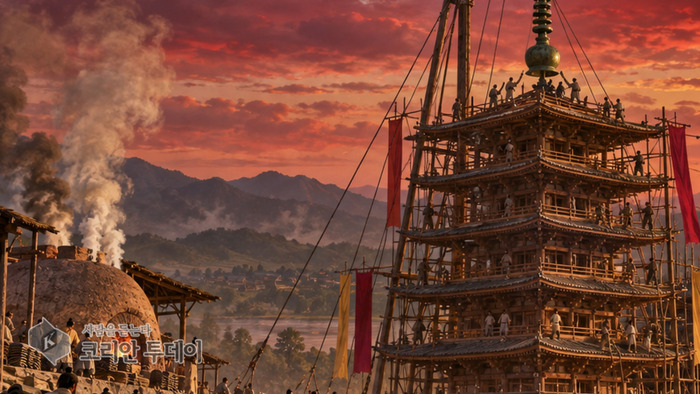
[Image: The 588 CE Baekje temple-building team dispatched from Sabi to Asuka]
⚔️ Scene from That Day
“On the wooden scaffolding rising over the Asuka plain, the Baekje craftsman Baek Maesun carefully lifts a still-warm bronze finial into place. Below, tile masters carry freshly fired lotus-patterned roof tiles from the kiln, while local laborers watch the unfamiliar pattern with wide eyes.”
“‘These Baekje nails won’t loosen, even under strain,’ a master carpenter says with quiet confidence. Watching nearby, Soga no Umako’s gaze deepens – the temple on which his clan’s future rests is being completed by hands that crossed the sea.”
◆ Uncovering Historical Truth
Construction of Asuka-dera began in 588 and its main structures were largely complete by around 596, with final completion around 609. Its layout – one pagoda encircled by three main halls – became the template for later Japanese temple architecture. Just five years later, in 593, Prince Shotoku commissioned Shitenno-ji in Osaka, again completed by a Baekje craftsman, Yu Jung-gwang (Yanagi Shigemitsu). Its straight north-south axis of gate, five-story pagoda, and main hall is nearly identical to the layout of temple ruins found at Gunsu-ri in Baekje’s capital, Buyeo – much as a Gothic cathedral’s floor plan can be traced across borders through the masons who built it.
What is remarkable is that this was not a one-time technology transfer. Yu Jung-gwang’s descendants carried temple construction as a family trade for generations, founding the firm Kongo Gumi – which traces its founding to 578 (the start of Shitenno-ji’s construction) and survived, remarkably, for roughly 1,400 years until it was absorbed by another builder in 2006 amid financial difficulty. The Economist once named it the world’s oldest continuously operating company – a striking testament to how deeply the transplanted craft took root.
Horyuji itself, today’s oldest surviving wooden structure on Earth, was founded slightly later, in 607, by Empress Suiko and Prince Shotoku fulfilling the deathbed wish of Emperor Yomei. Lightning destroyed the original complex in 670, and reconstruction was completed in the early 8th century – a period that overlapped with the large-scale settlement of Baekje refugee craftsmen across Japan following Baekje’s fall in 660. Scholars point to Horyuji’s distinctive entasis columns (subtly swelling, much like those of the Parthenon) and its intricate bracket systems as evidence of continued Baekje and Goguryeo woodworking technique.
Period
Late 6th – early 7th century CE
Key Figures
King Wideok, finial master Baek Maesun, Shitenno-ji builder Yu Jung-gwang
Key Events
Building of Asuka-dera, Shitenno-ji, Horyuji reconstruction
Legacy
Foundation of the Asuka culture and Japanese temple architecture
🔍 International Academic Perspectives
Korean/Asian Scholars
Following the Nihon Shoki, most Korean and Japanese historians agree Baekje craftsmen directly led design, tile-making, and finial work – the physical foundation of Asuka culture itself was transplanted Baekje technology.
Western Historians
Some scholars note that within a generation, second- and third-generation descendants of Korean immigrants and native Japanese craftsmen had internalized the techniques, developing them further; the detailed biography of Yu Jung-gwang may also carry later embellishment from Kongo Gumi’s founding legend.
📖 Key Terms Explained
- Baekje (백제)
- Ancient Korean kingdom (18 BCE – 660 CE), one of the Three Kingdoms of Korea, renowned for maritime trade and cultural exchange with Japan and China.
- Roban-hakase / Waku-hakase
- Official Japanese titles (“finial master” and “tile master”) granted to Baekje specialists dispatched to build temples – evidence of a state-certified technology transfer system.
- Asuka Period
- Japan’s first Buddhist cultural era (roughly late 6th – early 8th century CE), shaped heavily by Baekje and Goguryeo influence.
◆ Lessons for Today’s World
What Baekje exported 1,400 years ago was not a finished product but people and know-how. The very existence of state-certified titles like “finial master” and “tile master” shows a government system for standardizing and dispatching technology – not unlike modern Korean construction firms building overseas infrastructure, or defense contractors exporting arms alongside technology-transfer clauses, or K-content exporting entire show formats rather than single episodes.
Kongo Gumi’s 1,400-year survival was not built on spectacular innovation alone, but on fundamentals passed down as a family trade, generation after generation. As Korea’s semiconductor, shipbuilding, and K-pop industries seek to preserve their competitive edge across generations, the Baekje craftsmen’s story poses a question that is 1,400 years old and still unanswered.
| Aspect | Baekje Era | Modern Parallel |
|---|---|---|
| Tech Export | State-certified master craftsmen dispatched abroad | Construction, infrastructure, and defense technology-transfer deals |
| Cultural Reach | Buddhist temple architecture became the Asuka standard | K-pop and K-dramas shape global pop-culture standards |
| Power of Legacy | Kongo Gumi survived 1,400 years as a family trade | The challenge of sustaining technical edge across generations |
[Image: The continuous thread from Baekje’s technology exports to modern Korea’s technology and cultural exports]
📚 Diving Deeper
- Excavated lotus-patterned roof tiles from Asuka-dera closely match tiles found at Baekje sites in Buyeo, offering archaeological confirmation of the Nihon Shoki’s account.
- Kongo Gumi, though absorbed by Takamatsu Construction in 2006 after financial trouble, still operates today as a specialist in temple and heritage-building restoration – much like England’s Sutton Hoo finds still inform craftsmanship studies.
- Horyuji became Japan’s first UNESCO World Heritage Site in 1993; researchers treat its bracket structures as a living sample of Baekje and Goguryeo woodworking technique.
The Voice of Living History
It is not only armies that cross borders. Skill absorbed into human hands crosses both nations and 1,400 years of time. What Baekje’s finial and tile masters left behind was not merely a temple that still stands – it was a lesson in connecting with the world through craft itself.
“Beneath the soil of Nara today, the fingerprints of Baekje remain.”
Previous Episode
Episode 13: The Baekje Gilt-bronze Incense Burner – A World of Immortals
Next Episode
Episode 15: Baekje Music and Dance – The Giak Masked Dance
The Korean Today “History Lives On” Series
The Baekje Chronicle (30 Episodes)
Bridging Ancient East Asia and the Modern World
© 2025 The Korean Today. All rights reserved.
This content is based on historical facts and presents balanced academic perspectives
for international readers.
THE KOREAN TODAY × WIA CODE
이 기사의 WIA Code

WIA Code 스캐너로 비추면 인터넷 없이 발행 사실과 위·변조 여부를 확인할 수 있습니다.
휴대폰 기본 카메라로 찍으면 스캐너 안내 페이지가 열립니다 — 기사 바로 열기
움직이는 코드(스트림) 한 장에 기사 전문(사진 포함)이 담겨 있습니다 — WIA Code 스캐너로 약 30초 비추면 폰에 저장되어 인터넷 없이도 읽을 수 있습니다. Stream.mp4 도 여기서 받습니다.
WIA Code · 코리안투데이


Leave a Reply