
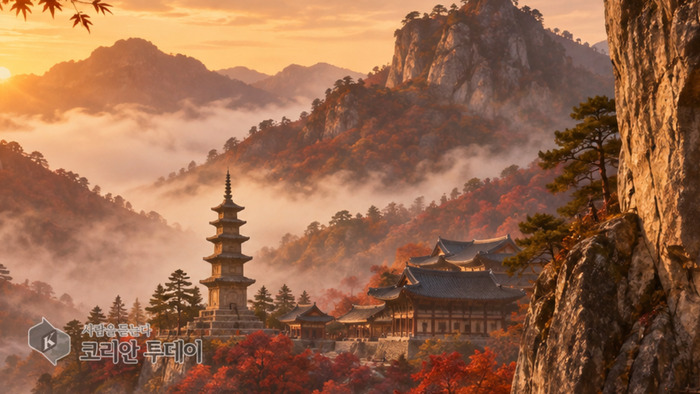
While Constantinople raised the great dome of Hagia Sophia, a Baekje sculptor carved a smile into a mountain cliff, and it is still there.
In a valley of Mount Gaya in Seosan, South Chungcheong Province, a cliff face known as “Inbawi” bears three figures: a tall standing Buddha flanked by a standing bodhisattva and a pensive, half-seated bodhisattva. All three wear a faint, serene smile. Koreans call it the “Smile of Baekje,” a phrase popularized by the art historian Kim Won-yong in his study of Korean aesthetics. This episode leaves the fortresses and battlefields behind and looks at the gentlest face Baekje left to history.
How did a kingdom that had just lost its king at the Battle of Gwansanseong (554 CE) produce such serene art? And how are this cliff-carved smile and two of Korea’s oldest stone pagodas, at Jeongnimsa in Buyeo and Mireuksa in Iksan, connected? Think of Europe’s “Archaic smile” of Greek statues, or the “Smiling Angel” of Reims: the smile in sacred art is a universal language, and Baekje spoke it in its own accent.
🌍 Western Historical Parallel
The Seosan triad was carved in the late 6th to early 7th century. Hagia Sophia had been consecrated in 537 under Justinian, and Pope Gregory the Great (r. 590-604) was sending missionaries to Anglo-Saxon England. Like Christian Europe, Baekje used religion as a diplomatic language, sending monks, craftsmen and images abroad, notably to Yamato Japan. But the tone differs. Byzantine icons of Christ Pantocrator aim at awe, whereas Baekje’s Buddhas invite closeness through a gentle smile. The famous “Smiling Angel” of Reims Cathedral came some 600 years later.
◆ The Ancient Landscape
Buddhism officially arrived in Baekje in 384 CE, when the monk Malananta came from the Eastern Jin dynasty during the reign of King Chimnyu. Baekje absorbed Southern Dynasties culture from China, and after King Seong moved the capital from Ungjin (modern Gongju) to Sabi (modern Buyeo) in 538, temples and pagodas rose across the new capital. Baekje also carried Buddhism to Japan in the mid-6th century, and the Nihon Shoki records Baekje craftsmen helping build temples in the Asuka region around 588.
Scholars date the Seosan triad to the late 6th or early 7th century, the reigns of Kings Wideok to Mu. The Gaya mountain valley lay on the route between the Sabi capital and Baekje’s west-coast ports, and Bowonsa temple (now only ruins) once stood in it. Many scholars read the carving as a cultural gateway watching over sea traffic to China. The triad was designated National Treasure No. 84 in 1962.
“In the ninth month, the foreign monk Malananta came from Jin. The king welcomed him into the palace and treated him with reverence. Buddhism began from this.”
◆ Same Era, Different Worlds
🏛️ China
The Sui dynasty reunified China in 589, and the Tang followed in 618. Buddhism flourished under both, and Chinese sculptural styles, including those of the Shandong region, are often compared with Baekje work.
🗿 Byzantine Empire
Justinian completed Hagia Sophia in 537. Heraclius reigned from 610 to 641, almost exactly the years of Baekje’s King Mu (r. 600-641).
⚔️ Western Europe
Frankish kingdoms were consolidating, and Augustine of Canterbury began the mission to the Anglo-Saxons in 597. The Sutton Hoo ship burial dates to roughly the 620s.
🕌 Islamic World
Muhammad’s migration to Medina came in 622, and the early Caliphate expanded rapidly in the decades that followed.
[Image: Schematic map of Baekje’s three Buddhist art masterpieces and the sea route to China]
⚔️ Scene from That Day
“In April 1959, the researcher Hong Sa-jun was surveying the ruins of Bowonsa temple. He asked a passing woodcutter whether there was any Buddha statue nearby. The woodcutter, so the story goes, said he had seen no Buddha or pagoda, but that up at the ‘Inbawi’ rock there lived a mountain spirit who smiled brightly.”
“Before the cliff, a face that local people had long called a mountain spirit came into view. Its smile seemed to deepen and fade as the sunlight moved across the rock. It was less a discovery than a reunion.” (Reconstructed from the traditional account of the discovery)
◆ Uncovering Historical Truth
1. The Seosan triad. The central Buddha stands about 2.8 meters tall, with a full face, crescent brows, almond eyes, a broad nose and gently upturned lips. The flanking bodhisattva figures are smaller. The cliff leans forward, which shelters the carving from some rain, and the faces are understood to have been modeled to change expression with the angle of sunlight. Think of the way medieval cathedral sculptors planned for light, except here the “building” is a mountain. The nearby Taean triad (National Treasure No. 307) is cruder and simpler, and is generally considered slightly earlier.
2. Jeongnimsa’s five-story pagoda. Standing in the heart of the Sabi capital, this pagoda is National Treasure No. 9 (designated 1963), a five-story tower on a low, narrow base. After the Tang general Su Dingfang destroyed Baekje in 660, he had a victory inscription carved on the first story (“Great Tang’s inscription on the pacification of Baekje”), and the tower was long called the “Pagoda of Pacification.” Note that the name “Jeongnimsa” is known from a Goryeo-era roof tile of 1028; the temple’s name in Baekje times is uncertain.
3. Mireuksa’s stone pagoda. In January 2009, during dismantling of the west pagoda, a gold reliquary and a gold plate recording the enshrinement were found in the central relic hole. The record dates the enshrinement to 639. Faithfully translating wooden-pagoda joinery into stone, this pagoda is National Treasure No. 11. Restoration began with a safety review in 1998, and the restored pagoda opened to the public in April 2019. Together, the two pagodas trace Baekje’s shift from wooden to stone pagodas, much as European builders moved from timber to stone in their churches. Both temple sites are part of the UNESCO World Heritage “Baekje Historic Areas,” inscribed in 2015.
“A Maitreya triad appeared in the pond. The king stopped his carriage and paid his respects. The queen said to him, ‘I wish to build a great temple on this spot.’ The king granted it.”
Period
Late 6th-7th century CE
Key Site
Seosan Buddha Triad (National Treasure No. 84)
Key Event
Relics enshrined in Mireuksa’s pagoda, 639
Legacy
Origin of Korean stone pagodas and a Korean aesthetic ideal
🔍 International Academic Perspectives
Korean/Asian Scholars
The mainstream view dates the Seosan triad to the late 6th-early 7th century, later than the Taean triad. The Jeongnimsa pagoda is generally seen as slightly later than, or contemporary with, Mireuksa’s (639). Yun Mu-byeong, who led excavations at Jeongnimsa, argued for a mid-6th-century date at the time of the move to Sabi. On Mireuksa’s founder, the 2009 inscription names a queen, daughter of Sataek Jeokdeok, which challenges the legend of Princess Seonhwa, and some scholars suggest King Mu may have had more than one queen.
Western Historians
Western art historians tend to place Baekje sculpture within the wider East Asian Buddhist sphere, comparing it with Chinese Northern and Sui styles and with early Japanese work such as that of the Asuka period. The question is where Baekje sits between borrowing and invention. Many stress that Baekje transformed continental models into a distinctive, gentler idiom.
📖 Key Terms Explained
- Baekje (百濟, 백제)
- Ancient Korean kingdom (traditionally founded 18 BCE, fell 660 CE), one of the Three Kingdoms
- Maaesamjonbul (마애삼존불)
- A “rock-carved Buddha triad”: three sacred figures carved directly into a cliff face
- Sarira
- Relics of the Buddha, enshrined in a pagoda much as saints’ relics are placed in Christian altars
- Tang Dynasty
- Chinese empire (618-907 CE), contemporary with the Byzantine Empire under Heraclius
◆ Lessons for Today’s World
The Smile of Baekje draws renewed attention because its beauty is unforced: restraint over exaggeration, a living expression over polished perfection. Koreans often trace this sensibility to the roots of their aesthetic, and some see a distant ancestor of what K-Beauty today calls a “natural glow.” That is an interpretive link across 1,400 years, not a documented lineage. Like the soft power that the Byzantine Empire wielded through icons and liturgy, or that Europe draws from its medieval cathedrals today, Baekje’s heritage still speaks for Korea.
Preservation carries its own lesson. The Mireuksa pagoda took almost twenty years, from the decision to dismantle in 1999 to its public opening in 2019. One gold plate found in 2009 rewrote the temple’s founding story, a reminder that a single record or object can revise what we thought we knew.
| Aspect | Baekje Era | Modern Parallel |
|---|---|---|
| Geopolitics | Buddhism as a state ideology and a language of diplomacy | Cultural heritage and K-culture as soft-power diplomacy |
| Exchange | Absorbing Southern Dynasties culture, sending craftsmen to Japan | K-content and K-Beauty reaching global markets |
| Culture | A gentle, unforced smile and restrained form | An aesthetic valuing naturalness and subtle radiance |
[Image: From an ancient smile to a modern Korean sensibility]
📚 Diving Deeper
- UNESCO World Heritage: Jeongnimsa Temple Site (Buyeo) and Mireuksa Temple Site (Iksan) are among the eight components of the “Baekje Historic Areas,” inscribed in July 2015. The Seosan triad is a National Treasure but is not one of the eight components.
- Comparable finds: like the Sutton Hoo ship burial in England, the 2009 Mireuksa relic discovery, with a gold reliquary and a dated dedication plate, showed how a single deposit can rewrite an early medieval story.
- Further reading: Kim Won-yong’s work on Korean art history, the Korea Heritage Service portal entries for Seosan and Jeongnimsa, and the National Museum of Korea’s Baekje Buddhist art collections.
The Voice of Living History
Baekje’s walls fell, but its smile survived in stone. The tidy tower of Jeongnimsa, the grand pagoda of Mireuksa and the smiling Buddha of Mount Gaya all come from a kingdom that knew how to meet the world through beauty. Empires from Constantinople to Chang’an built for awe; Baekje also built for warmth.
“The kingdom fell in 660, yet the smile of Baekje still looks out from the rock.”
Previous Episode
Episode 10: The Battle of Gwansanseong – The Last Stand of King Seong
Next Episode
Episode 12: Wangheungsa Temple – The Heart of Baekje Buddhism
The Korean Today “History Lives On” Series
The Baekje Chronicle (30 Episodes)
Bridging Ancient East Asia and the Modern World
© 2025 The Korean Today. All rights reserved.
This content is based on historical facts and presents balanced academic perspectives
for international readers.
THE KOREAN TODAY × WIA CODE
이 기사의 WIA Code

WIA Code 스캐너로 비추면 인터넷 없이 발행 사실과 위·변조 여부를 확인할 수 있습니다.
휴대폰 기본 카메라로 찍으면 스캐너 안내 페이지가 열립니다 — 기사 바로 열기
움직이는 코드(스트림) 한 장에 기사 전문(사진 포함)이 담겨 있습니다 — WIA Code 스캐너로 약 28초 비추면 폰에 저장되어 인터넷 없이도 읽을 수 있습니다. Stream.mp4 도 여기서 받습니다.
WIA Code · 코리안투데이


Leave a Reply