
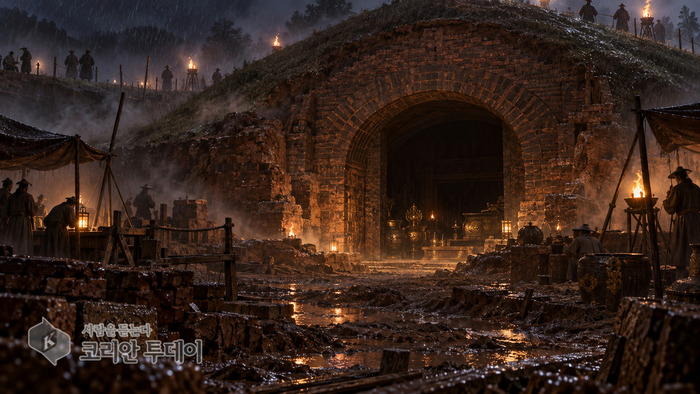
A door untouched for 1,500 years was opened in a single night.
In early July 1971, a drainage crew working near an ancient burial mound in Gongju, South Korea, struck a wall of ancient bricks. What they uncovered was the tomb of King Muryeong, the 25th ruler of the Baekje kingdom — the only Three Kingdoms-era royal tomb ever found completely undisturbed by looters.
Yet this once-in-a-century find is also remembered as one of Korean archaeology’s most rushed excavations. How could a discovery this precious be handled so hastily — and what did it still manage to teach the world?
🌍 Western Historical Parallel
The closest global parallel is Howard Carter’s 1922 discovery of Tutankhamun’s tomb in Egypt’s Valley of the Kings — another rare royal burial found essentially intact. But where Tutankhamun’s tomb kept its owner’s identity a mystery for decades, King Muryeong’s tomb announced its own name, age, and death date the moment it was opened.
◆ The Ancient Landscape
King Muryeong (r. 501–523 CE) inherited a kingdom in crisis. In 475, Baekje’s capital had fallen to the rival kingdom of Goguryeo and the previous king had been killed. Muryeong spent his reign repelling further Goguryeo attacks and restoring diplomatic ties with China’s Liang Dynasty (502–557). In a 521 letter to Emperor Wu of Liang, he declared that after repeatedly defeating Goguryeo, Baekje had “once again become a strong nation.”
He died in 523 CE at age 62 and, after a customary three-year mourning period, was interred in 525. His queen died in 526 and joined him in the tomb in 529. These precise dates were not reconstructed by historians later — the tomb itself recorded them.
“The Great General Pacifying the East, King Sama of Baekje, passed away at age 62 on the 7th day of the 5th month of the year gyemyo (523 CE), and was properly interred in the great tomb on the 12th day of the 8th month of the year eulsa (525 CE); this is recorded accordingly.”
◆ Same Era, Different Worlds
🏛️ China
Emperor Wu of the Liang Dynasty ruled southern China (502–549) — the very court that formally recognized Muryeong’s kingship.
🗿 Byzantine Empire
Justinian I was about to ascend the Byzantine throne in 527, just years after Muryeong’s burial.
⚔️ Western Europe
The Frankish kingdom fractured among Clovis’s heirs following his death in 511.
🌏 Japan
Emperor Keitai was consolidating the Yamato court, maintaining close ties with Baekje.
[Image: Conceptual layout of the brick tomb chamber and artifact placement during the 1971 excavation]
⚔️ Scene from That Night
“Rain had just stopped when the sealed brick entrance gave way, and for the first time in 1,500 years, night air rushed into the chamber. Flashlight beams caught gold ornaments glinting in the loosened earth.”
“Reporters and onlookers swarmed the site within hours, and the excavation spiraled out of control. Lead archaeologist Kim Won-yong later called it ‘the greatest shame of my career’ — there had been no measured survey, no photography protocol; artifacts were scooped up by hand into cardboard boxes.”
◆ Uncovering Historical Truth
What makes Muryeong’s tomb extraordinary is not just its treasures, but its self-identification. The epitaph tablet and an accompanying “land deed” document (maejigwon — a symbolic purchase of burial land from the earth gods) named the occupant, his exact age, and his precise death and burial dates. No other Three Kingdoms royal tomb has ever spoken for itself this way.
The tomb’s brick-vault architecture followed a style fashionable in southern China, while the wooden coffins were built from Japanese umbrella pine (kōyamaki), a species that does not grow on the Korean peninsula. Add Chinese-made celadon vessels and a string of Liang-dynasty coins found near the entrance, and the tomb reads like a compressed archive of 5th–6th century East Asian trade and diplomacy.
The excavation may have been rushed, but its yield was not diminished: roughly 4,600 artifacts across 108 types were recovered (a 2021 item-by-item recount at Gongju National Museum put the figure at 5,232), and 12 categories comprising 17 pieces were designated National Treasures in 1974. Because the tomb’s date is fixed with certainty, its contents now serve as the chronological benchmark for dating all other Baekje art and artifacts.
Period
501-523 CE (reign of Muryeong)
Key Figure
King Muryeong (King Sama)
Key Event
1971 discovery and excavation
Legacy
Fixed chronological anchor for Baekje studies
🔍 International Academic Perspectives
Korean/Asian Scholars
Traditionally, the Samguk Sagi identifies Muryeong as the son of King Gaero, and this genealogy was accepted before the tomb’s discovery.
Comparative Historians
Working backward from the epitaph’s “died at 62,” his birth falls around 461-462 — aligning instead with the Japanese chronicle Nihon Shoki, which says he was born on Kakarashima island in Kyushu as the son of Prince Gonji. Much like how epigraphic evidence reshaped debates over Egyptian or Roman royal genealogies, a single inscribed stone rewrote a family tree.
📖 Key Terms Explained
- Baekje (백제)
- Ancient Korean kingdom (18 BCE – 660 CE), one of the Three Kingdoms of Korea, known for its maritime trade and refined art.
- Liang Dynasty (南朝梁)
- Southern Chinese dynasty (502-557 CE) that formally recognized Baekje’s kings and shared its tomb architecture with Baekje.
- Jiseok (誌石, Epitaph Tablet)
- A stone slab inscribed with a deceased royal’s identity, age, and dates — comparable in function to a Roman funerary inscription, but exceptionally rare in Korean archaeology.
◆ Lessons for Today’s World
The “one-night excavation” became a cautionary tale that reshaped Korean archaeology. Rigorous measured surveys, photographic documentation, and staged reporting are now mandatory — standards enforced today by Korea’s National Heritage Agency and its affiliated research institutes.
The tomb also proves that documentation is evidence. Without its epitaph, this would still be an anonymous burial mound. Just as the tomb spoke its own name across 1,500 years, modern Korea uses careful heritage preservation and documentation to tell its own story to the world.
| Aspect | Baekje Era | Modern Parallel |
|---|---|---|
| National Standing | Declared itself “strong again,” sent envoys to Liang China | Cultural heritage diplomacy and Korean Wave soft power |
| Record-Keeping | Epitaph and land deed self-certify exact dates | Standardized excavation protocols, digital archiving |
| Culture | Open exchange with China and Japan | Global engagement through K-Culture |
[Image: Timeline from the 1971 excavation through 2015 UNESCO inscription to today’s museum display]
📚 Diving Deeper
- Gongju National Museum permanently displays the original gold crown ornaments and royal sword.
- A full-scale replica chamber near the original mound lets visitors see the tomb’s interior without disturbing the preserved site — much like replica tombs built near the Valley of the Kings.
- A 2021 special exhibition recounted every one of the tomb’s 5,232 individual artifact pieces.
The Voice of Living History
In death, King Muryeong recorded his own name, age, and final day. Fifteen centuries later, that single inscription reset the chronology of an entire kingdom.
“Those who leave a name behind outlast time itself.”
Previous Episode
Episode 7: King Muryeong – The Restorer King
Next Episode
Episode 9: King Seong’s Ambition – The Move to Sabi
The Korean Today “History Lives On” Series
The Baekje Chronicle (30 Episodes)
Bridging Ancient East Asia and the Modern World
© 2025 The Korean Today. All rights reserved.
This content is based on historical facts and presents balanced academic perspectives
for international readers.
THE KOREAN TODAY × WIA CODE
이 기사의 WIA Code

WIA Code 스캐너로 비추면 인터넷 없이 발행 사실과 위·변조 여부를 확인할 수 있습니다.
휴대폰 기본 카메라로 찍으면 스캐너 안내 페이지가 열립니다 — 기사 바로 열기
움직이는 코드(스트림) 한 장에 기사 전문(사진 포함)이 담겨 있습니다 — WIA Code 스캐너로 약 26초 비추면 폰에 저장되어 인터넷 없이도 읽을 수 있습니다. Stream.mp4 도 여기서 받습니다.
WIA Code · 코리안투데이


Leave a Reply