
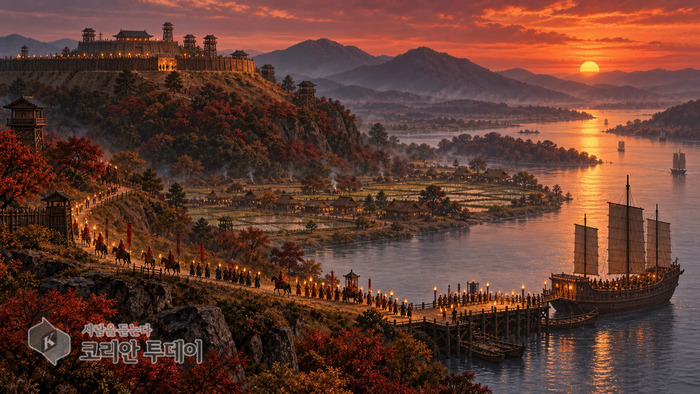
A ruler who inherits a crown in crisis must prove himself. King Muryeong of Baekje left his proof in six words: “we have become a strong nation again.”
In 501 CE, the Baekje royal court stood on the edge of collapse. Its reformist king, Dongseong, had just been assassinated by his own official — 26 years after Baekje had lost its original capital of Hanseong (475 CE) and relocated to Ungjin, modern-day Gongju. Royal authority was still shaky and the provinces barely answered to the throne. Into this chaos stepped a forty-year-old prince named Sama, who would become King Muryeong.
He was neither a conqueror nor a founding father. Yet today he is arguably the most vividly documented ruler in ancient Korean history. Why? The answer lies in a brick tomb that sat undisturbed underground for nearly 1,500 years.
🌍 Western Historical Parallel
While Muryeong was stabilizing Baekje after chaos (501-523 CE), Theodoric the Great was doing much the same thing on the other side of Eurasia — ruling the Ostrogothic Kingdom in post-Roman Italy (493-526 CE) and rebuilding order out of the collapse of Western Rome.
◆ The Ancient Landscape
Born around 462 CE, Sama was a son of Prince Gonji, a member of the Baekje royal line. According to the Nihon Shoki (Chronicles of Japan), citing the Baekje-derived text Baekje Sinchan, he was actually born in 461 CE on a small island called Kakarashima off the coast of Kyushu, Japan, while Gonji was sailing there on a diplomatic mission — hence his childhood name “Island Lord” (Dogun). The story itself is a window into the maritime network connecting Baekje, Japan, and the Gaya confederacy in the 5th century.
When King Dongseong was assassinated in 501, Sama ascended the throne as King Muryeong facing three urgent tasks: repel Goguryeo’s repeated southward invasions (501, 503, 507, 512), reclaim control over provinces that had drifted from royal authority since the move to Ungjin, and restore Baekje’s diplomatic standing abroad.
“Having repeatedly defeated the strong enemy [Goguryeo], [Baekje] has now become a strong nation once again.”
◆ Same Era, Different Worlds
🏛️ China
The Liang Dynasty under Emperor Wu (r. 502-549) was at its height. Muryeong sent missions in 512 and 521 CE, receiving the title “Grand General Pacifying the East, King of Baekje.”
🗿 Byzantine Empire
Under Emperor Anastasius I and then Justin I — the generation right before Justinian’s reconquests began.
⚔️ Western Europe
Clovis I of the Franks died in 511 CE and his kingdom was split among four sons — the opposite path from Muryeong’s centralizing Damno system.
🕌 Persia & Arabia
The Sassanid Persian Empire under Kavad I (r. 488-531, with interruption) was pursuing its own reforms, while pre-Islamic Arabia remained organized around client kingdoms like the Ghassanids and Lakhmids.
[Image: Muryeong governing 22 Damno from Ungjin while managing simultaneous diplomacy with Liang China and Japan]
⚔️ Scene from That Day
“Late autumn, 521 CE, at the harbor of Ungjin. An envoy ship prepares to sail. The king hands over the memorial himself: ‘Tell them — we who were once crushed by Goguryeo have now defeated them again.’ The ship crosses the Yellow Sea toward the Liang court at Jiankang.”
“Months later, the answer returns: the title ‘Grand General Pacifying the East, King of Baekje.’ The king never let go of that title — even in death. Carved into his tomb epitaph, the eight characters still read clearly: ‘Grand General Pacifying the East, King Sama of Baekje.'”
◆ Uncovering Historical Truth
Muryeong’s restoration unfolded on three fronts at once. Militarily, he struck Goguryeo’s Sugok fortress preemptively in 501, repelled Goguryeo-Mohe raids in 503 and 507, and personally led 3,000 troops to crush a Goguryeo force in 512 — the first sustained period since the fall of Hanseong that Baekje held the initiative against its northern rival, much as Byzantine and Ostrogothic forces contested territory with rival powers in the same decades.
Domestically, he reasserted control through the 22-Damno system. The Book of Liang describes these Damno as “princely domains” governed by the king’s own sons and kinsmen rather than appointed bureaucrats — a structure closer to how the Carolingians would later use family members to hold frontier marches than to a modern administrative hierarchy. In 510, he also ordered nationwide repair of irrigation dikes and resettled displaced farmers back onto the land, pairing military strength with economic recovery.
Then, in July 1971, construction workers digging a drainage ditch near the Songsan-ri tombs in Gongju accidentally broke into a brick chamber tomb — untouched by looters for nearly a millennium and a half. Built in the South Dynasties brick-vault style, it contained Chinese celadon, a coffin made of Japanese umbrella pine (kōyamaki) imported from Japan, and two stone epitaph tablets. The tomb itself was a microcosm of the international network Muryeong had rebuilt — comparable in archaeological significance to finds like Sutton Hoo in England.
Reign
501-523 CE
Key Figure
King Muryeong (Sama)
Key System
22-Damno provincial system
Legacy
Baekje’s restoration, international exchange
🔍 International Academic Perspectives
Korean/Asian Scholars
The Samguk Sagi (History of the Three Kingdoms) records Muryeong as King Dongseong’s second son — the traditional genealogy long taught in textbooks.
Revisionist View
The tomb epitaph states Muryeong died in 523 CE at age 62, placing his birth around 462 CE — making him older than Dongseong, which undermines the “father-son” claim. Most scholars now favor the Nihon Shoki’s account that he was a son of King Gaero and elder relative of Prince Gonji instead.
📖 Key Terms Explained
- Damno (擔魯)
- Regional command posts of Baekje, each governed by a royal son or kinsman rather than an appointed official — 22 in total under Muryeong.
- Liang Dynasty (梁)
- A Southern Dynasties Chinese empire (502-557 CE) that granted Muryeong the title “Grand General Pacifying the East” in 521 CE.
- Epitaph Tablets (誌石)
- Two stone tablets buried with King Muryeong and his queen, recording their titles and exact dates of death — the single most important primary source for dating Baekje history precisely.
◆ Lessons for Today’s World
Muryeong’s recovery was not a single dramatic reversal but a deliberate sequence: security first (defeating Goguryeo), then domestic order (the Damno system), then diplomacy (Liang investiture). It is a sequence modern crisis leadership — corporate or national — still tends to relearn the hard way.
The Chinese porcelain, Japanese timber, and glass beads of Southeast Asian/Indian origin found in his tomb show that 6th-century Baekje was already operating on a multi-directional trade and diplomatic network — not unlike how Korean cultural exports today reach multiple global markets simultaneously rather than depending on a single relationship.
| Aspect | Baekje Era | Modern Parallel |
|---|---|---|
| Governance | Royal kin dispatched to 22 Damno to restore control | Local autonomy and balanced regional development policy |
| Security/Diplomacy | Liang investiture and multi-directional diplomacy to contain Goguryeo | Alliance-anchored, multilateral diplomacy |
| Culture | Open adoption of Southern Dynasties culture and trade | Global simultaneous spread of K-Culture |
[Image: From the 1971 excavation of King Muryeong’s tomb to today’s Gongju National Museum and UNESCO recognition]
📚 Diving Deeper
- The Gongju National Museum displays national treasures from the tomb, including the epitaph tablets, gilt-bronze crown ornaments, and a ring-pommel sword; the original tomb chamber remains closed to protect it, but a full-scale replica exhibit lets visitors experience its interior.
- On Kakarashima Island off Karatsu, Kyushu, Japan — Muryeong’s legendary birthplace — an annual “Muryeong Birth Festival” is held every first Saturday of June as a symbol of Korea-Japan cultural exchange.
- In 2015, the Baekje Historic Areas, including the Songsan-ri tombs in Gongju, were inscribed as a UNESCO World Heritage Site.
The Voice of Living History
King Muryeong did not reinvent Baekje. He simply put it back where it belonged. That quiet act of restoration returned to us, 1,500 years later, in an untouched tomb and a name still legible in stone.
“We have become a strong nation again – six words that still hold true.”
Previous Episode
Episode 6: The Move to Ungjin – Rebirth in Gongju
Next Episode
Episode 8: The Tomb of King Muryeong – A Meeting After 1,500 Years
The Korean Today “History Lives On” Series
The Baekje Chronicle (30 Episodes)
Bridging Ancient East Asia and the Modern World
© 2025 The Korean Today. All rights reserved.
This content is based on historical facts and presents balanced academic perspectives
for international readers.
THE KOREAN TODAY × WIA CODE
이 기사의 WIA Code

WIA Code 스캐너로 비추면 인터넷 없이 발행 사실과 위·변조 여부를 확인할 수 있습니다.
휴대폰 기본 카메라로 찍으면 스캐너 안내 페이지가 열립니다 — 기사 바로 열기
움직이는 코드(스트림) 한 장에 기사 전문(사진 포함)이 담겨 있습니다 — WIA Code 스캐너로 약 29초 비추면 폰에 저장되어 인터넷 없이도 읽을 수 있습니다. Stream.mp4 도 여기서 받습니다.
WIA Code · 코리안투데이


Leave a Reply