
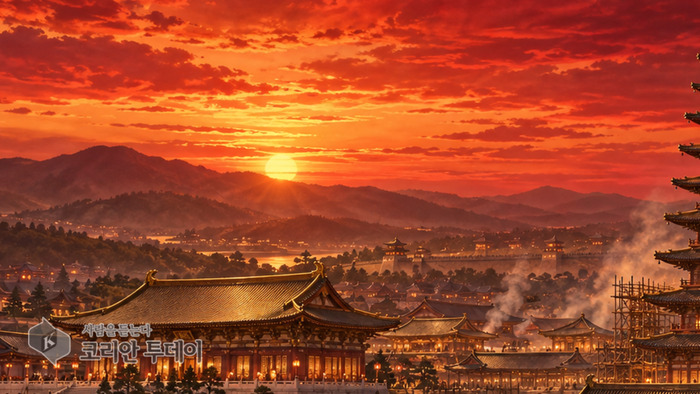
Today, a visitor to Hwangnyongsa in Gyeongju sees open grass and rows of foundation stones. Yet on this empty ground once stood a wooden tower roughly 80 meters high, taller than any church spire in Europe at the time.
Hwangnyongsa was Silla’s largest temple. Work began in 553 CE and the complex took shape over roughly a century. It housed a sixteen-foot (about 5 m) Buddha image, and in 645 it received a nine-story wooden pagoda. For the Silla court the temple was more than a place of worship. It was a statement about royal authority, national identity, and the kingdom’s security.
Why would a mid-sized kingdom pour so much of its wealth into one temple? Think of how Justinian’s Hagia Sophia, finished in 537, announced Byzantine power and faith in a single building. What did Silla want to say, and what does that tower still say to us?
🌍 Western Historical Parallel
Hwangnyongsa’s first phase (553 to about 569 CE) came a generation after Hagia Sophia (537 CE). In both cases a ruler used a monumental religious building to bind a diverse realm together and to display divine favor. In Silla’s case the ruler was expanding into the Han River basin and the Gaya territories. The pagoda itself, completed in 645, belongs to the era of Constans II in Byzantium and the Merovingian kings in Francia.
◆ The Ancient Landscape
Silla adopted Buddhism later than its neighbors Goguryeo and Baekje. It was officially recognized under King Beopheung around 527 CE, after the martyrdom of the courtier Ichadon. King Jinheung (r. 540-576) then turned it into a state project. His armies had taken the upper Han River valley and absorbed parts of Gaya, so he needed a shared faith to unite newly conquered peoples under one order.
In 553 the king planned a new palace east of the Wolseong fortress. According to tradition a yellow dragon appeared on the site, so the plan was changed and a temple was built instead, named Hwangnyongsa, “Yellow Dragon Temple.” The first phase was completed around 569. In 574 the Samguk Sagi records the casting of the great Jangnyuk (sixteen-foot) Buddha, using over 35,000 geun of bronze plus gold for gilding. In Queen Seondeok’s reign the nine-story pagoda was completed in 645, at the urging of the monk Jajang, who had returned from Tang China. Many scholars place the start of construction around 643, though sources differ on the exact dates and the length of the work.
“In the third month of the fourteenth year of Queen Seondeok, the pagoda of Hwangnyongsa was erected, in accordance with the request of Jajang.” (paraphrased from the Chinese original)
◆ Same Era, Different Worlds
🏛️ China
In 645, the year the pagoda was finished, Tang Emperor Taizong led a campaign against Goguryeo. Tang was both a potential ally for Silla and the cultural homeland that Jajang had visited in search of the Dharma.
🗿 Byzantine Empire
Justinian’s Hagia Sophia had stood since 537. By the 640s, after the long reign of Heraclius, the empire was losing Syria and Egypt to the new Islamic power.
⚔️ Western Europe
The Frankish Merovingian kings ruled Gaul, and Anglo-Saxon kingdoms competed in Britain. The Sutton Hoo ship burial dates to the 620s. Large stone churches existed, but nothing rose to the scale of a nine-story wooden tower.
🕌 Islamic World
The Rashidun Caliphate, then under Caliph Uthman, was expanding rapidly across Egypt, Syria and Persia. Within a few decades it would reshape the Mediterranean world.
[Image: Timeline of Hwangnyongsa from its founding to World Heritage listing (553-2000 CE)]
⚔️ Scene from That Day
“In 645, above the rooftops of Seorabeol, the final tier of the tower is hoisted into place. Below, the carpenters hold their breath and look up. The iron mast at the summit catches the midday sun and flashes gold. People walking down from the Wolseong fortress stop in the road and tilt their heads back as far as they can.”
“What did Abiji, the master builder who came from Baekje, think at that moment? He was building a tower for the king of a rival state. The legend says he wavered, but in the end he did not put down his tools. This scene is imagined from the account in the Samguk Yusa.”
◆ Uncovering Historical Truth
The nine tiers were meant to subdue Silla’s rivals through divine protection. The Samguk Yusa says Jajang met the bodhisattva Manjusri on Mount Wutai in China, who told him the dragon guarding Hwangnyongsa was his own eldest son, and that a nine-story tower would make neighboring peoples submit. Each tier is said to stand for a foe, among them Japan, China, Wuyue, Tamna, Baekje, the Malgal, Dan’guk, the Jurchen and the Yemaek. It was faith and foreign policy in one structure. A Roman reader might think of a triumphal arch, though this monument was meant to win victories in advance, through Buddhist power.
Archaeology backs up the scale of the temple. Excavations that began in 1976 revealed a vast compound and more than 40,000 artifacts, including a giant roof-end ornament (a chimi) 182 cm tall. At the pagoda site, the central-pillar foundation stone and 64 other base stones, each about a meter across, survive. An inscription from 872 allows scholars to estimate a height of about 80 m, though the figure depends on how the old units of measure are converted. For comparison, Hagia Sophia’s dome rises roughly 55 m, and the five-story pagoda at Horyuji in Japan stands about 32 m.
Politically, the temple strengthened the throne. Jinheung’s great Buddha fits the idea of the king as a living embodiment of the Buddha, comparable in spirit to Byzantine ideas of the emperor as God’s regent. Seondeok’s pagoda can be read as shoring up the legitimacy of a female ruler in a skeptical court. Where Frankish and Anglo-Saxon kings were often dependent on local lords, Silla’s rulers could mobilize bronze, gold, and skilled craftsmen across the kingdom, even from Baekje, for one centrally directed project. That capacity says a great deal about how centralized the state had become.
Period
6th-7th century CE (553-645)
Key Figures
King Jinheung, Queen Seondeok, Jajang, Abiji
Height
About 80 m (estimated), roughly a 25-story building
Construction
All timber, assembled without iron nails
🔍 International Academic Perspectives
Korean/Asian Scholars
Most see the pagoda as a monument of state-protecting Buddhism and royal authority, with a height near 80 m. Restoration planning relies on this reading and on the excavation record.
Western Historians
Reference estimates range from about 68 to 82 m, depending on how historical measures are converted. Some caution that the Samguk Yusa’s miraculous stories are later religious tradition and should not be read as literal political planning.
📖 Key Terms Explained
- Silla (신라)
- Ancient Korean kingdom (traditionally 57 BCE to 935 CE), one of the Three Kingdoms and later the unifier of most of the peninsula
- Hwangnyongsa (황룡사)
- “Yellow Dragon Temple” in Gyeongju, Silla’s largest temple, destroyed in 1238
- Jangnyuk (장륙)
- “Sixteen feet,” the height of a Buddha image believed to match the Buddha’s own stature
- Tang Dynasty
- Chinese empire (618-907 CE), contemporary with Byzantium’s Heraclian dynasty and the early Caliphates
◆ Lessons for Today’s World
What a nation builds at its center reveals how it sees itself. Silla put its identity and security hopes into religious architecture. Today, comparable symbols include cathedral reconstructions such as Notre-Dame after its 2019 fire, and heritage sites that nations use to tell a shared story. The modern emphasis falls less on warding off enemies than on shared memory.
Hwangnyongsa has been gone for nearly eight centuries, yet its value has grown. It is part of the UNESCO-listed Gyeongju Historic Areas (inscribed in 2000). Research and excavation have continued since 2006, a one-tenth-scale model of the pagoda has been built, and augmented reality now lets visitors see the lost temple. Whether to reconstruct or to preserve the ruin as it is remains an open question, one that heritage debates from Warsaw’s rebuilt Old Town to the Parthenon would recognize.
| Aspect | Silla Era | Modern Parallel |
|---|---|---|
| Geopolitics | A nine-tier tower to ward off hostile neighbors | National monuments and heritage sites that build identity and solidarity |
| Military | Spiritual defense advised by Jajang, who had returned from Tang | Cultural diplomacy and shared World Heritage cooperation |
| Culture | Buddhist faith joined with royal power and imported craft skills | Digital and AR restoration; the deep roots of K-culture |
[Image: Silla’s wooden tower set beside contemporary monuments. All heights are rough estimates]
📚 Diving Deeper
- Visit the Hwangnyongsa site in Gyeongju, part of the UNESCO-listed Gyeongju Historic Areas, and the Hwangnyongsa History and Culture Museum nearby.
- A gilt-bronze reliquary was recovered from the pagoda’s central foundation stone, a find in the same spirit as the Sutton Hoo hoard in Britain, showing how a kingdom treasured sacred objects.
- For further reading, see the Samguk Sagi and Samguk Yusa, the 1984 Hwangnyongsa excavation report, and the Cambridge History of Korea literature on Silla Buddhism.
The Voice of Living History
Hwangnyongsa gathered a kingdom’s faith, power, craftsmanship and hopes for the future in one place. The building burned, but the question of what a society chooses to raise at its center is still ours to answer.
“The tower is gone, yet the aspiration stacked toward the sky still lingers over the plains of Seorabeol.”
Previous Episode
Episode 10: Queen Jindeok and Kim Chunchu – The Transfer of Royal Power
Next Episode
Episode 12: Kim Chunchu’s Diplomacy – The Birth of the Silla-Tang Alliance
The Korean Today “History Lives On” Series
The Silla Chronicle (35 Episodes)
Bridging Ancient East Asia and the Modern World
© 2025 The Korean Today. All rights reserved.
This content is based on historical facts and presents balanced academic perspectives
for international readers.



답글 남기기