
We visited the “Intangible Heritage Bridge Classroom” Salpuri Dance program, titled “The Story of My Body and Breath,” conducted as part of the 2026 National Intangible Heritage Transmission Community Revitalization Support Project.
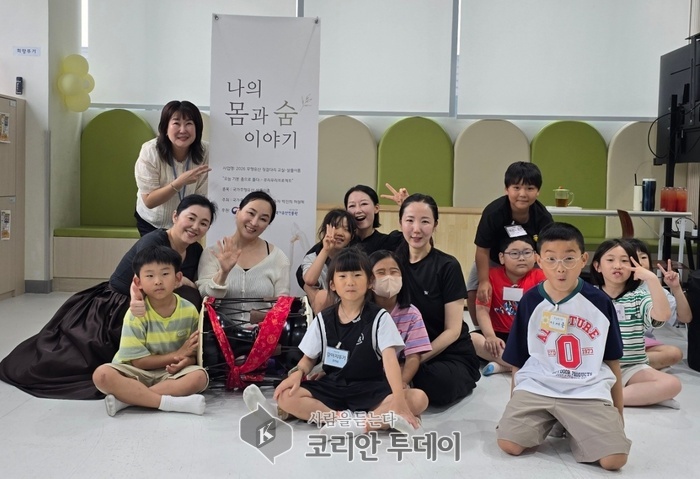 [The Korean Today] 2026 Intangible Heritage Bridge Classroom – Salpuri Dance “The Story of My Body and Breath,” a child-friendly educational program with National Intangible Cultural Heritage Salpuri Dance practitioners Park Jin-hee and Heo Seol-hye. © Reporter Baek Chang-hee |
The program was designed as a child-centered heritage transmission class led by Park Jin-hee, the main instructor and certified practitioner of the National Intangible Cultural Heritage Salpuri Dance, together with assistant instructor Heo Seol-hye. Through play, physical activity, and emotional expression, children were able to encounter Korean traditional dance in a way that felt natural and approachable.
When people hear the term “Salpuri Dance,” even adults may imagine an old traditional dance performed in hanbok with a long white cloth, or think of it as a difficult and highly specialized form of traditional dance. But for the children in this class, Salpuri Dance was something very different.
The white cloth became a flower, a breeze, and a butterfly. At times, it even became a way of expressing “my feelings” that could not easily be put into words.
During this special class, Song Hyo-jin, also a certified practitioner of National Intangible Cultural Heritage Salpuri Dance, and trainee No Myeong-ryun participated as supporting instructors. They helped the children experience not only Salpuri Dance, but also Jindo Arirang, traditional rhythms, and other aspects of Korean traditional performing arts at close range.
From “memorizing movements” to “expressing myself through dance”
The classroom presented a very different scene from a conventional practical lesson in which accurately copying predetermined movements is considered the most important goal.
The children played, drew, moved their bodies, and expressed their own emotions.
Rather than asking them to memorize Salpuri Dance movements from the very first session, the instructors began by showing photographs and introducing the concept of national heritage. The children explored examples of tangible heritage, natural heritage, and intangible heritage for themselves.
By introducing the potentially difficult concept of national heritage through quizzes and storytelling, the instructors naturally sparked the children’s interest in Korea’s cultural heritage.
The white cloth, one of the most important elements of Salpuri Dance, was also treated as more than a simple dance prop.
The children drew their own pictures on their cloths and even gave them names. In this way, each child created a one-of-a-kind “my cloth.”
In their imaginations, the cloth became a flower and a breeze. Sometimes it flew like a butterfly, and at other times it became another language through which they could express their feelings and emotions.
“What kind of movement represents how I feel today?”
“How can I introduce myself through movement?”
Instead of introducing themselves with words, the children introduced themselves with their bodies. They expressed what they liked, their personalities, and how they felt that day through a single movement, while their friends copied those movements or talked about the feelings they sensed from them.
There were no right or wrong answers.
Even when listening to the same music and holding the same kind of cloth, every child moved differently. Rather than correcting their movements by saying they were “wrong,” the instructors asked questions such as, “Why did you move that way?” and “How else could you express that feeling through movement?”
Each time they were asked a question, the children discovered new movements on their own. Through this process, their creativity, imagination, and ability to express themselves developed naturally.
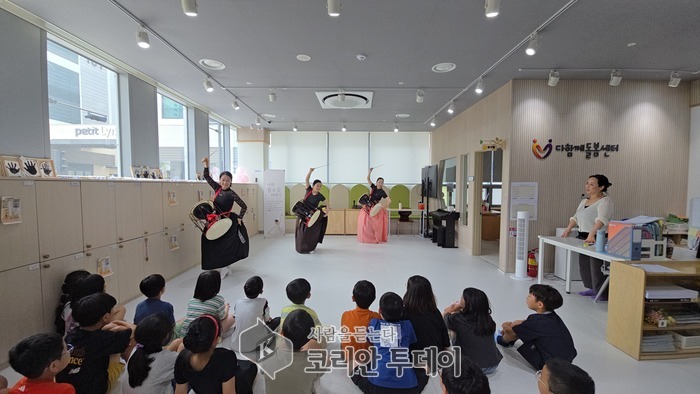 [The Korean Today] Activities from the National Intangible Cultural Heritage “Bridge Classroom” Program © Reporter Baek Chang-hee |
“Helping children enjoy our traditional dance comes before teaching them to dance it perfectly”
Main instructor Park Jin-hee explained, “I did not want the children to begin by simply memorizing Salpuri Dance movements.”
“We began by expressing our feelings with our bodies, drawing pictures on the cloths, giving them names, and introducing ourselves through movement. As the children played and explored, they naturally found themselves entering into the breathing and movement of our traditional dance.”
After the children had sufficiently experienced play and self-expression, the instructors gradually introduced the fundamental elements of Salpuri Dance, including breathing, walking, the movements of the fingertips and gaze, slowness, and pauses.
As a result, Salpuri Dance did not feel like an unfamiliar traditional dance that suddenly had to be memorized. Instead, it became “a process in which the movements I used to express myself naturally met Korean traditional dance.”
Park emphasized that the transmission of tradition to children should also be approached from the children’s perspective.
“Passing on tradition does not necessarily mean that young children must first be taught precise movements. I believe transmission can also begin by helping them enjoy it, become curious about it, and want to experience it again.”
Boys also look forward to Salpuri Dance… “Is this really the last class?”
Before the program began, there had been some concern. Because many of the children at the center were boys, the instructors wondered how interested they would be in a Salpuri Dance class.
Once the class began, however, those expectations quickly changed.
Both boys and girls participated enthusiastically, and as the sessions continued, the children began looking forward to the days when the instructors would visit. Some would greet them excitedly, saying, “The Salpuri Dance teacher is here!”
With the completion ceremony scheduled for the following week, some children were now asking, “Is this really the last class?” and “Aren’t we doing this again next time?”
Park Jin-hee said these reactions from the children gave her the greatest sense of reward.
“More than simply completing a public project successfully, I think it is more important for Salpuri Dance to remain in the children’s memories as a joyful experience. I am truly happy that this has become a class the children look forward to.”
The fact that the children were waiting for the next class also suggested that traditional culture had changed from something they “had to learn” into something they “wanted to experience again.”
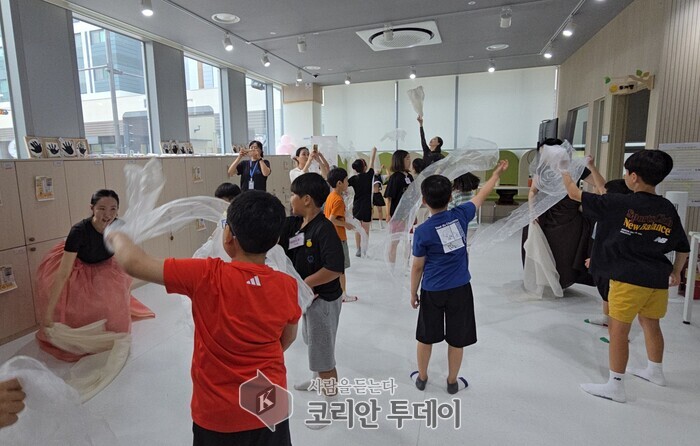 [The Korean Today] Children taking part in a National Intangible Cultural Heritage Salpuri Dance class designed at their eye level. © Reporter Baek Chang-hee |
Walking slowly and pausing to listen to “the voice of my body and mind”
Another distinctive feature of the program was its focus on helping children pay attention to their own bodies and emotions.
For children accustomed to fast-paced videos and highly stimulating content, the “slowness” and “pauses” of Salpuri Dance became a new kind of play.
Salpuri Dance contains breathing and waiting. The dancer walks slowly, pauses for a moment, looks toward the fingertips, and waits for the movement of the cloth.
Contrary to the assumption that children would only enjoy running and moving quickly, they also showed interest in activities that encouraged them to walk slowly, pause, and pay attention to their bodies.
Moving freely and releasing their physical energy naturally helped relieve stress. At the same time, observing friends’ movements, copying them, and creating new movements together allowed the children to learn cooperation and consideration for others.
It was a moment when Salpuri Dance expanded beyond practical traditional dance instruction into a form of arts and cultural education that encouraged children to listen to the stories of their own bodies and minds, recognize their emotions, and express them.
Experiencing intangible heritage by seeing, listening, playing rhythms, singing, and dancing
This special session was not simply a presentation of what the children had learned so far.
After reviewing breathing, walking, cloth movements, slowness, pauses, and emotional expression, the children watched professional traditional artists perform Salpuri Dance in front of them.
It gave them the opportunity to discover how the movements they had experienced through play were connected and expressed within an actual traditional dance.
The children then watched a Janggo dance performance and had an opportunity to play the traditional hourglass-shaped drum themselves. In particular, Song Hyo-jin, a certified practitioner of National Intangible Cultural Heritage Salpuri Dance, taught the melody and singing style of Jindo Arirang using playful body movements and hand gestures so that not only the children, but also the adults observing the class, could easily follow along.
As the children moved their bodies and sang, “Ari Arirang~,” the classroom quickly filled with excitement and joy.
Together Care Center Director Lee Eun-ok and the instructors also actively joined the children, keeping the rhythm, singing, and participating in the movements, adding even more energy to the class.
Through seeing, listening, playing rhythms, singing, and dancing, the children did not experience dance, sound, and rhythm as separate subjects. Instead, they encountered them as interconnected parts of a single Korean cultural tradition.
On this day, the classroom became more than a learning space for children. It turned into a small cultural gathering place where children and adults could enjoy Korean traditional culture together.
The enthusiastic development of the program was also supported by the strong interest and cooperation of Together Care Center Director Lee Eun-ok and the center’s staff members.
They created a comfortable atmosphere in which the children could move freely and express their thoughts, while actively responding to the activities so that the instructors and children could interact naturally.
Rather than a one-way lesson in which children simply sat and listened to explanations, the program used a dance-play approach. Children played with cloths, walked slowly, moved their bodies to traditional rhythms, and expressed their own thoughts and emotions.
This approach not only encouraged active participation, but also allowed the children to release energy and relieve stress while naturally developing creativity, imagination, expressive ability, and cooperation through observing their friends and creating movements together.
Humming “Ari Arirang~ Seuri Seurirang~” even while completing activity sheets
The learning did not end when the class officially finished.
As the children began completing their activity sheets, a small voice could be heard from one side of the classroom.
“Ari Arirang~ Seuri Seurirang~”
The children were unconsciously humming Jindo Arirang, which they had learned together only moments earlier.
No one had told them to sing. They had not memorized the song for a test. The melody of Korea, experienced joyfully through seeing, listening, singing, and moving their bodies, was naturally flowing from their mouths.
Perhaps the most memorable scene of the day was not a spectacular dance movement, but the sight of children quietly humming Arirang while working on their activity sheets.
From an “old traditional dance” to “a dance for today’s children”
Salpuri Dance is a precious National Intangible Cultural Heritage that has been passed down through generations.
However, preserving tradition and helping today’s generation enjoy that tradition are not separate goals.
The “Intangible Heritage Bridge Classroom” demonstrated that while the essence of tradition should be preserved, the way it is taught can be creatively adapted to the perspective and needs of children.
The program began with a simple activity: drawing on a cloth and giving it a name. From there, children expressed their feelings through movement, respected the gestures of their friends, learned breathing and patience, and eventually encountered Korean dance, sound, and traditional rhythm.
In this process, Salpuri Dance was no longer an old cultural form belonging in a museum, nor a difficult dance known only to adults.
It became a “living cultural heritage” that children living today could encounter through their own bodies and emotions, enjoy, and want to experience again.
“This is not a class aimed simply at making children good Salpuri dancers. It is a class that helps them express their emotions through their bodies and grow to appreciate our intangible cultural heritage.”
The children asking, “Is this really the last class?” ahead of the completion ceremony, and those humming Arirang while filling out their activity sheets, reveal the deeper meaning of the program.
Passing on tradition may not simply mean teaching the next generation to accurately remember old movements and melodies.
It can mean helping them enjoy it, become curious about it, and want to encounter it again. It can also mean allowing them to naturally absorb “our culture” into their bodies and hearts while enjoying it like play.
Perhaps the true transmission of National Intangible Cultural Heritage begins with children’s desire to “experience it again” and with the joy of naturally learning and discovering Korea’s cultural traditions.


[Apply for the Korean Brand Awards] [Apply for the Best CEO Awards] [Apply for the Consumer Satisfaction Awards]
THE KOREAN TODAY × WIA CODE
이 기사의 WIA Code

WIA Code 스캐너로 비추면 인터넷 없이 발행 사실과 위·변조 여부를 확인할 수 있습니다.
휴대폰 기본 카메라로 찍으면 스캐너 안내 페이지가 열립니다 — 기사 바로 열기

움직이는 코드는 스트림입니다 — WIA Code 스캐너로 약 90초 비추면 기사 전문(사진 포함)이 폰에 저장되어 인터넷 없이도 읽을 수 있습니다.
WIA Code · 코리안투데이


Leave a Reply