
A circular research system in which artificial intelligence (AI) proposes new drug candidate substances, automated laboratories verify them, and the results are in turn used to train the AI has been established in Korea for the first time. The Ministry of Science and ICT held a launch ceremony for the ‘Synthetic New Drug AIxBio Innovation Research Hub Pilot Project Group’ in Daegu on August 12, marking the first step toward an AI-based drug development innovation hub.
 [코리안투데이] Launch ceremony of the Synthetic New Drug AIxBio Innovation Research Hub Pilot Project Group © 장형임 기자 |
The Ministry of Science and ICT (Deputy Prime Minister and Minister of Science and ICT Bae Kyung-hoon) attended the launch ceremony of the ‘Synthetic New Drug AIxBio Innovation Research Hub Pilot Project Group,’ held in Daegu on Wednesday, August 12, announcing the launch of an artificial intelligence (AI)-based drug development innovation hub and sharing the direction of the project going forward. This project is the first innovation hub in the K-Moonshot AI drug development field and is a core task of the ‘Creation of an AI Bio Industry-Academia-Research-Hospital Open Ecosystem,’ one of the hyper-innovation economy leading projects being pursued by the government.
Drug development is a representative high-risk field that requires long periods of time and enormous costs to discover and verify new therapeutic candidate substances. While it has long relied on researchers’ experience and repeated experimentation, it has recently been rapidly shifting toward a method of using AI to analyze vast amounts of bio data to predict and design candidate substances and experimental conditions. Global competition is likewise expanding beyond securing superior AI models to securing research systems that connect AI models with actual experimental environments for continuous learning and improvement. Major countries such as the United States and the United Kingdom are concentrating national capabilities on building AI bio research hubs, data platforms, and automated experimental infrastructure.
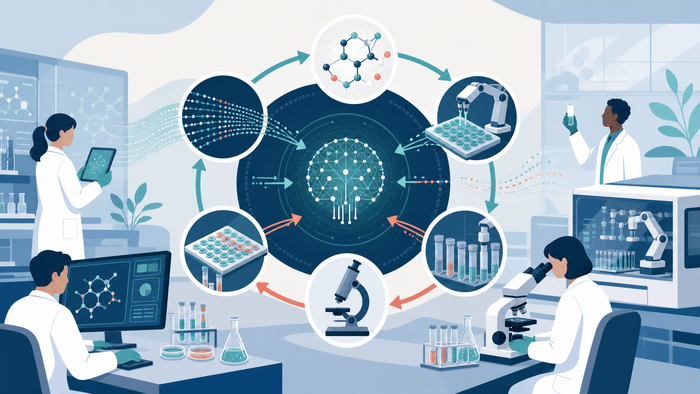
The core of this project is a ‘Lab-in-the-Loop’-based drug development system in which AI and the laboratory interact and advance together. When an AI model proposes new candidate substances and experimental conditions based on bio data, an automation-based experimental platform rapidly verifies them, and the results are in turn used to advance the AI model, forming a virtuous cycle. This raises the efficiency of exploring and verifying candidate substances, allowing researchers to concentrate on higher-level hypothesis setting and research decision-making. It is distinguished from existing methods in that it aims for a transition to an autonomous, circular research system in which the AI model and experimental system learn from accumulated data and improve their performance, going beyond AI simply supporting the existing research process.
The first pilot hub targets the synthetic new drug field. The Ministry of Science and ICT judged that synthetic new drugs, being both a core field of the global pharmaceutical market and highly amenable to the application of AI technology, are well suited for prioritizing the verification of a system that combines AI models with automated experimental environments. The project will be handled by a Daegu consortium. Universities, hospitals, research institutions, and companies—including Kyungpook National University, Kyungpook National University Hospital, the Daegu-Gyeongbuk Medical Innovation Foundation, and Univa—are joining to pool their core capabilities.
Kyungpook National University, the lead managing institution, oversees the operation of the AI-based synthetic new drug Lab-in-the-Loop research system and the project as a whole, and places priority on building AI computing infrastructure and cultivating AI bio convergence talent. Kyungpook National University Hospital, the data-focused managing institution, plays the key role of establishing a system for utilizing medical data needed for AI drug development, drawing on patient-based data covering approximately 2 million people. The Daegu-Gyeongbuk Medical Innovation Foundation builds high-speed verification infrastructure in cooperation with companies such as HLB Life Sciences, Arontier, MolCube, and Able Labs. It establishes the foundation for rapidly verifying the candidate substances and research hypotheses presented by AI models in an automated laboratory at a partial automation (A2) level and connecting them to results. Univa develops foundation models applicable to drug development and creates an AI research environment in which data and experimental results are continuously reflected, contributing to the advancement of the platform.
The project group plans to link AI computing infrastructure, a bio data utilization system, a high-speed verification experimental environment, and AI model development capabilities into a single research ecosystem to establish a world-class AI-based synthetic new drug development system. Based on the AI models, data, experimental infrastructure, and operating experience accumulated in the course of running the pilot hub, it intends to expand hubs into other AI bio fields going forward.
Oh Dae-hyun, Director General for Future Strategic Technology Policy at the Ministry of Science and ICT, said, ‘The competitiveness of future drug development depends on how effectively AI technology and data are connected to and utilized with actual experimental environments,’ adding, ‘The AIxBio innovation research hub is a pilot hub being pursued in the synthetic new drug field, and it carries great significance in that it lays a Lab-in-the-Loop foundation where AI models, experiments, and data form a virtuous cycle.’ He continued, ‘Next year, based on the results of the pilot hub, we will expand into additional AI bio fields and provide support so that the Republic of Korea can lead global AI bio innovation.’
At the launch ceremony, a vision proclamation ceremony sharing the research hub’s vision and direction was held, along with a symposium attended by experts in the AI drug development field, where future R&D directions and cooperation measures were discussed. The Ministry of Science and ICT plans to establish an AI-based drug development innovation model and to continue expanding an open AI bio innovation ecosystem in which industry, academia, research, and hospitals grow together.
지역 홍보대사 신청 기자양성과정 신청 코리안투데이 지부장 신청 코리안투데이 인천강화
THE KOREAN TODAY × WIA CODE
이 기사의 WIA Code

WIA Code 스캐너로 비추면 인터넷 없이 발행 사실과 위·변조 여부를 확인할 수 있습니다.
휴대폰 기본 카메라로 찍으면 스캐너 안내 페이지가 열립니다 — 기사 바로 열기

움직이는 코드는 스트림입니다 — WIA Code 스캐너로 약 26초 비추면 기사 전문(사진 포함)이 폰에 저장되어 인터넷 없이도 읽을 수 있습니다.
WIA Code · 코리안투데이





Leave a Reply