
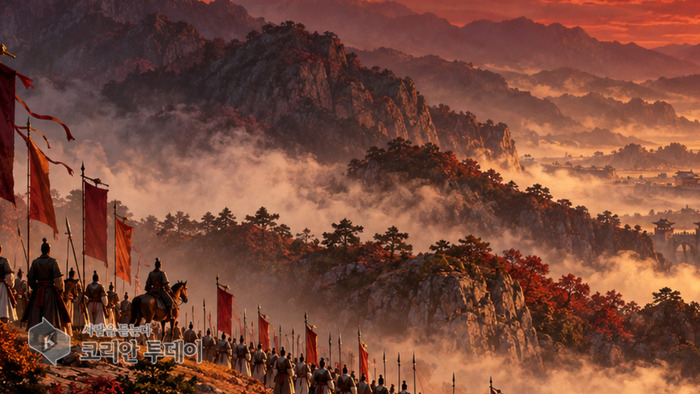
Long before medieval Europe dreamed of knightly chivalry, a small Korean kingdom was already training its sons to be both poets and warriors.
Every society asks how to turn its young people into trustworthy leaders. In the sixth century, the Korean kingdom of Silla gave an answer: the Hwarang, “Flowering Youths.” Aristocratic young men of good character were chosen as leaders, each gathering a band of followers who studied, traveled, sang, and trained together. When war came, many of them marched out as officers and soldiers.
Was this a school, a scout troop, a knightly order, or a recruitment pipeline? As we will see, it was something of all four, and the real story is messier than the textbook legend.
🌍 Western Historical Parallel
When the Hwarang were organized in the late 500s, the Frankish kings ruled a patchwork of warrior retinues in Gaul, and Gregory the Great became pope in 590. In Constantinople, the generation after Justinian (r. 527–565) fought Persia and the Avars. Medieval knighthood, with its blend of martial skill and code of honor, came centuries later. The Hwarang resemble it in spirit, but they were tied to a centralized state, not a private lord. A closer comparison is the Spartan agoge or the Roman officer-training tradition, though the Hwarang placed music, poetry, and Buddhist ethics beside weapons.
◆ The Ancient Landscape
In the 500s the Korean peninsula was divided among Goguryeo in the north, Baekje in the southwest, and Silla in the southeast, centered on today’s Gyeongju. Silla was the last to build a strong state, but under King Jinheung (r. 540–576) it pushed into the Han River valley, near modern Seoul, and gained land and people. Yet Silla’s “bone-rank” system fixed status by birth, leaving few channels for finding talent across families and regions.
The Samguk Sagi records that in 576, the 37th year of Jinheung’s reign, the court first “revered” the Wonhwa (“Source Flowers”). Ruler and ministers, it says, worried they had no way to know people’s worth, so they gathered groups to socialize and observed their conduct. The first two women chosen, Nammo and Junjeong, fell into rivalry that ended in tragedy (told in more detail in the later Samguk Yusa). The court abolished the Wonhwa and later selected handsome, well-bred young men as “Hwarang” instead.
“Wise counselors and loyal ministers rose from here; fine generals and brave soldiers came from here.” (賢佐忠臣 從此而秀 良將勇卒 由是而生) The passage quotes the Silla scholar Kim Daemun and praises the Hwarang as a wellspring of talent. (Translation is the author’s.)
◆ Same Era, Different Worlds
🏛️ China
The Sui reunified China in 581; the Tang followed in 618. Both pressed Goguryeo, and Silla needed officers who could fight and negotiate.
🗿 Byzantine Empire
After Justinian’s reconquests, the empire was strained by Persian war. Heraclius took the throne around 610 and fought a desperate struggle for survival.
⚔️ Western Europe
Frankish kings and Anglo-Saxon rulers relied on personal warbands; Augustine’s mission reached Kent in 597.
🕌 Islamic World
In 622 the Muslim community migrated to Medina, the starting point of the Islamic calendar, just as Silla’s youth were swearing their own oaths.
[Image: Conceptual diagram of the Hwarang organization (author’s schematic)]
⚔️ Scene from That Day
“July 660, the plain of Hwangsanbeol. The Baekje general Gyebaek and his sworn-to-die troops have thrown back the Silla army four times. From the Silla ranks a sixteen-year-old Hwarang named Gwanchang spurs his horse alone into the enemy line.”
“Captured, he is sent back alive out of pity for his youth. He drinks a mouthful of water from a well and rides in again. This time he is beheaded, and his head is tied to his saddle and sent back. Seeing it, the Silla troops charge with desperate fury and turn the battle.” (A reconstruction based on the Samguk Sagi biography of Gwanchang.) Think of the stories of Thermopylae or the Roman devotio: legend and history are tangled, and the point is the inspirational effect.
◆ Uncovering Historical Truth
The ideal was munmu gyeomjeon, “mastery of both letters and arms.” Young men climbed famous mountains, bathed in rivers, and shared songs and dance. The ninth-century scholar Choe Chiwon called this tradition pungnyu, a native way that combined Confucian, Buddhist, and Taoist elements. Monks served among the followers, so the Hwarang were not a purely military body: religion, education, and soldiering overlapped, much as in the Roman collegia and later monastic military orders.
The famous “Five Secular Precepts” are traditionally traced to 600, when the monk Wongwang, back from Sui China, taught two youths named Gwisan and Chuhang: loyalty to the king, filial piety to parents, trust among friends, no retreat in battle, and discrimination in taking life. Both reportedly served as junior officers and died after the 602 battle at Amaseong against Baekje. Separately, the Imsin Oath Stone, found near Gyeongju in 1934 and now in the National Gyeongju Museum, records two young men swearing before Heaven to follow the way of loyalty for three years and study the Classic of Poetry, Book of Documents, and Book of Rites. The “Imsin” year is usually read as 552 or 612, but the date is not settled.
Politically, the Hwarang drew aristocratic youth into state service and built personal networks across regions, somewhat as the Roman cursus honorum or Tang examination culture did. Kim Yu-sin, a descendant of the conquered Gaya royal line, reportedly became a Hwarang at fifteen, led a band called the Yonghwa Hyangdo, and won his first recorded battle at Nangbiseong against Goguryeo in 629. He later led Silla’s armies in the wars of the 660s. Whether his ally and later King Taejong Muyeol, Kim Chunchu, was himself a Hwarang is not clearly established in the sources, so it is safer not to assert it.
Period
6th–7th century CE (first recorded 576)
Key Figures
Jinheung, Wongwang, Kim Yu-sin, Gwanchang
Key Events
Wonhwa (576), Five Precepts (600), Hwangsanbeol (660)
Legacy
Talent pipeline that fed Silla’s wars of the 660s
🔍 International Academic Perspectives
Korean/Asian Scholars
The mainstream view holds that the Hwarang grew from older youth-band traditions and were formalized by the state under Jinheung to select talent and supply military leaders. Some scholars argue the Five Precepts were Wongwang’s personal advice, not an official Hwarang charter.
Western Historians
Scholars of Korean history in the West generally accept the Hwarang as a real institution but note that our main sources, the Samguk Sagi (1145) and Samguk Yusa (13th century), were written centuries later. The manuscript “Hwarang Segi” is disputed and is best treated with caution.
📖 Key Terms Explained
- Hwarang (화랑, 花郞)
- “Flowering Youth”: the aristocratic leader of a youth band in Silla.
- Nangdo (낭도, 郞徒)
- The followers who trained under a Hwarang.
- Silla (신라)
- Korean kingdom traditionally dated 57 BCE–935 CE; it unified most of the peninsula after 668.
- Samguk Sagi (삼국사기)
- History of the Three Kingdoms, compiled in 1145 under Kim Busik.
◆ Lessons for Today’s World
The Hwarang remind us that leadership is learned through shared experience, not only exams. Modern parallels include service academies, Scouts, and Rhodes-style leadership programs. Each tries to produce people who are both capable and trusted.
They also carry a warning. Stories like Gwanchang’s can glorify the sacrifice of the very young, a theme that societies from Sparta to twentieth-century Europe have used for propaganda. What is worth keeping is the training in responsibility and loyalty to a community, not the cult of death.
| Aspect | Silla Era | Modern Parallel |
|---|---|---|
| Talent Selection | Leaders gather followers, court observes conduct | Mentorship, scholarships, leadership programs |
| Military | Martial arts, study, ethics; wartime service | ROTC, service academies, youth corps |
| Culture | Song, dance, trust, “letters and arms” | Character education, teamwork, civic spirit |
[Image: The ideal of balanced education, then and now]
📚 Diving Deeper
- The Imsin Oath Stone is on display at the National Gyeongju Museum; Gyeongju’s historic areas are a UNESCO World Heritage Site.
- Like the Sutton Hoo burial (early 7th century), Silla’s royal tombs show how a warrior elite displayed status through gold and craftsmanship.
- Read the biographies of Kim Yu-sin, Gwisan, and Gwanchang in the Samguk Sagi (see Peter H. Lee’s translations); general context appears in The Cambridge History of Korea and related volumes.
The Voice of Living History
The Hwarang were an imperfect institution. But when a state gave its young people a stage for learning and responsibility, those young people became its future.
“A society that trusts its youth and opens a path for them endures. The spirit of Silla lives in that trust.”
Previous Episode
Episode 7: King Jinheung, Silla’s Alexander
Next Episode
Episode 9: Queen Seondeok, East Asia’s First Reigning Queen
The Korean Today “History Lives On” Series
The Silla Chronicle (35 Episodes)
Bridging Ancient East Asia and the Modern World
© 2025 The Korean Today. All rights reserved.
This content is based on historical facts and presents balanced academic perspectives
for international readers.



답글 남기기