
The Ministry of Science and ICT (Deputy Prime Minister and Minister of Science and ICT Bae Kyung-hoon) announced that it held the launch ceremony for Korea’s first industry-academia-research consortium on self-driving labs at Orche Hall in L Tower, Seoul, on August 11. It marks the first step toward building, at the national level, a self-driving lab ecosystem that links experimental equipment, robots and artificial intelligence (AI) to automatically repeat experiments without human intervention.
 [코리안투데이] Launch ceremony of the industry-academia-research consortium for self-driving labs © 장형임 기자 |
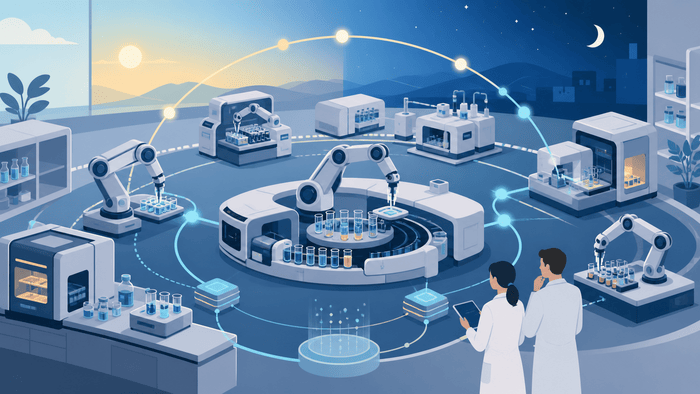
A self-driving lab (SDL) is a next-generation research platform in which experimental equipment, robots and AI are linked to carry out experiments automatically and repeatedly without human involvement. By running experiments around the clock and simultaneously exploring a vast range of experimental conditions, it can shorten research that once took years to a matter of months while improving reproducibility. It is rapidly spreading in fields such as materials, bio and pharmaceuticals, and major countries including the United States and Europe are also making concentrated national investments.
Self-driving labs are also a core foundation of the government’s ‘K-Moonshot’ initiative. K-Moonshot is a national project that uses AI to raise research productivity and solve national missions, and self-driving labs can fundamentally elevate the speed and quality of research through a closed-loop system of ‘hypothesis-experiment-analysis-re-hypothesis,’ in which AI-generated hypotheses are verified through experiments and the results are fed back for the AI to learn.
In Korea as well, demand for adopting self-driving labs is growing quickly, centered on advanced fields such as bio and materials, yet the infrastructure to support this remains insufficient. In particular, because standards for equipment, data and operations differ from institution to institution, individually built self-driving labs have been unable to connect with one another and have operated separately. The launch of this consortium is significant in that it seeks to resolve such fragmentation by bringing scattered capabilities together into one.
The consortium will operate as an industry-academia-research-government cooperation platform that identifies policy agendas through regular meetings and annual conferences, while covering the entire cycle from technology development to the joint use of infrastructure, data accumulation, the establishment of standards and interfaces, and demonstration and diffusion. Professor Jung Yousung of Seoul National University, who has led self-driving lab research, will serve as chair, with the National AI Research Center for Science (NAIS) and the Korea Basic Science Institute (KBSI) serving as joint secretariats. The consortium will carry out three core missions: ① establishing self-driving lab technologies, platforms and standards; ② building reference self-driving labs and other research and operational systems; and ③ supporting demonstration by demand companies and private-sector diffusion.
Participating institutions total about 80, including supplier companies such as Park Systems and HB Solution, 50 demand companies such as Samsung Advanced Institute of Technology and SK hynix, and more than 30 universities and research institutes, and the consortium plans to keep expanding its membership. It is organized into three subcommittees—technology, platforms and standards; research and operations; and demonstration and diffusion—and will continue cooperation through a quarterly steering committee, subcommittee working-level meetings and an annual industry-academia-research forum.
Hwang Geum-sook, acting president of KBSI, said, ‘Drawing on KBSI’s experience in operating and supporting research equipment, we will contribute to establishing a common operating system and standards for self-driving labs and to spreading them across research sites.’ Yoo Yong-gyun, director of NAIS, said, ‘We will build a system for accumulating data and managing its quality so that data produced in self-driving labs feeds directly into AI learning, and we will turn this into a national AI training asset.’
The launch ceremony drew some 400 attendees, including First Vice Minister of Science and ICT Koo Hyuk-chae, along with industry, academic and research experts and representatives of domestic equipment and AI platform companies. The event began with a joint declaration marking the consortium’s launch, followed by presentations on the status of major domestic self-driving lab research and industry-academia-research policy proposals and a panel discussion, and it also featured exhibition booths for relevant equipment and AI companies as well as a one-on-one matching consultation program linking demand companies, researchers and equipment firms.
First Vice Minister Koo Hyuk-chae stressed, ‘As core infrastructure underpinning national missions such as K-Moonshot, self-driving labs are expected to make a groundbreaking contribution to accelerating scientific discovery and verification,’ adding, ‘Through the consortium launched today, we will provide active policy and institutional support so that the government, government-funded research institutes, universities and industry can advance together toward the shared goal of building a domestic self-driving lab ecosystem.’ Inquiries may be directed to the Science, Technology and AI Innovation Division of the Ministry of Science and ICT (044-202-4575).
지역 홍보대사 신청 기자양성과정 신청 코리안투데이 지부장 신청 코리안투데이 인천강화
THE KOREAN TODAY × WIA CODE
이 기사의 WIA Code

WIA Code 스캐너로 비추면 인터넷 없이 발행 사실과 위·변조 여부를 확인할 수 있습니다.
휴대폰 기본 카메라로 찍으면 스캐너 안내 페이지가 열립니다 — 기사 바로 열기

움직이는 코드는 스트림입니다 — WIA Code 스캐너로 약 25초 비추면 기사 전문(사진 포함)이 폰에 저장되어 인터넷 없이도 읽을 수 있습니다.
WIA Code · 코리안투데이





Leave a Reply