
 10:10 PM KST (1:10 PM UTC)
Hook Opening
Good evening. As Seoul’s lamps came on a hundred years ago tonight, the city was still catching its breath from a Monday spent counting itself. Four days earlier, at the stroke of midnight on October 1, colonial Korea had undergone its first modern census. On this October 5, enumerators were still knocking on doors in the capital’s back alleys — while, six thousand miles away in a small Swiss town called Locarno, the foreign ministers of Europe’s great powers sat down together to try to talk their continent out of another war.
Korea Under Colonial Rule
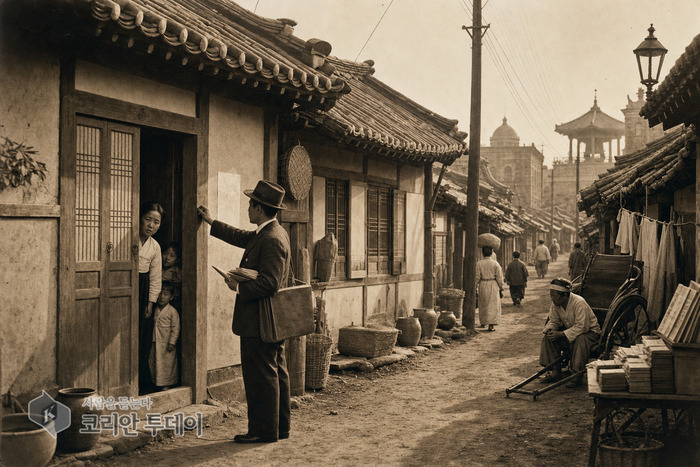
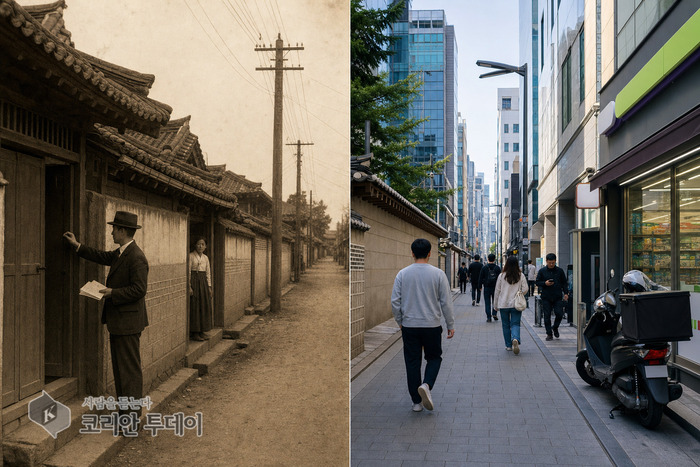
The Government-General of Chosen had ordered the survey — officially the “simplified national census,” or *ganyi gukse josa* — to take a full count of the colony’s population for the first time. Originally planned for 1920, it had been postponed after the March First Movement upended colonial administration. Now, five days into the count, unpaid enumerators drawn from local officials and neighborhood notables were still moving door to door through Seoul’s *jongno* backstreets, asking each household how many people lived there, their ages, and their occupations. Some doors never opened.
Further north, the shadow of the Miura Agreement — a secret pact signed that June between Japanese colonial police and a Manchurian warlord — still fell heavily over the Gando region. Under its terms, any Korean independence fighter captured in Manchuria was to be handed to Japanese consular authorities in exchange for a bounty. Arrests of Korean activists in and around Yongjeong continued through the autumn, deepening despair in the exile community.
Closer to home, Seoul had not fully recovered from the catastrophic Eulchuk flood of that summer — the worst in the peninsula’s twentieth-century memory, which had killed hundreds and left tens of thousands homeless. Relief funds organized through the Korean Flood Relief Association, with newspapers leading public fundraising drives, were still being distributed as autumn set in.
*No verified record of that day’s weather or market prices in Seoul survives in available sources; only the season — early autumn, the last of summer’s heat fading — can be confirmed.*
East Asia in Turmoil
In Shanghai, Korea’s government-in-exile was in the middle of a constitutional overhaul. A revised charter that took effect July 7 had abolished the presidency in favor of a State Council Chairman system. On September 24, Yi Sang-ryong — a veteran independence leader from western Manchuria — had been elected the Provisional Government’s first State Council Chairman. But by early October he was struggling to even assemble a cabinet, hemmed in by factional rivalries that had plagued the exile government for years.
South of Shanghai, the warlord Sun Chuanfang was mobilizing troops against the Fengtian faction, and the lower Yangtze region braced for renewed fighting — a reminder that China’s warlord era showed no sign of ending.
The World Stage
In the lakeside Swiss town of Locarno, foreign ministers Gustav Stresemann of Germany, Aristide Briand of France, and Austen Chamberlain of Britain opened a conference that would run sixteen days. Their goal: to settle, once and for all, the question of Germany’s western border and calm the fears that had haunted Europe since the Great War. All three would later share the Nobel Peace Prize for the treaty that emerged from these talks. It was, in its way, the same instinct that drove a colonial census — an attempt to know exactly where the lines were drawn, and who stood on which side of them.
Colonial Parallels
Korea’s 1925 census was not unique in colonial history. British India had long used census-taking as an instrument of rule, sorting subjects by caste and religion to administer them more efficiently — a practice that hardened social divisions still felt today. In Ireland, the fledgling Irish Free State was, that same year, planning its own first independent census, hoping to synchronize the count with Northern Ireland’s in a quiet act of post-partition diplomacy. In the Philippines, American administrators had used census data since 1903 to justify claims about Filipino “readiness” for self-rule. Across every empire, counting a people was rarely neutral — it was the first step toward deciding what could be taken from them, and when.
Person of the Day
Yi Sang-ryong (1858–1932) had already given up everything once. In 1911, this Andong-born scholar of the old Confucian gentry sold his family’s ancestral estate and led dozens of relatives across the Yalu into southern Manchuria, where he helped found Korean independence schools and militia training grounds. By 1925 he was in his late sixties, elected — on September 24 — as the first State Council Chairman of the reorganized Provisional Government in Shanghai. He arrived to find a government paralyzed by regional factionalism, unable even to fill its own cabinet seats. On this October evening, half a world from the home he’d sold fourteen years earlier, an old man who had wagered his entire fortune on Korean independence was still trying, and still struggling, to hold a fractured movement together.
Understanding Daily Life
For an ordinary Seoul household on this Monday, the census meant an unfamiliar knock at the door — a neighbor or minor clerk, unpaid and often unwelcome, asking questions few colonial subjects were eager to answer honestly. Distrust ran deep: many suspected, correctly, that the numbers gathered would eventually serve tax collection and labor conscription as much as administration. By midday, newsboys were already crying the census news alongside fragments of the distant Locarno story. By dusk, enumerators handed in the day’s stack of forms, tired but aware they were doing something that had never been done before — counting, for the first time, exactly how many Koreans there were.
Century Mirror
A hundred years later, South Korea no longer sends enumerators door to door with paper forms; population is tracked continuously through administrative and digital records. The 1925 count returned a figure of roughly 19.52 million across the peninsula — a number gathered by hand, household by household, over weeks of walking. Today’s Korea, home to over fifty million people just in the South, can produce a population estimate in real time. What took an army of unpaid volunteers a season to gather now takes a database query seconds — yet the impulse behind both remains the same: a nation trying to see itself clearly.
Tomorrow’s Preview
Tomorrow, October 6, enumerators will still be finishing their rounds through Seoul’s alleys, and in Locarno, Europe’s foreign ministers will still be at the table. Join us again tomorrow evening at 10:10 PM KST, as we return to a century ago.
THE KOREAN TODAY × WIA CODE
이 기사의 WIA Code

WIA Code 스캐너로 비추면 인터넷 없이 발행 사실과 위·변조 여부를 확인할 수 있습니다.
휴대폰 기본 카메라로 찍으면 스캐너 안내 페이지가 열립니다 — 기사 바로 열기

움직이는 코드는 스트림입니다 — WIA Code 스캐너로 약 83초 비추면 기사 전문(사진 포함)이 폰에 저장되어 인터넷 없이도 읽을 수 있습니다.
WIA Code · 코리안투데이






Leave a Reply