
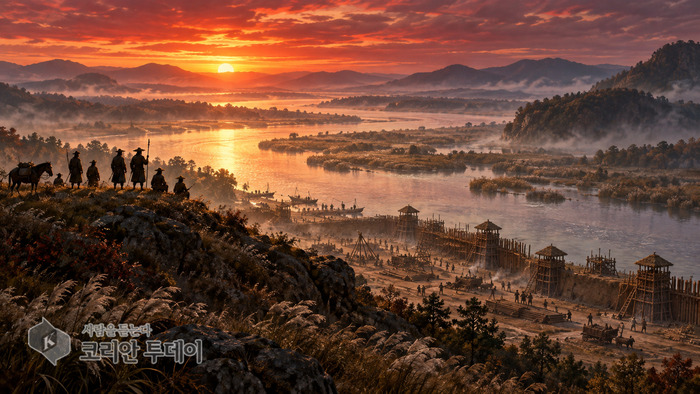
In 18 BCE, two brothers pushed out of a royal succession arrived on the banks of the Han River. They had no land, no subjects, no legitimacy — only ten loyal retainers and legs that had carried them south.
Even today, people arrive in unfamiliar lands and start their lives over from nothing, fleeing conflict or chasing opportunity. A small band of migrants who settled on the southern bank of the Han River more than two thousand years ago was no different. They became the seed of Baekje, a kingdom that would endure for nearly seven centuries as one of Korea’s Three Kingdoms.
A half-brother passed over for the throne, an elder brother whose settlement failed, and a younger brother who survived to rename his own kingdom — Baekje’s founding myth is a story of failure, recovery, and integration. Why did Onjo succeed where his brother Biryu did not? And where, exactly, in today’s Seoul was “Wiryeseong”?
🌍 Western Historical Parallel
In the very same year Onjo is said to have founded Baekje, 18 BCE, Rome’s first emperor Augustus — having just ended a century of civil war — issued the Lex Julia de adulteriis, part of his broader project to consolidate the Pax Romana. Two very different founders, on opposite ends of Eurasia, were both busy building the institutions of lasting states.
◆ The Ancient Landscape
In 37 BCE, Jumong — a prince of Buyeo lineage, later revered as King Dongmyeong — founded Goguryeo at Jolbon, near the upper Yalu River. There, with his wife Soseono, he had two sons, Biryu and Onjo. But when Yuri, a son Jumong had fathered earlier in Northern Buyeo, arrived and was named crown prince, the two brothers felt their position threatened. Along with their mother and ten loyal officials, they journeyed south.
Biryu settled near the coast at Michuhol (near present-day Incheon), while Onjo established his capital at Wiryeseong, south of the Han River. According to the Samguk Sagi, Michuhol’s soil was damp and its water brackish, making it a poor place to live. Onjo’s site, by contrast, was bounded by the river to the north and fertile plains to the south — a far more favorable position. When Biryu died, his followers abandoned Michuhol and joined Onjo instead.
“He established his capital at Hanam Wiryeseong, and with ten officials as his aides, named his state Sipje (‘Ten Ji-je’)… After Biryu’s officials and people all returned to Wiryeseong, the people came joyfully to follow him, so the name of the state was changed to Baekje (‘Hundred Ji-je’).”
◆ Same Era, Different Worlds
🏛️ Han China
The Western Han dynasty under Emperor Cheng was outwardly stable, though the Wang consort clan was quietly consolidating the power that would later end the dynasty.
🗿 Rome
Augustus, having ended decades of civil war, was cementing the Pax Romana and passing moral and marriage legislation to stabilize the new imperial order.
⚔️ Korean Peninsula
Goguryeo (est. 37 BCE) and Silla (est. 57 BCE) already existed, while dozens of small polities of the Mahan, Jinhan, and Byeonhan confederacies dotted the central and southern peninsula.
🌏 Japan
The Japanese archipelago was in its Yayoi period, as wet-rice farming communities spread and began coalescing into small regional chiefdoms.
[Image: Conceptual route map of Onjo and Biryu’s migration from Goguryeo to the Han River basin]
⚔️ Scene from That Day
“The river ran dark blue, and reeds stood taller than a man. Ten officials, among them Ogan and Maryeo, climbed a low ridge and looked out in every direction. To the north, the river curled like a moat; to the south, fertile plains stretched out; to the west, a route to the sea lay open.”
“‘There is no better land than this,’ the officials agreed. Onjo ordered earthen walls raised around the site. Later, when his brother Biryu’s exhausted followers arrived at the gates, Onjo did not turn them away — he opened them. It was in that moment that the kingdom’s name changed from ‘Ten’ to ‘Hundred.'”
◆ Uncovering Historical Truth
What stands out in Baekje’s founding myth is the contrast between “the failed elder brother” and “the successful younger one.” Michuhol was likely low-lying tidal ground near the West Sea. Wiryeseong, by contrast, secured both a stable water source and a natural defensive line along the Han River. A single pragmatic choice of settlement site — much like early colonial ventures in world history that succeeded or failed on soil and water alone — determined the fate of two rival groups.
Archaeologically, the Han River basin of this period has yielded large earthen fortifications, tombs, and imported Chinese goods, suggesting early Baekje grew quickly from a migrant band into a genuine regional power. At the Pungnap Toseong site in particular, excavators have found what appears to be a large palace complex, a paved road, roof tiles and pottery bearing inscriptions, and a moat — all consistent with a royal capital.
Yet under Onjo, Baekje was not yet a dominant power. Central and southern Korea was organized around the Mahan confederacy, whose paramount chiefdom, Mokji-guk, sat near present-day Cheonan. The newly founded “Baekje-guk” began as just one small member state within that confederacy, and it would take several more generations of kings before it grew strong enough to challenge Mahan’s leadership.
Period
18 BCE – 28 CE (reign of King Onjo)
Key Figures
King Onjo (founder), Biryu (elder brother), Queen Soseono
Key Event
Settlement at Wiryeseong; renaming Sipje to Baekje
Legacy
Starting point of a Han River regional power
🔍 International Academic Perspectives
Mainstream View
Hanam Wiryeseong most likely stood at the Pungnap Toseong site in Seoul’s Songpa district, where excavations have uncovered a probable palace complex, paved roads, inscribed pottery and tiles, and a moat — features consistent with a royal capital.
Alternative Views
At least eight competing theories persist, including the nearby Mongchon Toseong site and the Wiryesanseong fortress near Cheonan. Because textual sources alone cannot fix the exact location, the debate continues alongside ongoing excavation.
📖 Key Terms Explained
- Baekje (백제)
- One of Korea’s Three Kingdoms (18 BCE – 660 CE), founded on the Han River and centered on present-day Seoul before later capitals further south.
- Mahan Confederacy
- A loose alliance of dozens of small statelets across central and southwestern Korea, led by the paramount chiefdom of Mokji-guk, into which the earliest Baekje was absorbed as a minor member.
- Samguk Sagi
- Korea’s oldest surviving official history (compiled 1145 CE), covering the Three Kingdoms period and the primary source for Onjo’s founding narrative.
◆ Lessons for Today’s World
Onjo’s band were people displaced by existing power structures. Rather than despair in their new land, they absorbed the survivors of a failed rival settlement and grew stronger for it. The shift from “Sipje” to “Baekje” — from ten founders to a hundred clans — marks the moment a closed kinship group became an open, integrative community.
Modern Korean society, too, is increasingly shaped by immigrants, overseas Koreans returning home, and entrepreneurs venturing into unfamiliar fields. The pattern of overcoming failure by welcoming others into a larger community has changed remarkably little in two thousand years.
| Aspect | Founding Era | Modern Parallel |
|---|---|---|
| Migration/Settlement | Goguryeo refugees settle the Han River basin | Support for immigrants and returning overseas Koreans |
| Diplomacy/Survival | Growing pragmatically within the Mahan confederacy | Balanced, pragmatic diplomacy among great powers |
| Culture/Spirit | A pioneering, integrative spirit (Sipje → Baekje) | Startup culture and multicultural integration |
[Image: A symbolic composition linking the ancient migrant settlement to modern Seoul’s skyline]
📚 Diving Deeper
- Pungnap Toseong and Mongchon Toseong in Seoul’s Songpa district — ongoing excavation results are displayed at the Baekje Museum of Hanseong
- The Samguk Sagi’s Baekje Annals also preserve an alternate tradition naming Biryu, not Onjo, as the dynastic founder
- Next episode: how Onjo’s successors gradually absorbed power within the Mahan confederacy, leading to King Goi’s institutional reforms
The Voice of Living History
A kingdom was not founded by noble bloodline alone, but by people who embraced failure and took another step forward. Wiryeseong’s earthen walls are long gone, but the resolve to welcome strangers and build a “kingdom of a hundred” still runs through the Han River today.
“It began with ten and became a hundred – the very name Baekje is a history of integration.”
Previous Episode
First episode of the Baekje series
Next Episode
Episode 2: King Goi’s Institutional Reforms – The Foundations of an Ancient State
The Korean Today “History Lives On” Series
The Baekje Chronicle (30 Episodes)
Bridging Ancient East Asia and the Modern World
© 2025 The Korean Today. All rights reserved.
This content is based on historical facts and presents balanced academic perspectives
for international readers.
THE KOREAN TODAY × WIA CODE
이 기사의 WIA Code

WIA Code 스캐너로 비추면 인터넷 없이 발행 사실과 위·변조 여부를 확인할 수 있습니다.
휴대폰 기본 카메라로 찍으면 스캐너 안내 페이지가 열립니다 — 기사 바로 열기
움직이는 코드(스트림) 한 장에 기사 전문(사진 포함)이 담겨 있습니다 — WIA Code 스캐너로 약 29초 비추면 폰에 저장되어 인터넷 없이도 읽을 수 있습니다. Stream.mp4 도 여기서 받습니다.
WIA Code · 코리안투데이


Leave a Reply