
Good evening. It’s 10:10 PM KST (1:10 PM UTC), October 6, 2025 — which means, one hundred years ago, it was Tuesday, October 6, 1925, in colonial Korea. Five days had passed since Korea underwent its first modern population census. In Gyeongseong (present-day Seoul), enumerators with clipboards were still finishing their rounds, while along the Han River, workers continued repairing embankments shattered by the previous summer’s catastrophic flood. Two very different kinds of counting and rebuilding were unfolding side by side that autumn.
Korea Under Colonial Rule
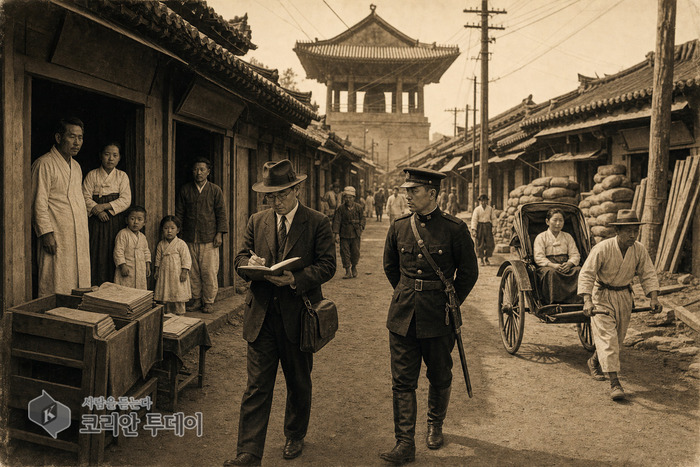
At midnight on October 1, 1925, the Government-General of Korea conducted the “Simple National Census” (간이국세조사) — the first modern population count ever taken on the Korean peninsula. A census had originally been planned for 1920, but was shelved in the aftermath of the March First Independence Movement of 1919, according to Korean historical archives. It took five more years before the count finally happened.
The results: a total population of 19,522,945 — 10,020,943 men and 9,502,002 women, according to Korea’s National Institute of Korean History database. The count included Koreans, resident Japanese, and other foreign nationals on the peninsula.
Counting people was never a neutral act. Historical researchers note the census served as foundational infrastructure for colonial administration and resource mobilization. Refusing to answer, or answering falsely, carried legal penalties under the census ordinance. Police officers frequently accompanied enumerators door to door.
As of October 6, detailed breakdowns by region and occupation appear to have still been in progress; the exact front-page coverage of that specific day’s newspapers could not be independently verified. [Unconfirmed]
East Asia in Turmoil
In China, the aftershocks of the May Thirtieth Movement and the July general strike in Shanghai were still reshaping politics. Under the First United Front between the Kuomintang and the Chinese Communist Party, the two movements prepared for what would become the Northern Expedition, even as tensions simmered following Sun Yat-sen’s death that March. Japan, meanwhile, watched its colonial administration in Korea absorb the twin pressures of census enforcement and flood recovery.
The World Stage
Across the globe, in the small Swiss town of Locarno, one of the decade’s most consequential diplomatic gatherings was entering its second day. From October 5 to 16, 1925, representatives of France (Aristide Briand), Britain (Austen Chamberlain), Germany (Gustav Stresemann), Belgium (Émile Vandervelde), and Italy (Benito Mussolini) negotiated what would become the Locarno Treaties — an attempt to guarantee peace among former wartime enemies. It was, in its way, a mirror image of colonial Korea’s own autumn: nations that had once fought each other now counting their chances for peace, just as Korea counted its own people under foreign rule.
Colonial Parallels
Korea’s 1925 census was far from unique in the colonial world. British India had long relied on decennial censuses as tools of administrative control, using population data to structure taxation and labor recruitment. In Ireland, only recently established as a Free State in 1922, the new government was conducting its own reckonings of a population reshaped by war and partition. In the Philippines, under American colonial administration, census-taking likewise doubled as a mechanism for governance and, eventually, for debates over the timeline to self-rule. Across these colonial geographies, the seemingly neutral act of counting people repeatedly served the interests of the ruling power first.
Person of the Day
No single named individual from October 6, 1925, could be verified for this feature. Instead, consider a composite, well-documented figure of the moment: a census enumerator walking the alleys of Jongno with a ledger and pencil, required by law to record every household, and a laborer on the Han River embankment, hauling stone blasted from Seonyubong to shore up the levee before the next rains. Neither is named in the historical record available to us — but both represent the ordinary hands through which this extraordinary autumn actually passed. [Illustrative composite, not a documented named individual]
Understanding Daily Life
By early October, Gyeongseong was a city living two timelines at once. One was administrative and forward-looking: the census apparatus, with its penalties for noncompliance, was actively reshaping how the colonial state understood — and controlled — the population it governed. The other was still recovering from catastrophe: the flood of July 1925 had caused damage equivalent to 58 percent of the Government-General’s annual budget, destroying entire villages along the Han River. Relief funds organized through the Flood Victims Relief Association were still being distributed that autumn, and embankment reconstruction continued using rubble from the demolished Seonyubong hill.
Century Mirror
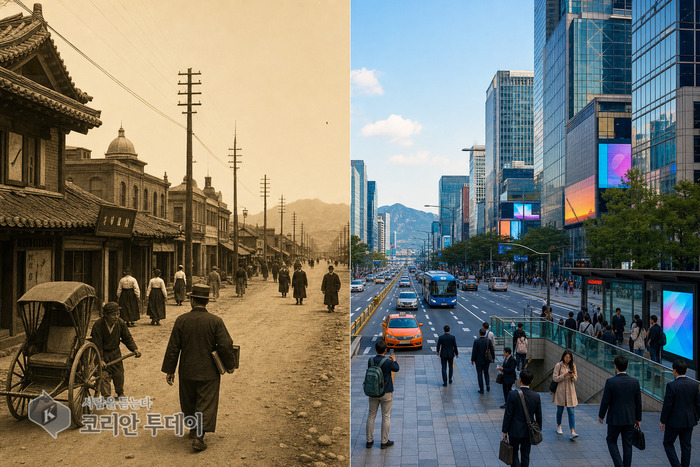
A hundred years on, South Korea’s population census is conducted largely through administrative registries and online self-reporting rather than door-to-door enumeration backed by police enforcement. Where the 1925 census served colonial administration, today’s census informs democratic policy planning. The number 19,522,945 — once tallied under threat of legal penalty — now stands as a historical baseline against which South Korea’s population of roughly 51 million, and its cultural export of K-pop, K-drama, and K-culture worldwide, can be measured. The counting continues; who it serves has changed.
Tomorrow, we return to Wednesday, October 7, 1925. Thank you for spending part of your evening with a century of history. Good night — and see you tomorrow at 10:10 PM KST.
THE KOREAN TODAY × WIA CODE
이 기사의 WIA Code

WIA Code 스캐너로 비추면 인터넷 없이 발행 사실과 위·변조 여부를 확인할 수 있습니다.
휴대폰 기본 카메라로 찍으면 스캐너 안내 페이지가 열립니다 — 기사 바로 열기

움직이는 코드는 스트림입니다 — WIA Code 스캐너로 약 58초 비추면 기사 전문(사진 포함)이 폰에 저장되어 인터넷 없이도 읽을 수 있습니다.
WIA Code · 코리안투데이






Leave a Reply