
Good evening. It’s 10:10 PM in Korea as we look back a century, to Sunday, October 11, 1925. Seoul kept the day quiet — church bells over Jeongdong and Jongno, hammering still rising from a stadium construction site, a press trial dragging on unresolved. Abroad, the day was anything but quiet: in Switzerland, diplomats edged toward a peace deal; in Shanghai, a warlord’s army seized a city; in Chicago, a federal agent was shot dead in the line of duty. All of it verified from the historical record.
Korea Under Colonial Rule
By this Sunday, the Chosun Ilbo’s press trial was still unresolved. Two months earlier, the paper had published an editorial on Korea’s relations with Russia; the Government-General judged it seditious, suspended the paper, and seized a rotary printing press bought only a month before. Editorial writer Shin Il-yong faced charges under the Peace Preservation Law, while the paper’s editor and printer were charged separately under the Newspaper Law. As mid-October approached, neither case had reached a verdict.
The city was also still nursing wounds from that July’s catastrophic flooding, which had displaced more than 40,000 people in the Seoul area alone. The Joseon Flood Disaster Relief Association kept collecting donations through Korean newspapers and youth groups, but with winter closing in, full recovery remained far off.
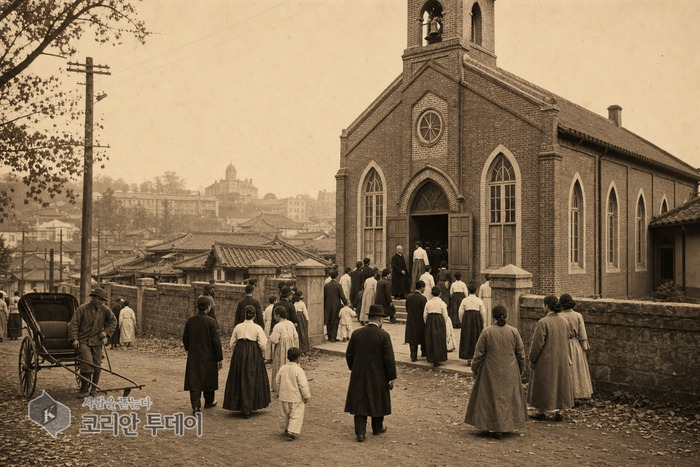
Yet Sunday in Seoul had another, quieter story. Korea’s Protestant churches were growing fast: Presbyterians alone counted roughly 2,165 congregations and about 182,650 members, with Methodists adding another 1,036 churches and 57,434 members — several times the numbers recorded a decade earlier. Historians trace the surge partly to the 1919 March First independence movement, after which Christianity, once seen as a purely Western import, came to be viewed by many Koreans as a faith that stood alongside the nation’s suffering rather than apart from it.
East Asia in Turmoil
Across the Yalu River in Manchuria, Korean independence groups were preparing for a major reorganization. A new coalition, Sinminbu, was set to hold its founding assembly in just three days, on October 14, with the guerrilla commander Kim Jwa-jin expected to take charge of its military department. The gathering carried real risk: since June, the Mitsuya Agreement between the Government-General and Manchurian warlord authorities had tightened cross-border crackdowns on Korean independence fighters, obligating Chinese officials to hand captured activists over to Japanese consular police. On opposite banks of the same river, Koreans were living through very different kinds of Sundays.
The World Stage
In Locarno, Switzerland, the conference that had opened October 5 was entering its final stretch. French, British, and German foreign ministers — Aristide Briand, Austen Chamberlain, and Gustav Stresemann — were reported to have moved close to agreement on the terms of Germany’s military status and its path into the League of Nations, groundwork for the Locarno Treaties to be finalized five days later, on October 16.
Far to the east, the guns had not gone quiet. Warlord Sun Chuanfang, having launched his uprising against the Fengtian clique, pushed his forces into Shanghai and Songjiang, driving deeper into the Jiangnan region in what would become known as the Anti-Fengtian War. And in Chicago, Special Agent Edwin C. Shanahan of the Bureau of Investigation was shot and killed while trying to arrest a car thief — the first agent of the future FBI to die in the line of duty.
Colonial Parallels
Korea’s Sunday of quiet churches and unresolved trials had counterparts across the colonized world that autumn. In British India, the colonial administration continued to govern under the Raj, censoring nationalist papers much as Seoul’s press had just been silenced. In Ireland — nominally independent since 1922 but still contesting its border with the north — a Boundary Commission was working through 1925 toward a settlement that would leave the original 1921 line largely unchanged, disappointing nationalists on both sides. And in French-administered Morocco, the Rif War against Spanish and French forces was grinding into its final year. Each conflict had its own shape, but a common pattern ran through them: a press restrained, a border imposed, an armed movement pushed to the margins by treaties struck between more powerful nations.
Person of the Day
Kim Jwa-jin was not yet a household name outside independence movement circles, but by this Sunday his next chapter was already being written. A veteran guerrilla commander who had led Korean forces to a major victory over Japanese troops at the Battle of Cheongsanri in 1920, he had spent the years since rebuilding scattered military units in Manchuria. In three days, on October 14, he would be named head of the military department of the newly formed Sinminbu — a coalition attempting to combine armed resistance with civil self-government for the Korean community in northern Manchuria. His appointment came at a precarious moment: the Mitsuya Agreement had just made Chinese territory far more dangerous for Korean fighters, forcing commanders like Kim to organize under greater risk than at any point since the crackdowns following the 1920 Hunchun Incident.
Understanding Daily Life
On the old Hullyeonwon grounds between Gwanghuimun and Dongdaemun gates, construction crews kept working even on a Sunday, racing toward the October 15 opening of Gyeongseong Stadium. Elsewhere in the city, the day followed a gentler rhythm: worshippers filled the pews of churches around Jeongdong and Jongno from early morning, and afternoons were given over to youth fellowship meetings and Bible study rather than commerce or labor. As dusk fell, readers gathered outside the Jongno bookshops waiting for the next day’s suspended-but-anticipated news, and lamps came on one by one in café windows along the street — an ordinary late-autumn Sunday evening, even as extraordinary events unfolded an ocean and a continent away.
Century Mirror
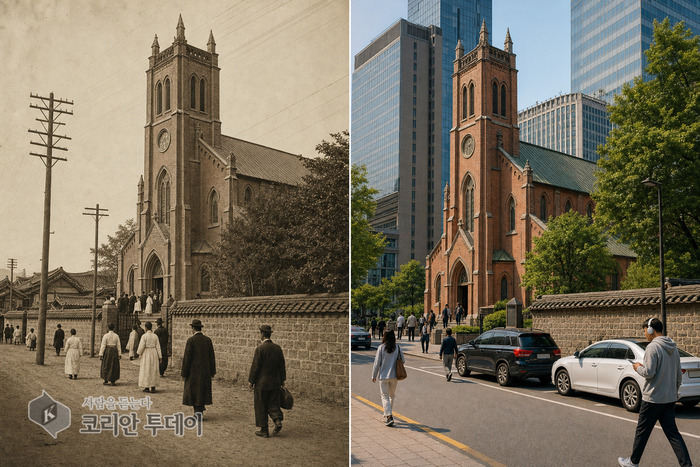
A hundred years separate roughly 240,000 Korean Protestants from today’s estimated eight million; a Korea watching Locarno’s diplomacy from outside the room from a Korea that now sits as a full member of the UN and G20; a Shanghai under warlord bombardment from a global financial capital, and a Seoul on trial for its press from a Seoul whose constitution guarantees it. The distance between 1925 and 2025 is not just the calendar — it is the difference between a nation narrated by others and a nation narrating itself.
Tomorrow — Monday, October 12, 1925 — we follow a single day through one person’s life. Good night from a century ago.
THE KOREAN TODAY × WIA CODE
이 기사의 WIA Code

WIA Code 스캐너로 비추면 인터넷 없이 발행 사실과 위·변조 여부를 확인할 수 있습니다.
휴대폰 기본 카메라로 찍으면 스캐너 안내 페이지가 열립니다 — 기사 바로 열기

움직이는 코드는 스트림입니다 — WIA Code 스캐너로 약 57초 비추면 기사 전문(사진 포함)이 폰에 저장되어 인터넷 없이도 읽을 수 있습니다.
WIA Code · 코리안투데이






Leave a Reply