
100 Years Ago Today
An Evening in 1925
Friday, October 9, 1925. Autumn light lingered over Gyeongseong, colonial Korea’s capital, as census takers finished their rounds on the ninth day of the country’s first modern population count. A preliminary tally, released just days earlier, had turned up something quietly striking: among 19,522,945 people, women were outnumbered by men by more than half a million. Tonight, as the census wound down, we look at what that gap meant — and what it hid.
Korea Under Colonial Rule
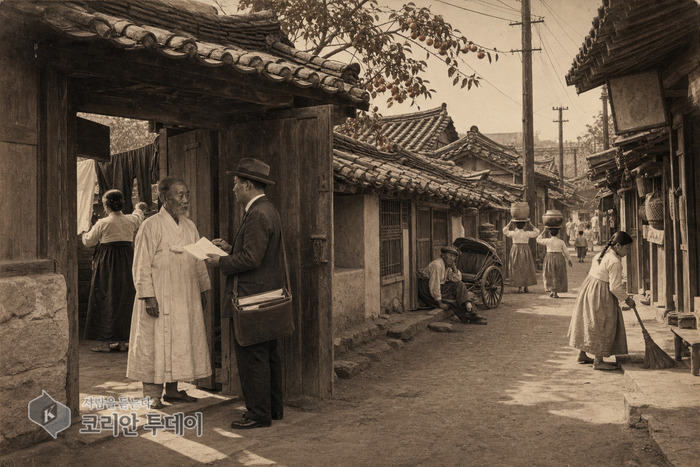
Korea’s first modern census, the “simplified national census” (간이국세조사), had originally been scheduled for 1920 but was postponed five years — a delay historians trace to the upheaval following the March First Independence Movement of 1919. Taken at midnight on October 1, 1925, it asked only five questions: name, sex, year and month of birth, marital status, and place of registration and nationality. The preliminary count showed 10,020,943 men and 9,502,002 women — a gap of 518,941, or roughly 105 men for every 100 women. Newspapers in the days surrounding October 9 reported the tally still being finalized region by region. The exact wording of that day’s front pages could not be confirmed and is not reproduced here. What is documented is the method: enumerators, usually low-level colonial officials or police, visited each household and recorded answers typically given by the male head of household. A woman’s name might appear on the form. Her voice rarely did. Colonial-era sources offer no clear explanation for the gap itself, though high maternal and infant mortality, and the structural likelihood that women went undercounted, were common themes of the period.
East Asia in Turmoil
The census wave reached beyond the capital. Just the day before, dockworkers in Wonsan had raised the flag of a newly formed labor association. Meanwhile the scars of the catastrophic Eulchuk flood of the previous summer — which had killed 647 people and displaced tens of thousands along the Han River — were far from healed; reconstruction of the Yongsan embankment and relief funded by the Korean Flood Relief Society were still underway. Across the border in Jiandao (Kando), Manchuria, tension was building: the Japanese military was preparing a large-scale “punitive” operation against Korean settlers, set to begin around Yongjeong and Guozijie in just six days, on October 15.
The World Stage
In Switzerland, delegates from Germany, France, Britain, Belgium, and Italy were in their fifth day of talks at Locarno over the security of Western Europe’s borders — negotiations led by German Chancellor Hans Luther and Foreign Minister Gustav Stresemann and French Foreign Minister Aristide Briand, which would run until October 16 and culminate in the Locarno Treaties. In Italy, prosecutors that day formally requested the indictment of Amerigo Dumini and several accomplices for the 1924 kidnapping and murder of socialist deputy Giacomo Matteotti — a case that, come the following spring, would end in light sentences and amnesty, exposing how thoroughly Mussolini’s fascist state had captured the judiciary. In Shanghai, the strike wave that followed the May Thirtieth Incident was finally subsiding, as workers drifted back to the mills.
Colonial Parallels
Korea’s undercounted women were not unique to 1925 colonial rule. Census and administrative records across empires of the era routinely rendered colonized women invisible, filtered through male household heads. In British India, women’s suffrage campaigns were only beginning to gain provincial footholds in the 1920s. In Ireland, newly independent since 1922, women who had marched for the Republic found themselves quickly pushed back toward domestic roles under the new state’s constitution. The pattern recurs across the colonial and post-colonial world of the 1920s: women’s labor and presence were essential to the household and the nation, yet their names, when recorded at all, were recorded through someone else.
Person of the Day: Na Hye-sok
Across the Yalu River in Andong (present-day Dandong), the painter and writer Na Hye-sok — Korea’s first prominent feminist artist — was, in the fall of 1925, running a night school for Korean women that she had founded in 1922, using her position as the wife of Korea’s vice-consul, Kim Woo-yeong. That spring, her short story “Grudge” had appeared in a literary magazine; she continued to paint architectural and landscape scenes of Manchuria. Two years later she would set off on a world tour that took her to Paris to study under the Fauvist painter Roger Bissière. In 1925, however, she was teaching literacy to women who, like the census itself, the colonial record too often left unnamed.
Understanding Daily Life
For most Korean women in 1925, the day had little room for painting studios or night schools. Mornings began at the well, hauling water before cooking breakfast; afternoons were filled with piecework sewing or peddling to supplement household income; and at dusk, some sought quiet at a church or temple. Meanwhile, groups like the “Women’s Observation Tours,” organized twice yearly by the Chosun Ilbo newspaper since 1924, offered a small number of women rare glimpses of the world beyond their households — evidence that a narrow but real space for women’s public life was opening, even as the census form still asked for “marital status” rather than a name that stood on its own.
Century Mirror
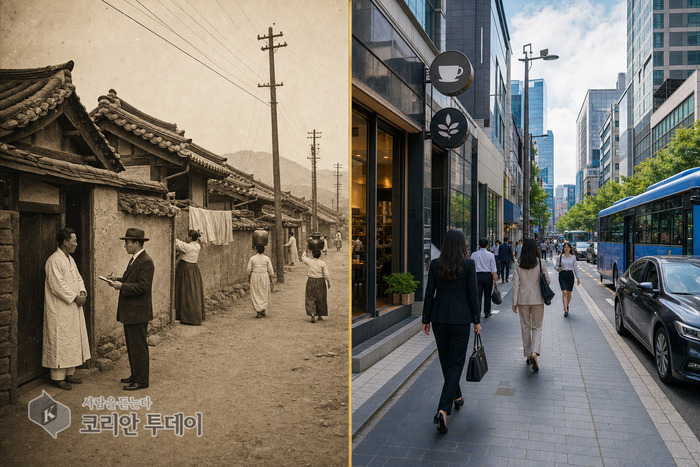
A hundred years later, South Korea’s population and housing census asks dozens of questions, not five, and any adult in a household can answer for themselves. The patriarchal head-of-household system (호주제) that once made men the default respondents was abolished in 2008. The population’s sex ratio, once skewed roughly 105 men to 100 women, sits close to balance today.
| Category | 1925 | 2025 |
|---|---|---|
| Census questions | 5 | Dozens |
| Sex ratio (men per 100 women) | ~105 | Near balance |
| Household representative | Usually male head | Head-of-household system abolished (2008) |
| Women’s voice in records | Rarely recorded directly | Individually recorded |
Tomorrow’s Preview
The official census results were still pending, and Locarno’s negotiators had a week left at the table. Tomorrow, October 10, 1925, whose story will the record keep — and whose will it lose? Join us tomorrow evening at 10:10 PM KST.
THE KOREAN TODAY × WIA CODE
이 기사의 WIA Code

WIA Code 스캐너로 비추면 인터넷 없이 발행 사실과 위·변조 여부를 확인할 수 있습니다.
휴대폰 기본 카메라로 찍으면 스캐너 안내 페이지가 열립니다 — 기사 바로 열기

움직이는 코드는 스트림입니다 — WIA Code 스캐너로 약 57초 비추면 기사 전문(사진 포함)이 폰에 저장되어 인터넷 없이도 읽을 수 있습니다.
WIA Code · 코리안투데이






Leave a Reply