
Hook Opening
Good evening, and welcome to 100 Years Ago Today. As you wind down your day, step back with us to a Tuesday a century ago — August 3, 1926. In Seoul, late-summer heat lingered over a courthouse district that had not gone quiet since June. On the other side of the world, gunfire echoed through a church in Mexico. And in London, a strange new machine began telling traffic when to stop.
Korea Under Colonial Rule
Two months earlier, on June 10, the funeral day of the deposed Emperor Sunjong, a coalition of the Korean Peasant-Labor Federation, the Korean Student Science Research Society, and the older wing of Cheondoism had planned a second nationwide uprising. Colonial police uncovered the plot just before it launched. Kwon O-seol and 176 others tied to the Korean Communist Party’s “Tuesday faction” were taken into custody, in what history would later call the “Second Korean Communist Party Incident.” That summer, the pretrial investigation ground on inside the Seoul District Court — a process that would not conclude until the following spring. No single front-page article from this exact date has been verified in the archives searched for this piece, but the season itself is well documented: the Government-General’s police bureau leaned hard on the Newspaper Law and the Peace Preservation ordinances, censoring pages and occasionally hauling editors before the same courts.
East Asia in Turmoil
In China, Chiang Kai-shek’s Northern Expedition was in full motion, having launched in July to unify the country under the Nationalist government. That August, Chiang reportedly offered warlord Sun Chuanfang a chance to defect to the National Revolutionary Army — an offer Sun refused. The armies of Wu Peifu and Sun Chuanfang were losing ground steadily, a slide that would carry Nationalist forces into Shandong and Henan by the following spring.
The World Stage
In Guadalajara, Mexico, roughly 400 armed Catholics barricaded themselves inside the Church of Our Lady of Guadalupe after the Calles government forced the closure of churches nationwide under new anticlerical law. The standoff with federal troops turned into a gun battle: 18 people killed, 40 wounded — the opening violence of what became known as the Cristero War. In London, at 11:25 that morning, the first automatic traffic signal in the world switched on at Piccadilly Circus, working alongside the traffic police rather than replacing them. On the island of Bali, Mount Batur erupted and buried the village of Karang Anyar, though residents had evacuated in time. In Italy, Mussolini’s government banned all unauthorized parades and public demonstrations.
Colonial Parallels
Korea’s censorship regime in 1926 was not unique. Under British rule, India lived under its own web of press ordinances and sedition laws that criminalized much of the nationalist press. In the American-administered Philippines, the 1916 Jones Law had promised eventual independence “as soon as a stable government can be established,” while in practice keeping real political authority in colonial hands. Across three continents, the same pattern held: colonial administrations tolerated print and protest only up to the point where it threatened their grip.
Person of the Day
Kwon O-seol, a labor organizer in his early thirties, had helped design the plan to turn Sunjong’s funeral procession into a second March First Movement. Arrested days before the funeral, he spent that summer of 1926 under interrogation in Seoul. The pretrial investigation into his case would not close until March 1927; he would eventually be sentenced to five years in prison, and die there in 1930 from the effects of torture. On this August evening, he was one name among 176 — a case still being built, a verdict still years away.
Understanding Daily Life
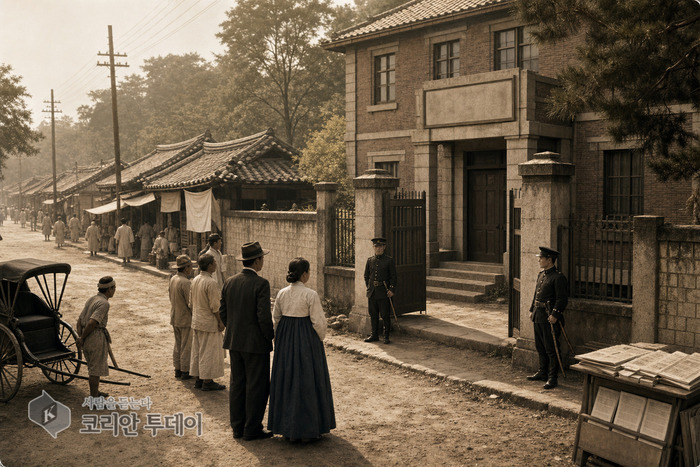
On a Tuesday like this one, the streets around the Seoul District Court saw more foot traffic than usual — lawyers, family members, spectators leaving the courtroom trading news in lowered voices. By midday, students browsed newly arrived magazines in the Jongno bookshops. In the cafés of Bonjeong, phonograph records played for anyone who could afford the ticket. As the heat broke toward evening, lines formed outside the theaters, and workers heading home filled the streets in small, unhurried groups — ordinary life carrying on inside a city stretched taut between law and order.
Century Mirror
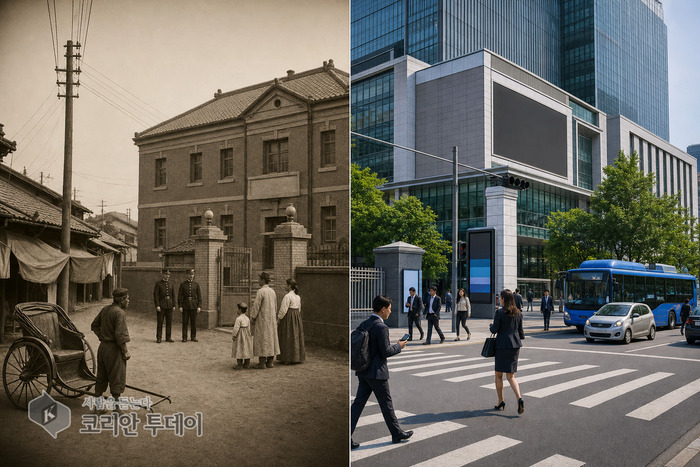
A hundred years on, the courthouse district looks nothing like it did. In 1926, the Peace Preservation Law and the Newspaper Law gave the state near-total power over what could be printed or organized; today, those freedoms are constitutional rights. The phonograph café, once a rare luxury, has given way to a world where any song, anywhere, plays instantly from a device in your pocket. Korea’s evolution from colonial subject to constitutional democracy is not a straight line — but this Tuesday in 1926 marks one of its harder, quieter chapters.
Tomorrow’s Preview
Tomorrow, August 4, brings a palace coup in Abu Dhabi and a hero’s welcome in Rome for an Arctic explorer. The heat in Seoul, and the foot traffic outside its courthouse, will carry on too. Join us again tomorrow evening at 10:10.






Leave a Reply