
100 Years Ago Today
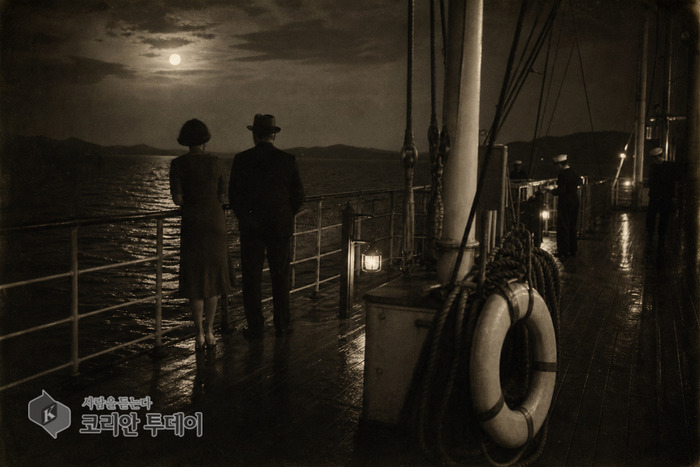
It is 10:10 PM in Korea, and somewhere between Busan and Shimonoseki, a search boat is still crossing dark water. Good evening, and welcome to 100 Years Ago Today. Tonight we return to August 17, 1926, a Tuesday, fourteen days since a soprano and a playwright vanished from the deck of a night ferry crossing the Genkai Strait — and fourteen days since anyone has found so much as a trace of them.
By this point in August 1926, colonial Korea had already lived through a spring funeral that turned into a student uprising, and a summer flood that drowned villages along the Daedong River. Now an ordinary overnight ferry crossing had become the biggest mystery in the Korean-language press — front page, day after day, with no ending in sight.
Tonight’s story is not really about a crime. No one was ever charged. There was no trial, no confession, no verdict. It is a story about how a colonized public, denied so much control over its own political life, poured its attention into two private lives it could never quite explain. As always: verified facts only, clearly sourced, and an honest “unconfirmed” wherever the record runs out.
Korea Under Colonial Rule
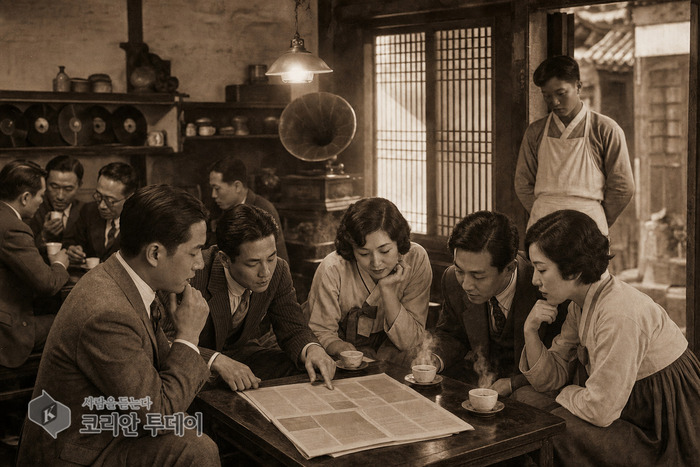
On the morning of August 17, 1926, Gyeongseong’s Korean-language dailies — the Dong-A Ilbo and the Chosun Ilbo among them — again ran the Genkai Strait story on their front pages, now well into its second week. The basic facts, first reported on August 5, had not changed: shortly after 11 PM on August 3, the Busan–Shimonoseki ferry Tokushu-maru left Japan bound for Korea. Around four the following morning, as it passed near Tsushima Island, a woman in Western dress and a middle-aged man were seen embracing on deck before they went over the side together. The crew stopped the ship and searched immediately. They found nothing.
The passenger manifest listed the pair under false names — a man calling himself Kim Su-san, age 30, and a woman calling herself Yun Su-seon, also 30. Within days, papers had identified them: Yun Sim-deok, Korea’s first professionally trained soprano, and Kim Woo-jin, a Waseda-educated playwright from a wealthy merchant family in Mokpo. By August 15, this paper’s own coverage was already calling it “the twelfth day of the Genkai Strait mystery — the ripple effect of a love-suicide without bodies.” Two days later, the joint search run by Busan’s maritime police and their Shimonoseki counterparts had produced nothing further. No bodies, no confirmed sighting, no note.
What kept the story burning was less the disappearance itself than the unanswered question behind it. Newspapers had settled on the word jeongsa — a double love-suicide — casting the pair as lovers driven to the sea because Kim was already married. But people close to both families pushed back hard, insisting there had been no romantic relationship at all. Whether it was a suicide pact, a staged disappearance, an accident, or something else, remained — as of August 17 — genuinely unresolved.
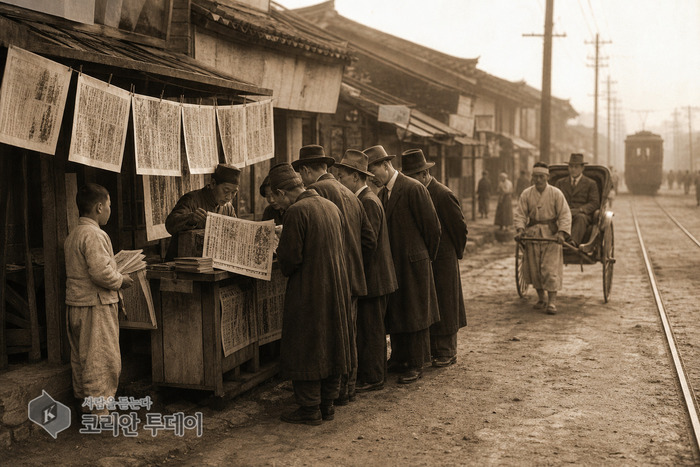
Coverage differed sharply along the fault line of empire. Japanese-language papers in Korea treated the story mostly as a curiosity. Korean-language papers gave it sustained, almost obsessive attention — a private tragedy turned into a shared, safely apolitical drama that censors had no particular reason to suppress.
Gyeongseong had other news that day. The Sidae Ilbo, one of the capital’s Korean-language dailies, had finally stopped publishing that August after months of financial trouble. Founded in 1924 by the writer Choe Nam-seon, the paper had once claimed a circulation above 20,000. Its silence left one fewer Korean-language voice on the newsstands — a loss that mattered more, in the long run, than most of that week’s headlines.
East Asia in Turmoil
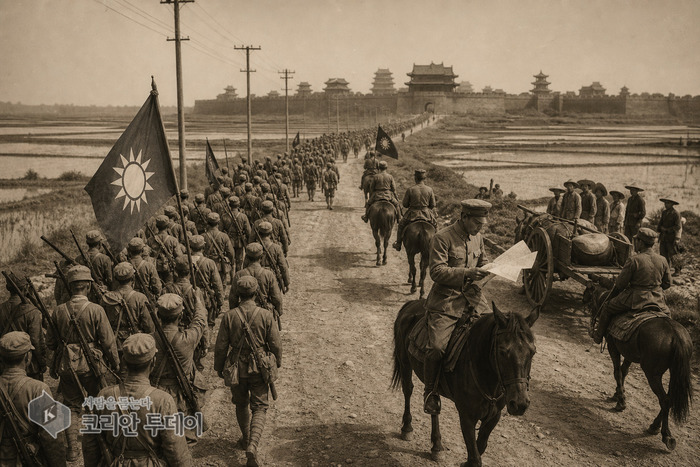
Nearly two thousand kilometers southwest of the Genkai Strait, China was in the middle of a war reshaping the region. In July 1926, the Nationalist government in Guangzhou had launched the Northern Expedition, sending the National Revolutionary Army — commanded by a rising general named Chiang Kai-shek — north to break the power of China’s regional warlords. Changsha fell on July 11. By mid-August, the army was pushing further into Hubei province, toward the fortified triple city of Wuchang, Hankou, and Hanyang, in fighting that would continue into October.
The general being driven back through Hubei, Wu Peifu, had for years been one of China’s most powerful warlords, and his faltering grip on the region was being watched closely by Japanese military planners with interests in Manchuria and North China.
For Koreans in exile — in Shanghai’s French Concession, where the Provisional Government kept its offices, and across Manchuria — the Northern Expedition was not a distant news item. A China unified under one government, rather than fragmented among warlords, could mean new room to maneuver against Japanese rule. In Tokyo, political circles were reportedly still absorbed by a scandal involving a prison photograph — the kind of story that could rattle a cabinet without touching the colonies directly, but that Korean readers followed all the same.
The World Stage
Across the Pacific, President Calvin Coolidge was spending the summer away from Washington, at White Pine Camp in the Adirondack Mountains of upstate New York. On August 17, 1926, he held one of his regular press conferences there, briefing reporters on correspondence between Washington and Mexico City over Mexico’s land laws. Coolidge told the press that Mexico had made substantial concessions toward American demands — a notable moment in a long dispute over how Mexico’s constitution treated foreign-owned land and mineral rights.
It was a small, procedural item by the standards of 1926. But it was also a reminder of a pattern colonial Korea knew intimately from the other end: a larger power negotiating over the land and resources of a smaller neighbor. Earlier that year, a U.S. federal appeals court had also upheld strict new visa requirements for foreign visitors entering the United States, part of a broader tightening of 1920s immigration law reshaping who could move where, under what conditions.
Colonial Parallels
Colonial Korea in 1926 was not alone in the particular kind of public hunger that the Genkai Strait mystery fed. Across the British and American colonial world of the 1920s, private scandals involving well-known cultural figures, consumed obsessively by publics with limited outlets for open political expression, played a comparable role.
In British-ruled India, Bengali and Hindi-language newspapers poured extraordinary attention into the private lives of poets and reformers, in a press environment constrained by sedition laws that made direct political criticism dangerous. Ireland, only a few years past its own war of independence by 1926, offers a related parallel: a newly divided press in which stories of personal tragedy sometimes served as rare common ground. In the American-administered Philippines, papers covered the private lives of performers with an intensity administrators found puzzling, given how little coverage the same papers gave to the ongoing debate over Philippine independence.
What connects Gyeongseong in 1926 to Calcutta, Dublin, and Manila is not that colonized readers cared less about their own political future — the June 1926 funeral of Emperor Sunjong and the student protests it triggered prove otherwise. It is that under colonial rule, the line between what could safely be discussed and what could not ran through everyday life, and this story sat, deliberately or not, on the safe side of it.
There was also a harder, practical parallel. Colonial-era newspapers across these territories were chronically underfunded, dependent on circulation in ways that made a sustained human-interest story commercially indispensable — a dynamic Gyeongseong’s own papers knew well, having just watched a competitor, the Sidae Ilbo, close for lack of money that same week.
Person of the Day
Yun Sim-deok was, by August 1926, already one of the most famous women in colonial Korea. Born in Pyongyang in 1897, she trained as a vocalist in Tokyo before becoming widely credited as Korea’s first professionally trained soprano. In 1925, she signed a recording contract with the Nitto Chikuonki company in Osaka, and by 1926 had recorded two dozen songs for the label.
Her fame was unusual for a Korean woman of her era: public, commercial, built on a Western art form still associated with modernity and, to some conservative critics, scandal in its own right. That visibility is part of why her disappearance became such an inescapable story — she was not an anonymous passenger, but arguably the most recognizable female performer in the country.
What is documented is that Nitto Chikuonki had a recording of hers scheduled for commercial release on August 29, 1926 — less than two weeks after this article’s date — a song later known by a title translating roughly as In Praise of Death. Whether the company altered its plans in light of her disappearance, this paper cannot confirm from the sources available as of August 17. What is certain: on this day, the woman Korean readers had followed as a singer for over a year was, for the fourteenth straight day, being discussed instead as the subject of an unsolved disappearance.
Understanding Daily Life
For readers not following the ferry story, mid-August 1926 meant the tail end of a long, humid Korean summer — though this paper cannot confirm the specific weather of that Tuesday from the sources available, and will not invent details it cannot verify.
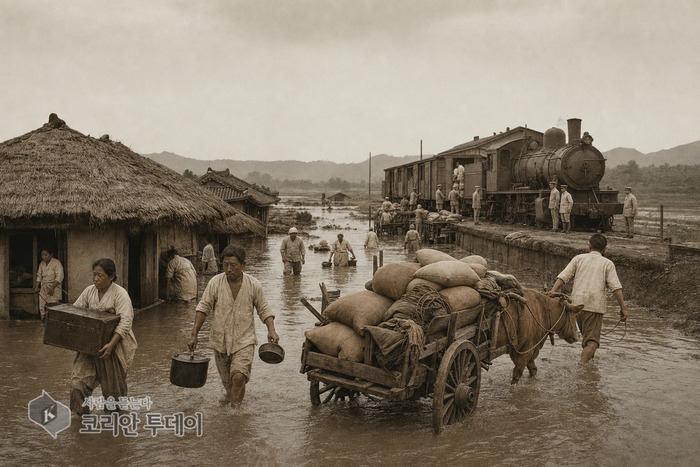
What is well documented is the state of the wider peninsula that August. Heavy rain earlier in the month, tied to a low-pressure system connected to storms over the Yangtze basin, had sent the Daedong, Cheongcheon, and Amnok rivers over their banks across the Gwanseo region. Villages flooded; relief grain and clothing moved north by rail to Pyongyang and Sinuiju throughout the month, and displaced families had not yet returned to permanent housing.
In Busan, the ferry route at the center of the mystery remained in ordinary operation even as the search continued along its path. Passengers on subsequent night crossings were, by some accounts, more subdued on deck than usual, though this paper found no verified ridership figures. In print culture, the closure of the Sidae Ilbo left one fewer Korean-language outlet on newsstands. Bookstores in the Jongno district, meanwhile, reportedly saw increased interest in Yun Sim-deok’s recordings.
Rice prices that August sat within a decade-long downward trend driven by the colonial government’s Rice Production Increase Plan, then entering its second phase, though this paper cannot confirm the specific market price on August 17 itself. Daily life for most Koreans that Tuesday continued along the same lines it had for weeks, even as the front pages stayed fixed on a mystery none of them could solve.
Century Mirror
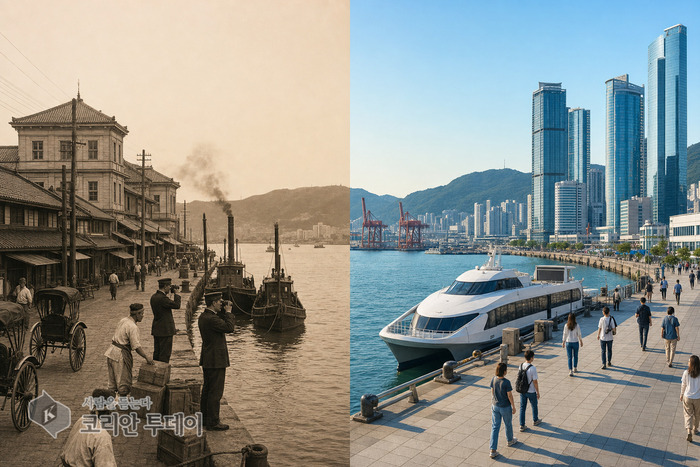
A hundred years later, the tools for solving a mystery like this have changed almost beyond recognition. In 1926, a search meant a boat, a spotlight, and the human eye scanning dark water. Today, a comparable disappearance would draw satellite tracking, radar sweeps, and underwater drones.
| Category | 1926 | 2026 |
|---|---|---|
| Search for the missing | Boats, human eyesight | Satellites, radar, underwater drones |
| Newspaper survival | Instant closure without funding | Online channels enable survival |
| Recorded music | Physical discs, limited pressing | Instant streaming, unlimited access |
Yun Sim-deok’s twenty-four recordings existed, in 1926, only as physical discs that had to be pressed, shipped, and purchased one at a time. Today, the same voice, if it survives in any archive, could in principle be streamed instantly, anywhere. What has not changed, a century on, is the underlying appetite: a public drawn to an unresolved human story precisely because so much of the news around it — imperial politics, foreign wars, colonial administration — remained entirely outside its control.
Tomorrow’s Preview
That is where we leave things on the evening of August 17, 1926: a ferry route still open, a search still coming up empty, and a newspaper industry that lost one voice this month while another stayed locked on the same unanswered question. Tomorrow, Gyeongseong’s morning papers will almost certainly return to the same story — day fifteen of a mystery that, as far as the verified record shows, was never conclusively solved.
THE KOREAN TODAY × WIA CODE
이 기사의 WIA Code

WIA Code 스캐너로 비추면 인터넷 없이 발행 사실과 위·변조 여부를 확인할 수 있습니다.
휴대폰 기본 카메라로 찍으면 스캐너 안내 페이지가 열립니다 — 기사 바로 열기

움직이는 코드는 스트림입니다 — WIA Code 스캐너로 약 138초 비추면 기사 전문(사진 포함)이 폰에 저장되어 인터넷 없이도 읽을 수 있습니다.
WIA Code · 코리안투데이






Leave a Reply