
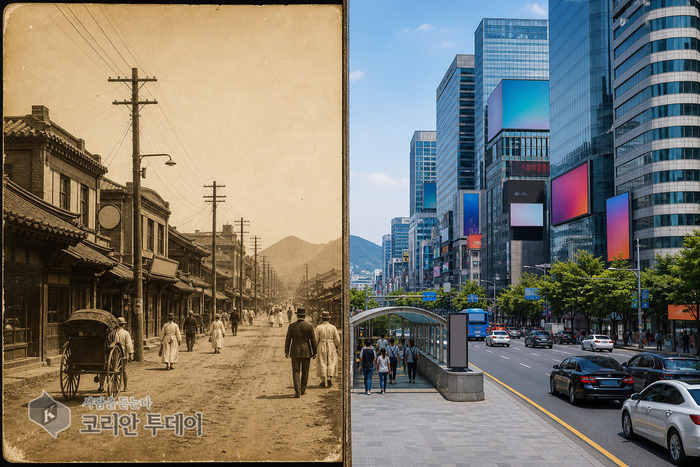
It was Sunday, August 22, 1926, in Gyeongseong — the colonial-era name for Seoul. The late-summer heat still clung to the streets, one day shy of Cheoseo, the solar term marking the retreat of summer. The city felt unremarkable, quiet in its Sunday rhythm. But tucked into a corner of the morning’s Dong-a Ilbo, on the front page, a few short lines were about to upend two men’s lives. The column was called “Hoengseol-suseol” — literally, “rambling talk” — and that Sunday, it was anything but idle chatter.
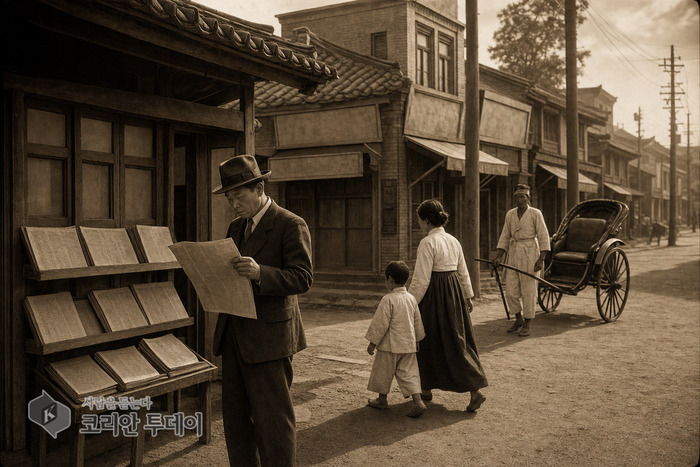
Korea Under Colonial Rule
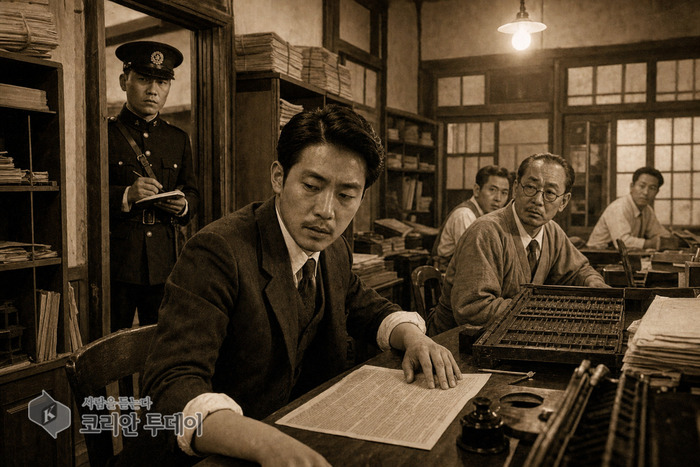
The “Hoengseol-suseol” column that ran in the Dong-a Ilbo on August 22, 1926, was barely a paragraph long. But its author, reporter Choi Won-soon, packed into it a pointed attack on the Japanese Government-General’s so-called “cultural policy” (bunka seiji) — the softer administrative posture Japan had adopted in Korea after the brutal crackdown on the 1919 March First Movement. Choi’s column noted, plainly, that this “culture” still meant arresting communists, muzzling newspapers, and banning public assembly. Beneath a friendlier name, he argued, the substance of military rule had not changed at all.
The authorities did not let it pass. Choi Won-soon was charged with violating the Peace Preservation Law (Boan-beop); the paper’s editor and publisher, Kim Cheol-jung, was charged separately under the Newspaper Law for allowing it to run. Choi was no stranger to colonial courts — as a student in Tokyo, he had taken part in the February 8th Declaration of Independence in 1919 and had been arrested then, too. Now, seven years later, a single newspaper column had put him back in the dock. At a hearing scheduled for September 8 at the Gyeongseong District Court, prosecutors were expected to seek an eight-month prison term for Choi and six months for Kim. (Historical record shows Choi was ultimately sentenced to six months on October 4, reduced to three on appeal in December, and finally acquitted by the High Court the following February — a small, hard-won victory that took a year and a half to arrive.)
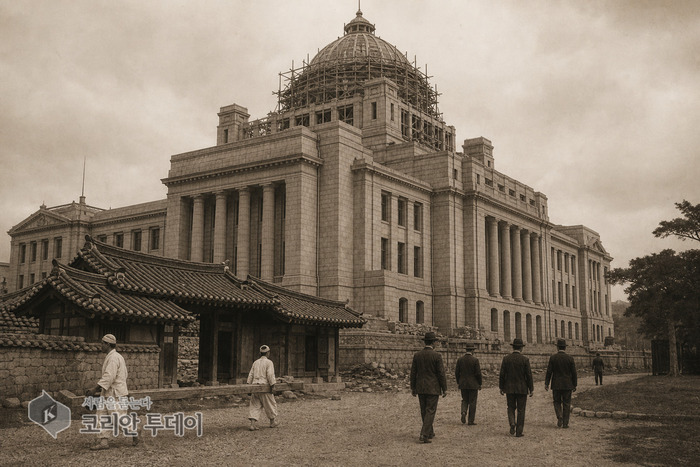
East Asia in Turmoil
Choi’s ordeal was not an isolated incident — it was the routine texture of press life under colonial rule. The Newspaper Law and the Peace Preservation Law hung over every Korean editorial desk; both the Dong-a Ilbo and the Chosun Ilbo had already weathered repeated confiscations and suspensions since their founding. Meanwhile, inside Gyeongbokgung Palace, the imposing new Government-General building — construction of which had required tearing down the palace’s Heungnyemun Gate a decade earlier — had begun operating that January and was gearing up for a grand completion ceremony barely five weeks away, on October 1. The contrast was not lost on contemporaries: as Korean voices were being silenced column by column, the colonial administration was preparing to celebrate its own monument to power.
Just across the sea, Japan’s own governance was quietly destabilizing. Emperor Taisho, who had suffered from severe mental and physical illness for years, remained gravely unwell through the summer of 1926 — a brief recovery that spring had lasted only days before he relapsed — leaving his son, the Crown Prince Regent Hirohito, to continue overseeing affairs of state. He would die that December.
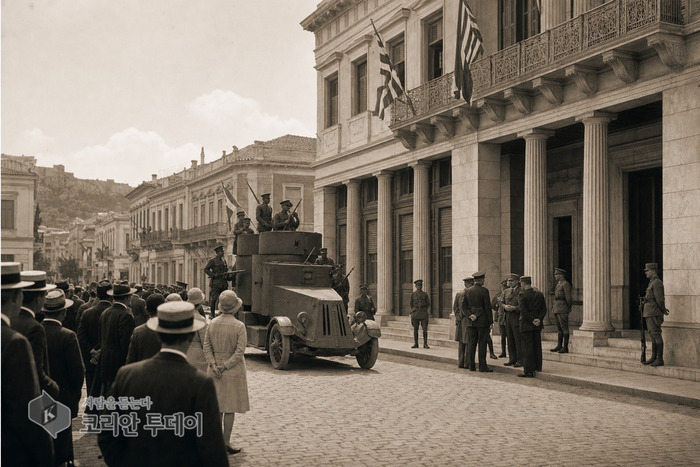
The World Stage
Far to the west, Greece saw a bloodless coup that same day: General Georgios Kondylis moved against dictator Theodoros Pangalos, ending his roughly fourteen-month rule and reinstating Admiral Pavlos Kountouriotis as president, with elections promised for November. In China, Chiang Kai-shek’s National Revolutionary Army seized the Yangtze River port city of Yueyang on August 22 as part of the Northern Expedition, bringing all of Hunan province under Nationalist control — a campaign whose outcome would matter enormously to Koreans in exile across Manchuria and Shanghai. And in New York, silent-film idol Rudolph Valentino lay critically ill at Polyclinic Hospital, his temperature spiking past 103 degrees as pleurisy set in atop a ruptured ulcer and peritonitis. He would die the very next day, sending Hollywood — and much of the world — into mourning.
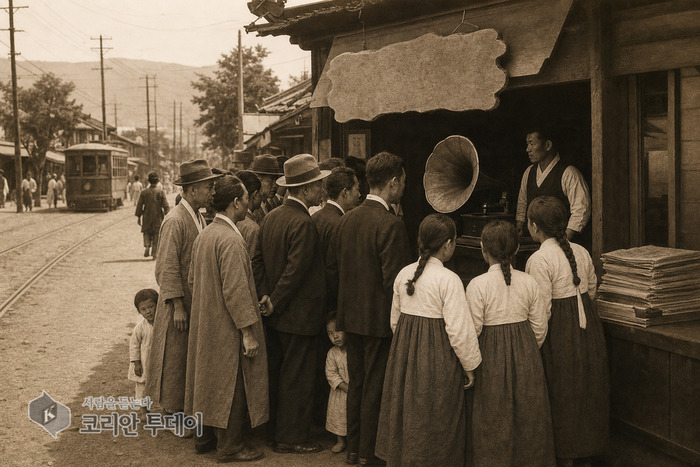
Colonial Parallels
Korea’s press censorship in 1926 sat within a much wider pattern of colonial control across the globe. In British India that same year, riots and unrest had already been tallied at 76 incidents nationwide by late August, as colonial authorities struggled to contain rising nationalist agitation. In the Philippines, American Governor-General Leonard Wood was locked in an increasingly bitter standoff with Senate President Manuel Quezon, accused by Filipino leaders of authoritarian overreach and rolling back the self-governance his predecessor had extended — grievances serious enough that President Coolidge dispatched an investigative commission to Manila that same year. And in the Irish Free State, only four years removed from civil war, a preliminary census report published that August was already being used by republican critics to expose the young government’s failures. From Seoul to Manila to Dublin, the 1920s were a decade in which the same question kept resurfacing in different languages: who gets to speak, and who gets punished for it.
Person of the Day: Choi Won-soon
Choi Won-soon was not a career firebrand — he was, by most accounts, a working journalist who kept returning to the same fight. Born in the Gwangju region, he had studied in Tokyo, where in February 1919 he joined fellow Korean students in issuing the February 8th Declaration of Independence, an act that led to his arrest and helped ignite the nationwide March First Movement weeks later. By 1926 he had settled into newspaper work at the Dong-a Ilbo, eventually rising to head its political desk and later serve as acting editor-in-chief. His August 22 column was, in that sense, entirely consistent with a life spent testing the limits of what colonial censors would tolerate — a quiet, persistent form of resistance carried out one printed paragraph at a time.
Understanding Daily Life
For most residents of Gyeongseong, that Sunday looked ordinary. Churchgoers filled pews along the streets near Jongno in the morning; by afternoon, crowds gathered outside gramophone shops to listen to the latest popular songs drifting from the speakers. The tabloid sensation of the summer — the double suicide of soprano Yun Sim-deok and playwright Kim Woo-jin, who had leapt together from a ferry into the Korea Strait weeks earlier — was still very much alive in gossip, so much so that a rumor had begun circulating that the pair were secretly alive and running a small shop in Rome. Meanwhile, students from four private schools — Baejae, Chungang, Whimoon, and Kyungshin — were in the middle of a month-long inter-school baseball league, a small, stubborn pocket of normal life carrying on beside the headlines.
Century Mirror
A hundred years later, the idea that a newspaper column could land its writer and editor in a colonial courtroom feels almost unimaginable — which is exactly the point. The freedoms taken for granted today, to criticize a government in print without fear of the Peace Preservation Law, were purchased in installments by people like Choi Won-soon, one confiscated issue and one prison sentence at a time. It is a lineage that runs, in an unbroken if winding line, to the open, argumentative, occasionally reckless media culture — K-dramas that openly critique authority, pop stars who speak on politics, a press that investigates presidents — that defines South Korea today.
| Category | 1926 | 2025 |
|---|---|---|
| Press Freedom | Pre-censorship under Peace Preservation & Newspaper Laws | Constitutionally guaranteed free press |
| Consequence of Dissent | Prosecution, imprisonment | Broadly protected as free expression |
| News Cycle | One morning edition per day | Real-time, global, instantaneous |
Tomorrow’s Preview
Tomorrow brings Cheoseo, the day the heat is meant to break. Choi Won-soon and Kim Cheol-jung still had a courtroom date waiting for them in September. As that long-ago summer edges toward its close, we’ll keep watching to see how one small column’s fate unfolds.
THE KOREAN TODAY × WIA CODE
이 기사의 WIA Code

WIA Code 스캐너로 비추면 인터넷 없이 발행 사실과 위·변조 여부를 확인할 수 있습니다.
휴대폰 기본 카메라로 찍으면 스캐너 안내 페이지가 열립니다 — 기사 바로 열기

움직이는 코드는 스트림입니다 — WIA Code 스캐너로 약 144초 비추면 기사 전문(사진 포함)이 폰에 저장되어 인터넷 없이도 읽을 수 있습니다.
WIA Code · 코리안투데이






Leave a Reply