
Evening Edition · Tuesday, August 24, 1926
As New York Rioted Over Valentino’s Coffin, Gyeongseong’s Theaters Trembled Over Censorship Fees
10:10 PM KST (1:10 PM UTC) – As you wind down your day, reflect on a century of history
Hook Opening
Good evening, and welcome back to “100 Years Ago Today.” It’s 10:10 PM here in Korea, one day past Cheoseo — the traditional marker for the end of summer’s worst heat — and Gyeongseong’s morning sky had risen noticeably higher than the day before. But relief from the weather did not mean relief from worry. Along Jongno, the street lined with the city’s Korean-run movie theaters, a new government fee schedule was souring the mood of an entire industry. Half a world away in New York, a very different kind of crowd was about to turn violent outside a funeral home. Two cities, two crowds, one Tuesday in August — and neither of them had anything to do with each other, except that both would end up in tomorrow’s newspapers.
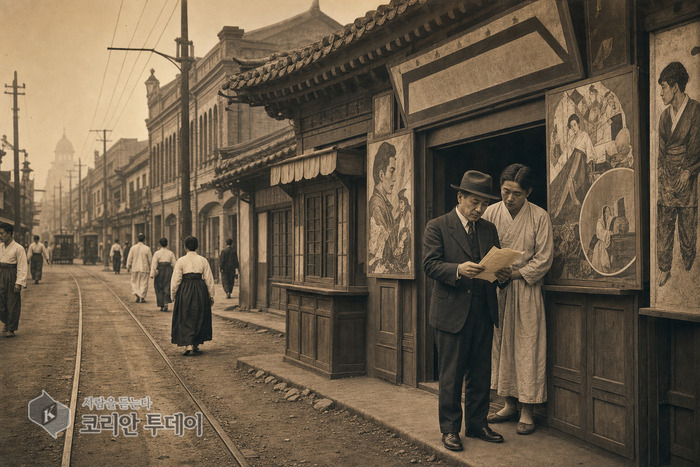
Korea Under Colonial Rule
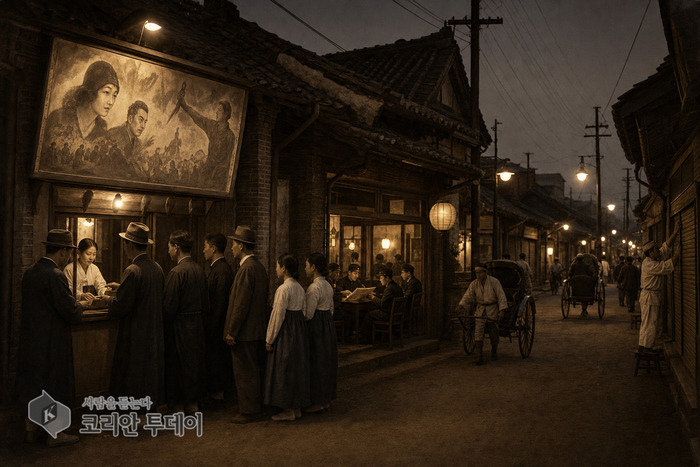
For the theater owners of Bukchon — Dansungsa, Chosun Theater, and Umigwan, the three houses that anchored Korean-run cinema in colonial Seoul — late August 1926 was not a season of relief. On August 1, the Government-General’s “Motion Picture Film Censorship Regulation” (Governor-General’s Ordinance No. 59, promulgated July 5) had gone into effect across the peninsula. Every reel screened in a public theater now had to pass a fresh colonial censorship review, and — this was the part that stung — theater operators and film distributors were billed a fee scaled to the length of each film print. Trade gossip circulating that week held that some smaller operators were openly wondering whether they could afford to keep their doors open. The burden landed hardest on the very theaters that had built their identity on screening Western films with live Korean-language narration by a byeonsa, the silent-film narrator whose voice, more than any actor’s face, was what audiences paid to hear.
A few blocks away, an entirely different crowd was gathering under the same August sun. The Dong-A Ilbo newspaper’s sponsored baseball league — a running series between four of Gyeongseong’s secondary schools, Baejae, Joongang, Hwimun, and Kyungsin, known informally as the “Four Clubs League” — was still in full swing through the summer heat. Students in uniform filled the field; onlookers filled the sidelines. In one city, on one Tuesday, a censorship ledger and a scoreboard were both being watched with equal anxiety.
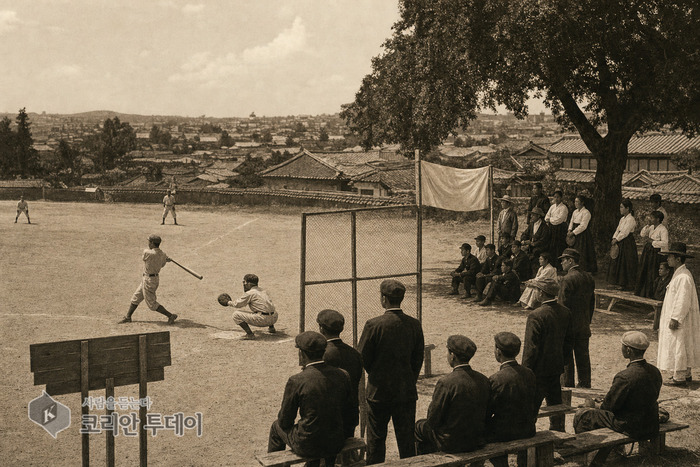
East Asia in Turmoil
The new censorship fee was not a Seoul problem alone — as a Governor-General’s ordinance, it applied uniformly to every licensed theater across the peninsula, and provincial exhibitors reportedly grumbled just as loudly as their counterparts in the capital. Meanwhile, across the Tumen River in Jiandao (간도), the slow migration of Korean farmers continued as it had for years. Dispossessed by the colonial land survey project back home, tens of thousands of Korean households had resettled across the border; by this period, Korean households in Jiandao numbered roughly 52,000 — outnumbering local Chinese households — and Koreans cultivated more than half of the farmland in the region. A theater ledger in Jongno and a rice paddy in Jiandao had little in common on the surface, but both sat under the long reach of the same colonial administration.
Two days earlier, on August 22, Chinese Nationalist forces under Chiang Kai-shek had captured the Yangtze River port of Yuezhou, bringing all of Hunan Province under Kuomintang control as part of the Northern Expedition that had begun in July. The revolutionary army was now regrouping for a push toward Wuchang and Hankou in neighboring Hubei — a campaign that Korean readers, many of them sympathetic to any force challenging entrenched warlord and imperial power in the region, followed with more than passing interest.
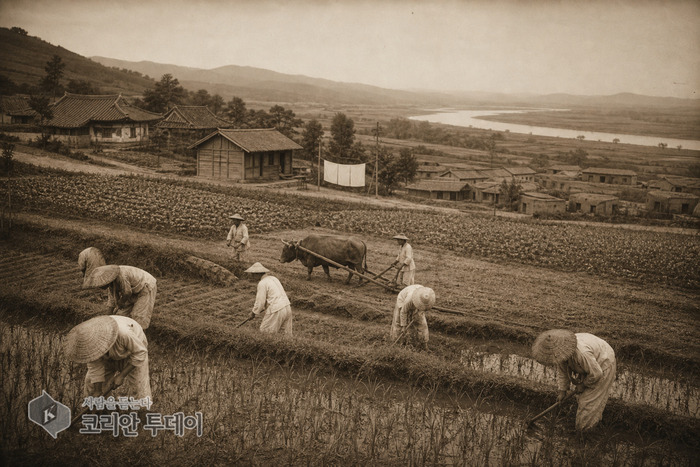
The World Stage
New York City spent this entire Tuesday in chaos. Silent-film idol Rudolph Valentino — “the Great Lover,” star of *The Sheik* and *Blood and Sand* — had died the previous afternoon at age 31, following complications from a ruptured ulcer and emergency surgery. When his body was laid out at the Frank E. Campbell funeral home on Broadway, tens of thousands of grieving fans converged on the block. What began as a line of mourners became a riot: shop windows shattered, more than a hundred mounted police officers were called in alongside police reserves, and reports circulated of despondent fans attempting suicide in the aftermath. It would rank among the most extraordinary displays of celebrity mourning New York had ever witnessed — a scale of public grief for a film star that newspaper editors on both sides of the Pacific found almost impossible to explain to their readers.
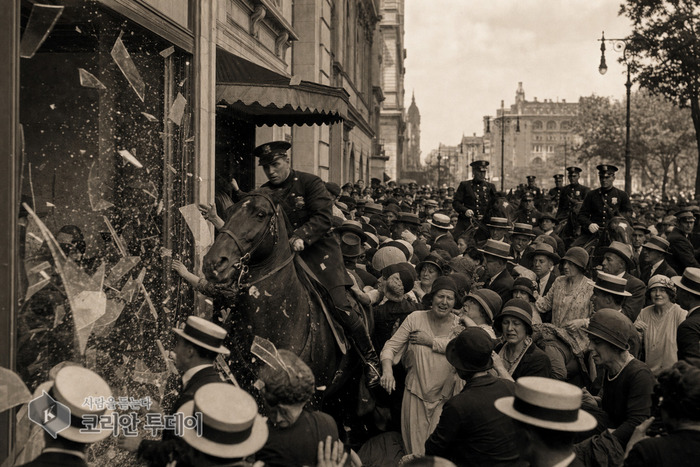
Colonial Parallels
Colonial film censorship was not a uniquely Korean invention of 1926 — it was, in fact, part of a global pattern that colonial administrations from London to Tokyo had been refining for years. British India had operated under the Cinematograph Act of 1918, which required every film to pass regional Boards of Film Censors before public exhibition, with certification fees that fell disproportionately on smaller, often Indian-owned exhibitors rather than the larger British distribution houses. Ireland, newly independent as the Irish Free State, had passed its own Censorship of Films Act in 1923, establishing an official censor with sweeping authority to cut or ban imported pictures — a law drafted, ironically, by a state that had just finished fighting for its own independence from the very empire whose administrative habits it was now copying. What set colonial Korea’s version apart was less the mechanism than the audience it targeted: a censorship fee scaled to film length hit hardest not the Hollywood studios shipping prints into Asia, but the small Korean-run houses on Jongno struggling to keep Western films — narrated live, in Korean, by a byeonsa — affordable for a colonized public that had few other windows onto the outside world.
Person of the Day
Today’s Person of the Day is, unusually for this series, not Korean: it is Rudolph Valentino himself, whose death this week rippled far beyond Hollywood. Born Rodolfo Guglielmi in Castellaneta, Italy, in 1895, Valentino emigrated to the United States as a young man and rose from dance-hall gigolo to the silent screen’s defining romantic idol, his performances in *The Four Horsemen of the Apocalypse*, *The Sheik*, and *Blood and Sand* making him arguably the first global male sex symbol of the film age. His sudden death from peritonitis at just 31 — following surgery for a ruptured ulcer and appendicitis — triggered a wave of public mourning so intense that historians still cite it as one of the earliest examples of mass celebrity grief in the modern media era, complete with reported fan suicides and the funeral-home riot described above. For Korean readers encountering the story secondhand through wire reports and newsreels, Valentino was proof that the new mass medium of cinema — the very medium the colonial government was busy taxing and censoring at home — had already made its stars more powerful, and more mourned, than most kings.
Understanding Daily Life
Picture a single Tuesday moving through colonial Gyeongseong. Before dawn, theater managers along Jongno were likely still hunched over fee calculations from the new censorship ordinance, trying to work out whether a given print’s length made it worth booking at all. By mid-morning, students and young writers filled the city’s tearooms and cafés, newspapers spread across the tables — the same papers carrying wire-service snippets about the chaos in New York. Through the afternoon, the Four Clubs League baseball games drew crowds who, for a few hours, seemed to forget everything else. As the light softened toward evening, shopkeepers along the main street began closing their shutters one by one, yet a line still formed outside the theater box office — proof that no censorship fee, however heavy, could fully dampen the appetite for an evening at the movies. Tucked into a small corner of that day’s newspaper, a brief item noted that interrogations and hearings continued, as they nearly always did, at the courts and police stations nearby — a quiet, constant hum beneath the more colorful stories of the day.
Century Mirror
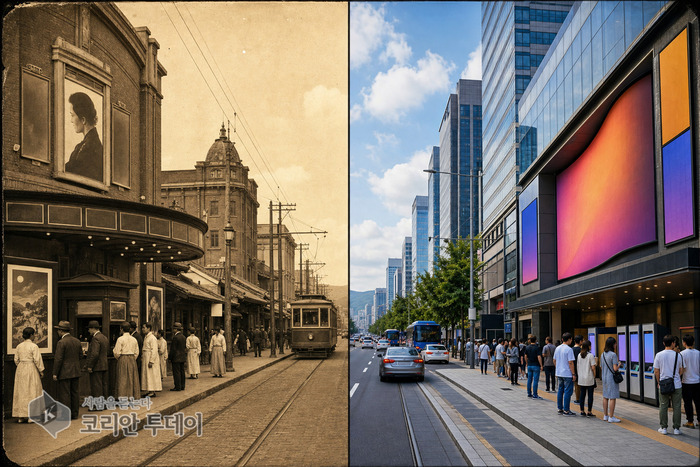
| Comparison | 1926 | 2026 |
|---|---|---|
| Film exhibition | Mandatory colonial censorship review plus a length-based fee | Rating classification by an independent media board; broad free expression protections |
| Theater-going | Silent films narrated live by a byeonsa | Multilingual subtitles, dubbing, and simultaneous streaming releases worldwide |
| Celebrity death and the public | News crossed the Pacific by cable, arriving days late | Real-time breaking news and instant global online mourning |
Set side by side, the panicked theater owner totaling his new censorship fee in 1926 and the grief-stricken New York fan smashing a funeral-home window that same week are not, in the end, so different — both were people whose relationship to a flickering screen had become something close to devotion. A century later the screens are everywhere and the gatekeepers are fewer, but the devotion, it turns out, needed no century to arrive. It was already there in August 1926, on both sides of the Pacific.
Tomorrow’s Preview
Tomorrow morning’s papers in Gyeongseong will carry a far sharper story: a single photograph taken inside a Tokyo prison cell, showing two political prisoners in an unexpectedly intimate pose, is about to become public for the first time — and the scandal it triggers will eventually reach all the way up to the judge who allowed it to be taken. That’s tomorrow, at 10:10. Good night.
THE KOREAN TODAY × WIA CODE
이 기사의 WIA Code

WIA Code 스캐너로 비추면 인터넷 없이 발행 사실과 위·변조 여부를 확인할 수 있습니다.
휴대폰 기본 카메라로 찍으면 스캐너 안내 페이지가 열립니다 — 기사 바로 열기

움직이는 코드는 스트림입니다 — WIA Code 스캐너로 약 152초 비추면 기사 전문(사진 포함)이 폰에 저장되어 인터넷 없이도 읽을 수 있습니다.
WIA Code · 코리안투데이






Leave a Reply