
Every rank insignia on a soldier’s shoulder, every color-coded badge on a hospital coat, has a distant ancestor in the dyed robes of a Korean royal court in 260 CE.
If Episode 1 showed King Onjo planting the seed of a kingdom on the banks of the Han River, this episode’s protagonist, King Goi (r. 234-286), is the ruler who grew that seed into a state with a skeleton and a working bureaucracy. Twenty-seven years into his reign, he did something radical for his time: he numbered his officials and made those numbers visible on their bodies, through the color of their robes.
Why clothing? Why not simply issue titles on paper? A ruler seventeen centuries ago understood something modern organizations still wrestle with: order that people can *see* is order they obey faster than order they merely hear about.
🌍 Western Historical Parallel
In the very same year King Goi color-coded his court, 260 CE, Rome was suffering one of the worst humiliations in its history: Emperor Valerian was captured alive by the Sasanian king Shapur I and died in captivity — a symbol of the chaotic “Crisis of the Third Century” that nearly tore the Roman Empire apart. While Rome fractured, a small kingdom on the Korean peninsula was quietly building bureaucratic order.
◆ The Ancient Landscape
The 3rd century CE was an age of upheaval across East Asia. After the fall of China’s Han dynasty, the Three Kingdoms — Wei, Shu, and Wu — fought for supremacy. To the north, Goguryeo’s King Dongcheon lost his capital, Hwando Fortress, to an invasion by the Wei general Guanqiu Jian around 244-246 CE. On the Korean peninsula’s southwest, the Mahan confederacy of some fifty small polities was losing cohesion as its leading state, Mokji-guk, declined — and Baekje was moving to fill the vacuum.
Roughly two centuries after King Onjo founded Baekje, the kingdom still resembled a loose tribal confederation more than a state. King Goi, who ascended as the 8th monarch in 234 CE and reigned an extraordinary 53 years until 286, chose consolidation over conquest. The turning point came in his 27th regnal year — 260 CE.
“In the spring of the 27th year, in the first month, the Naesin Jwapyeong was established to handle royal decrees; the Naedu Jwapyeong to oversee the treasury; the Naebeop Jwapyeong to manage rites… In the second month, an order was issued: officials of the sixth rank and above shall wear purple robes with silver flower ornaments on their caps; those of the eleventh rank and above, scarlet; those of the sixteenth rank and above, blue.”
◆ Same Era, Different Worlds
🏛️ China
The Three Kingdoms period (Wei, Shu, Wu) raged on; Sima Yan would found the Jin dynasty in 265 and reunify China by 280.
🗿 Roman Empire
260 CE: Emperor Valerian captured by Shapur I of Persia — the only Roman emperor ever taken prisoner by a foreign power.
⚔️ Northeast Asia
Goguryeo reeling from the loss of its capital to Wei forces; Japan transitioning from the Yayoi to Kofun period.
🕌 Sasanian Persia
Shapur I at the height of his power, having humbled three Roman emperors within a generation.
[Image: Baekje’s six-minister, sixteen-rank hierarchy and three-color dress code (260 CE)]
⚔️ Scene from That Day
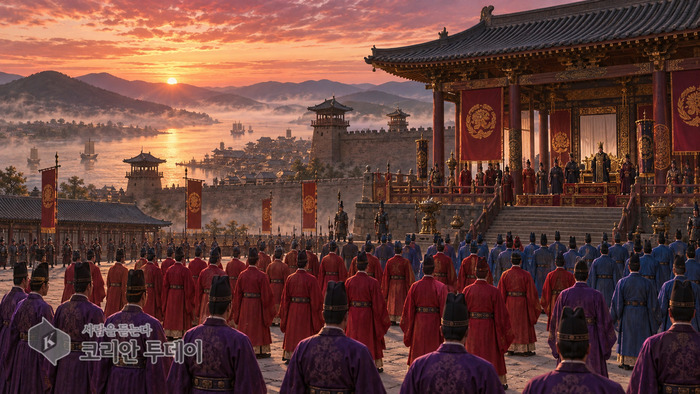
“Early spring, 260 CE, the courtyard of Wiryeseong Fortress on the Han River. Before the morning chill lifts, officials file into rows. In front stand six men in deep purple robes, silver flower ornaments glinting on their caps — the Jwapyeong. Behind them, mid-ranking officials in scarlet. Filling the widest space at the back, junior officials in pale blue.”
“King Goi ascends the throne and reads the decree aloud. The courtyard answers not with murmurs but with silence — men who had known each other only by face now know, at a glance, exactly whom to bow to.”
◆ Uncovering Historical Truth
The first-month decree of 260 CE had two parts. It created six ministers (Jwapyeong) — for royal decrees, treasury, rites, palace guard, criminal justice, and provincial military affairs — replacing the older, vaguer “Left and Right Advisor” system with a structured cabinet of specialized departments. Alongside this, sixteen official ranks were established, from Jwapyeong (rank 1) down to Geugu (rank 16), roughly comparable in spirit to how the later Roman tetrarchy or Byzantine court hierarchies formalized administrative rank.
The dress code issued the following month made that hierarchy instantly legible: officials of rank six and above wore purple with silver-flower headgear, rank eleven and above wore scarlet, and everyone down to rank sixteen wore blue. In a society without name badges or printed titles, color did the work of instantly sorting who outranked whom — a tool for concentrating royal authority and absorbing aristocratic power into a single chain of command, not unlike how Diocletian would later use elaborate court ceremony and dress to reinforce imperial authority in Rome.
Archaeology backs up the texts. Pungnap Fortress in Seoul, exposed by a catastrophic flood in 1925 and excavated from 1997 onward, reveals massive rammed-earth walls, palace-scale building foundations, and large storage facilities dating to around this period — evidence of a state with real administrative capacity, not merely a chronicler’s flourish. Still, scholars debate exactly when the sixteen-rank system reached the finished form described in the sources.
Period
Mid-to-late 3rd century (c. 260 CE)
Key Figure
King Goi (r. 234-286)
Key Event
Six-minister cabinet, 16 ranks, tri-color dress code
Legacy
Baekje’s rise over Mahan; foundation for King Geunchogo’s golden age
🔍 International Academic Perspectives
Korean/Asian Scholars
The mainstream view holds that King Goi began the process, but the fully-formed 16-rank system described in the Samguk Sagi was actually completed under King Seong (r. 523-554) in the Sabi period, and later chroniclers retroactively attributed it to Goi’s reign.
Alternative View
Citing the scale of 3rd-century construction at Pungnap Fortress, some scholars argue Goi’s reforms were already substantively real, with later reigns adding refinement rather than inventing the system wholesale.
📖 Key Terms Explained
- Baekje (百濟)
- Ancient Korean kingdom (18 BCE – 660 CE), one of the Three Kingdoms of Korea, centered on the Han River and later the southwest peninsula
- Jwapyeong (佐平)
- Baekje’s highest ministerial rank; six specialized ministers created in 260 CE, roughly analogous to a cabinet of secretaries
- Samguk Sagi (三國史記)
- 12th-century official history of Korea’s Three Kingdoms, the primary source for King Goi’s reforms
◆ Lessons for Today’s World
We still live in a world that makes hierarchy visible: the color bars on a firefighter’s uniform, a soldier’s insignia, the title printed on a business card, even the color of a hospital coat. King Goi’s 1,700-year-old instinct — that rank should be legible at a glance — never really left us; it just changed materials.
It’s telling that many organizations today are doing the opposite — flattening hierarchies, killing job titles, experimenting with “no-boss” structures. If Goi built a kingdom by making order visible, some modern institutions are testing what happens when they deliberately make it invisible again. The real question was never hierarchy itself, but what it’s used to protect: accountability, or just power.
| Aspect | Baekje Era | Modern Parallel |
|---|---|---|
| Governance | Left/Right Advisor system replaced by 6 ministers, 16 ranks | Presidential system; civil service grades 1-9 |
| Military/Diplomacy | Absorbing Mahan’s leadership; standoff with Lelang/Daifang commanderies | Joint Chiefs of Staff chain of command; multilateral diplomacy |
| Culture | Purple/scarlet/blue robes visualizing status | Civil-service insignia, corporate title badges and uniforms |
[Image: From Baekje’s official ranks to modern institutional hierarchy]
📚 Diving Deeper
- Pungnap Fortress in Seoul, first revealed by a catastrophic flood in 1925
- The 1997 halt of apartment construction at Pungnap after major Baekje-era finds — a case comparable to how Sutton Hoo reshaped understanding of early medieval England
- Rank and dress-code artifacts held at the Hanseong Baekje Museum and the Buyeo National Museum
The Voice of Living History
A state is never completed by territory alone. Who answers for what, and how visibly that answer is worn — King Goi’s question from 260 CE still hangs over every org chart we draw today.
“The colors have faded, but the instinct to make order visible still clothes us all.”
Previous Episode
Episode 1: King Onjo Founds a Kingdom on the Han River
Next Episode
Episode 3: King Geunchogo’s Golden Age – Birth of a Maritime Kingdom
The Korean Today “History Lives On” Series
The Baekje Chronicle (30 Episodes)
Bridging Ancient East Asia and the Modern World
© 2025 The Korean Today. All rights reserved.
This content is based on historical facts and presents balanced academic perspectives
for international readers.
THE KOREAN TODAY × WIA CODE
이 기사의 WIA Code

WIA Code 스캐너로 비추면 인터넷 없이 발행 사실과 위·변조 여부를 확인할 수 있습니다.
휴대폰 기본 카메라로 찍으면 스캐너 안내 페이지가 열립니다 — 기사 바로 열기
움직이는 코드(스트림) 한 장에 기사 전문(사진 포함)이 담겨 있습니다 — WIA Code 스캐너로 약 30초 비추면 폰에 저장되어 인터넷 없이도 읽을 수 있습니다. Stream.mp4 도 여기서 받습니다.
WIA Code · 코리안투데이


Leave a Reply