
Deep inside a shrine storehouse in Nara, Japan, a 74.9-centimeter iron sword has kept its silence for more than 1,600 years. Six branch-like blades extend from its sides, and 61 gold-inlaid characters on its surface still ignite fierce academic debate between Korea and Japan today.
This is the Seven-Branched Sword, or Chiljido – forged by the kingdom of Baekje and presented to the Wa polity of the Japanese archipelago. It is not merely a weapon; it is a handwritten original of 4th-century East Asian diplomacy. Much as a single line in a modern joint communique can shake an alliance, a single character on this blade once determined the hierarchy between two ancient states.
Did Baekje “bestow” this sword upon Wa as a superior power, or did it “present” the sword as tribute? Would you believe that the entire modern historical relationship between Korea and Japan has, at times, hinged on the answer to that single question?
🌍 Western Historical Parallel
When the Seven-Branched Sword was likely forged around 369 CE, the Roman Empire was being jointly ruled by Valentinian I and Valens, and Rome’s practice of granting insignia, robes, and honorary titles to allied Germanic chieftains to formalize hierarchy was at its height – a Western echo of exactly the kind of “diplomacy through objects” that the Seven-Branched Sword represents.
◆ The Ancient Landscape
In the late 4th century, King Geunchogo of Baekje (r. c. 346-375) was locked in a life-or-death struggle with the rival kingdom of Goguryeo to the north, while simultaneously extending Baekje’s reach over the Gaya confederacy and Mahan polities to the south. Around 369 CE, allied Baekje-Wa forces are recorded as having subdued a number of Gaya statelets before turning west to bring the Chimmidarye region to submission.
In 372, King Geunchogo dispatched an envoy to the Eastern Jin dynasty (Dong Jin) in southern China and received the investiture title “General Who Guards the East, Governor of Lelang” – formal recognition within the China-centered international order of the day. Historians believe it was in this same window, as Baekje wove Wa into its anti-Goguryeo diplomatic network, that the Seven-Branched Sword was crafted and sent across the sea.
“…Forged from steel folded a hundred times, this Seven-Branched Sword can repel all manner of enemy troops and is fit to be given to a vassal lord… Never before, since ancient times, has there been such a blade. The crown prince of Baekje, in reverence of a sacred design, had it made for the King of Wa, Ji – let it be handed down to later generations.”
◆ Same Era, Different Worlds
🏛️ China
The Eastern Jin dynasty held southern China while contending with the “Sixteen Kingdoms” in the north. Baekje’s envoy to Eastern Jin secured international legitimacy for its throne.
🗿 Roman Empire
Ruled jointly by Valentinian I and Valens, Rome faced growing pressure from Gothic tribes across the Danube – a geopolitical squeeze not unlike Baekje’s position between Goguryeo and the sea.
⚔️ Western Europe
Frankish and other Germanic peoples were still organized as tribal confederations, decades before their eventual kingdoms would emerge on former Roman soil.
🌏 Wa (Japan)
The Yamato polity was still consolidating power on the Japanese archipelago, eagerly absorbing advanced technology and prestige goods from the Korean peninsula.
[Image: Baekje at the center of a 4th-century East Asian diplomatic network – its anti-Goguryeo line and ties to Wa and Eastern Jin]
⚔️ Scene from That Day
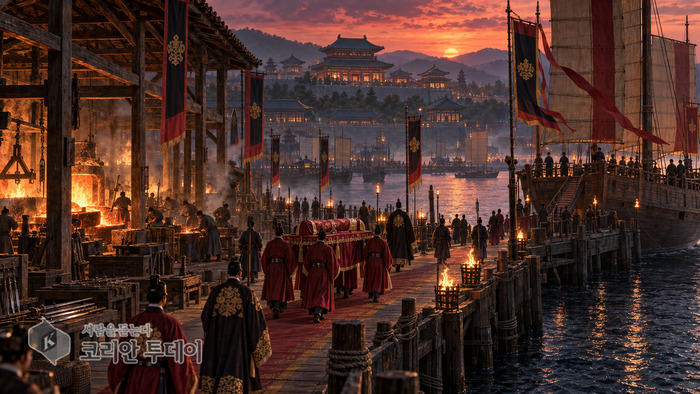
“Beside the royal forge, a lump of iron folded a hundred times over slowly sprouts six branching blades. The Baekje smith’s hand trembles as he inlays the final gold character – every stroke on this sword will decide the standing Baekje claims before the ruler of Wa, across the sea.”
“Wrapped in silk, the finished blade is carried by envoys across the West and South Seas toward Wa. Whether or not its recipient could read the unfamiliar inlaid script, he could not have missed the sheer weight – literal and political – of what Baekje had just placed in his hands.”
◆ Uncovering Historical Truth
Two questions dominate scholarly debate over the inscription. First is the reign-era name. If the two faded characters near the start are read as “Taihe” (Taiwa), they match the Eastern Jin era name for 369 CE, supporting a date under King Geunchogo. But if those same characters are instead read as “Bongwon,” a reign name unique to King Jeonji of Baekje, the sword’s creation shifts nearly four decades later, to around 408 CE.
Second is the dispute over “bestowal” versus “tribute.” Some Japanese scholars have read a key phrase in the inscription as evidence that Baekje “presented” the sword to Wa as tribute – used historically to support the now-discredited “Mimana Nihonfu” theory that Wa once controlled parts of the southern Korean peninsula. Korean scholars counter that the inscription’s own term for the Wa king, “vassal lord” (huwang), indicates the opposite: that Baekje placed Wa within its own investiture hierarchy.
In 2025, the Nara National Museum performed the sword’s first-ever X-ray CT scan, separating characters that had long overlapped between the front and back inscriptions – sharpening the “wa” in “Taiwa” and the “je” in “Baekje.” The scan has not settled the century-old dispute, but it has added fresh physical evidence to an argument that refuses to go quiet.
Period
Late 4th century (c. 369-408 CE, disputed)
Key Figures
King Geunchogo and the Baekje crown prince; King Ji of Wa
Artifact
Seven-Branched Sword, 74.9cm, 61 gold-inlaid characters
Significance
The single best physical proof of Baekje-Wa relations
🔍 International Academic Perspectives
Mainstream View
Reads the era name as “Taihe” (369 CE) and interprets the sword as a “bestowal” from Baekje, the diplomatically senior party, to Wa.
Alternative View
Historians such as Hong Sung-hwa argue the era name reads “Bongwon,” a name unique to King Jeonji, placing the sword’s manufacture around 408 CE and its delivery in 409. The debate remains open.
📖 Key Terms Explained
- Baekje (백제)
- One of Korea’s ancient Three Kingdoms (traditionally 18 BCE – 660 CE), centered on the southwest of the peninsula
- Wa (倭)
- The name used in Chinese and Korean records for the polities of the ancient Japanese archipelago, later consolidated under the Yamato court
- Eastern Jin (東晉)
- Chinese dynasty (317-420 CE) ruling from the south, roughly contemporary with the late Roman Empire in the West
- Mimana Nihonfu theory
- A discredited colonial-era Japanese theory claiming Wa once ruled parts of the southern Korean peninsula; the Chiljido inscription has been cited on both sides of this debate
◆ Lessons for Today’s World
The Seven-Branched Sword was an attempt to define a relationship between neighboring states not through military force but through a single, exquisitely crafted object – the ancestor of what we now call soft power. It resembles a modern state honor bestowed during a diplomatic visit, or a national treasure sent abroad on a prestige exhibition tour.
Consider the role Korean pop culture plays in today’s diplomacy, and the weight of a single 1,600-year-old sword no longer seems so distant. Yet the enduring dispute over how to read it is also a warning: turning a shared history of cultural exchange into a zero-sum hierarchy can leave embers of conflict burning for centuries.
| Aspect | Baekje Era | Modern Parallel |
|---|---|---|
| Geopolitics | Baekje builds an alliance with Wa to counter Goguryeo | South Korea’s trilateral security ties with the US and Japan |
| Diplomacy | Prestige objects used to mark hierarchy between states | State honors and gifts exchanged at summit visits |
| Culture | Transfer of advanced technology and learning to Wa | Global spread of Korean pop culture as soft power |
[Image: A 1,600-year lineage of cultural diplomacy from the Korean peninsula, from prestige objects to global pop culture]
📚 Diving Deeper
- In 2025, the Nara National Museum’s first X-ray CT scan of the sword revealed previously indistinct inscribed characters
- The sword is treated as a sacred treasure (shinpo) of Isonokami Shrine and is not on regular public display
- Designated a Japanese National Treasure in 1953; Korean scholars continue active research into alternative readings of its inscription
The Voice of Living History
That 61 characters inlaid on a single blade could still spark debate 1,600 years later proves that written words outlast even the weapons that carry them.
“The blade has not rusted, and the words inscribed upon it are still asking us questions today.”
Previous Episode
Episode 3: The Zenith of King Geunchogo – Birth of a Maritime Kingdom
Next Episode
Episode 5: The Fall of Hanseong – The Tragedy of 475
The Korean Today “History Lives On” Series
The Baekje Chronicle (30 Episodes)
Bridging Ancient East Asia and the Modern World
© 2025 The Korean Today. All rights reserved.
This content is based on historical facts and presents balanced academic perspectives
for international readers.
THE KOREAN TODAY × WIA CODE
이 기사의 WIA Code

WIA Code 스캐너로 비추면 인터넷 없이 발행 사실과 위·변조 여부를 확인할 수 있습니다.
휴대폰 기본 카메라로 찍으면 스캐너 안내 페이지가 열립니다 — 기사 바로 열기
움직이는 코드(스트림) 한 장에 기사 전문(사진 포함)이 담겨 있습니다 — WIA Code 스캐너로 약 31초 비추면 폰에 저장되어 인터넷 없이도 읽을 수 있습니다. Stream.mp4 도 여기서 받습니다.
WIA Code · 코리안투데이


Leave a Reply