
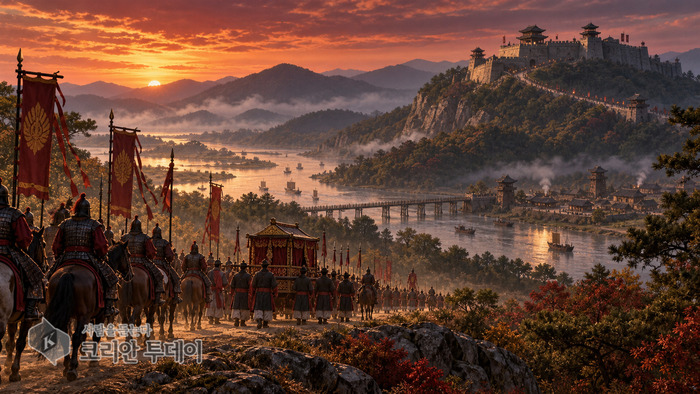
How long can a kingdom survive after losing its capital? In the winter of 475 CE, Baekje had to answer that question with its very survival on the line.
Days after King Gaero fell defending Hanseong and the capital burned to the ground, the Baekje court, escorted by 10,000 Silla reinforcements, retreated south to Ungjin – a small fortress town on the Geum River, in what is now Gongju, South Chungcheong Province. An entire state apparatus was transplanted overnight.
The recovery, however, was anything but smooth. The newly enthroned king was assassinated by his own official. A thirteen-year-old boy took the throne. Another assassination followed amid renewed power struggles. How does leadership rebuild itself when a state is shaken to its foundations? The first 26 turbulent years of Baekje’s Ungjin period offer a vivid case study.
🌍 Western Historical Parallel
In 476 CE – the very year after Baekje’s move to Ungjin – the Western Roman Empire formally ended when its last emperor, Romulus Augustulus, was deposed by the Germanic general Odoacer. Both civilizations faced the same question in the same decade: what remains of a state once its capital and central authority collapse?
◆ The Ancient Landscape
In the tenth lunar month of 475 CE, King Munju left the ruins of Hanseong behind and relocated the capital to Ungjin. The site was a natural fortress, ringed by mountains with the Geum River forming a defensive line – terrain that cavalry-heavy Goguryeo forces would find hard to exploit. But the narrow basin left little room for a capital to expand, and the royal court struggled to exert the same control over provincial lords it once held at Hanseong.
The year after the move, in 476, Munju appointed Haegu to the powerful military post of Byeonggwan Jwapyeong – but Haegu instead grew into a direct threat to the throne. In 477, Munju was assassinated by Haegu’s faction, and the thirteen-year-old King Samgeun succeeded him, only to die himself in 479. It was not until King Dongseong (r. 479-501) took the throne that Baekje finally began to find its footing.
“In the tenth month of winter, the capital was moved to Ungjin.”
◆ Same Era, Different Worlds
🏛️ China
The Liu Song dynasty gave way to the Southern Qi amid the chaos of the Northern and Southern Dynasties period. Baekje kept diplomatic ties with the southern courts to preserve international legitimacy.
🗿 Byzantine Empire
While the Western Roman Empire fell in 476, the Eastern Roman (Byzantine) Empire under Zeno endured in Constantinople – a striking parallel to how Baekje, though it lost its northern capital, survived in the south.
⚔️ Western Europe
Germanic kingdoms such as the Ostrogoths and Franks were carving up former Roman territory, forging new legitimacy from the ruins of empire – much as Baekje’s new nobility rose from the wreckage of Hanseong.
🌏 Japan (Wa)
The Wa court maintained close ties with Baekje throughout this period. A bronze mirror King Muryeong later sent to the Japanese royal house, preserved at Suda Hachiman Shrine, testifies to this bond.
[Image: The relocation route from Hanseong to Ungjin, 475 CE]
⚔️ Scene from That Day
“The procession moving south along the Geum River was no triumphant royal march. Munju had not even properly buried his father, King Gaero. Escorted by 10,000 Silla soldiers, he walked toward an unfamiliar mountain fortress he would now have to call home.”
“At the gates of Ungjin, officials bowed to greet their new king, but anxiety showed on every face. The treasury was empty, and the loyalty of local strongmen was untested. Standing atop the fortress wall, looking down at the river below, the new king repeated to himself: ‘We must begin again, from here.'”
◆ Uncovering Historical Truth
What Baekje experienced immediately after the move to Ungjin was not a simple change of address – it was a near-collapse of royal authority itself. The traditional aristocratic clans, such as the Jin and Hae families, who had underpinned the throne at Hanseong, lost much of their footing during the relocation, and rising factions moved to seize military power in the vacuum. That King Munju was assassinated by his own Byeonggwan Jwapyeong, Haegu, just three years into his reign – and that his successor, the boy-king Samgeun, died after only three years on the throne – reveals just how fragile the monarchy had become.
The turning point came under King Dongseong. He promoted newer aristocratic houses – the Sa, Yeon, and Baek clans – to unsettle the entrenched power structure, and in 493 sent envoys to Silla to secure the daughter of Ibeolchan Bi-ji as his queen, elevating the Silla-Baekje alliance from a military pact to a marriage alliance. It was a calculated move to institutionalize cooperation with Silla against mounting pressure from Goguryeo in the north. Large-scale construction traces uncovered at Gongsanseong (then Ungjinseong) show the court was also investing heavily in rebuilding its physical foundations during this period.
Yet even Dongseong could not escape the era’s violence: in 501, while out hunting, he was attacked and killed by an assassin sent by Baekga, the very official he had appointed as Wisa Jwapyeong – proof that his push to consolidate royal power had not fully broken the resistance of entrenched strongmen. His successor, King Muryeong (r. 501-523), crushed Baekga’s rebellion early in his reign and finally established a stable base of rule, turning the Ungjin period from chaos toward revival.
Period
475-501 CE (Move to Ungjin – Muryeong’s accession)
Key Figures
King Munju, King Samgeun, King Dongseong
Key Events
Relocation, two royal assassinations, marriage alliance with Silla
Legacy
Laid the groundwork for King Muryeong’s revival
🔍 International Academic Perspectives
Korean/Asian Scholars
The mainstream view holds that the early Ungjin turmoil stemmed from a struggle for dominance between the old Hanseong aristocracy and local Ungjin-based powers, and that Dongseong’s promotion of new clans was a deliberate realignment to strengthen the throne.
Western Historians
Some scholars note that Baekje’s post-collapse recovery pattern – retreat, factional violence, then consolidation through alliance-building – closely mirrors post-Roman “successor state” formation in early medieval Western Europe.
📖 Key Terms Explained
- Ungjin (熊津)
- Baekje’s second capital (475-538 CE), located at present-day Gongju, South Korea.
- Byeonggwan Jwapyeong (兵官佐平)
- One of Baekje’s six highest ministerial posts, overseeing military affairs – roughly comparable to a Roman magister militum.
- Silla-Baekje Alliance (Naje Dongmaeng)
- A defensive pact between the kingdoms of Silla and Baekje against Goguryeo, later reinforced by royal marriage in 493 CE.
◆ Lessons for Today’s World
The move to Ungjin is a textbook case of post-crisis rebuilding. An organization that loses its home base needs two things to survive: physical stability at a temporary foothold, and a new structure of trust built on top of it. Over 26 years, Baekje lost two kings to assassination yet never let the state itself collapse. That was not luck – it came from co-opting provincial powers and building an external safety net through diplomacy, namely the marriage alliance with Silla.
For any modern organization or nation, resilience after disaster is measured less by how quickly things return to “normal” and more by how core relationships of trust are rebuilt while the crisis is still unfolding. Judged by that standard, Baekje’s 26 turbulent years at Ungjin, despite being full of failures, were anything but a story of failure.
| Aspect | Baekje’s Ungjin Era | Modern Parallel |
|---|---|---|
| Geopolitics | Hastily defending a makeshift stronghold after losing the capital | Relocating a disaster-response command center after war or catastrophe |
| Military | Securing a security backstop through marriage alliance with Silla | Spreading security risk through alliances and coalitions |
| Culture | A state structure that endured two royal assassinations | Crisis management and organizational resilience |
[Image: 26-year timeline of the Ungjin period – from crisis to revival]
📚 Diving Deeper
- UNESCO World Heritage site Gongsanseong Fortress – the physical remains of the Ungjin-era royal citadel
- The 503 CE bronze mirror (“mirror with figures”) at Suda Hachiman Shrine, Japan – a gift from King Muryeong to the Wa royal house
- The tomb of King Muryeong, discovered by accident in 1971 – the only unrobbed royal tomb of Baekje ever found, comparable in significance to England’s Sutton Hoo ship burial
The Voice of Living History
Even after losing its capital and two kings to assassination, Baekje did not vanish. Twenty-six years of rebuilding trust from the ruins made the coming revival possible.
“The mountain fortress of Ungjin never fell – only the people within it had to rise again.”
Previous Episode
Episode 5: The Fall of Hanseong – The Tragedy of 475 CE
Next Episode
Episode 7: King Muryeong – The Monarch of Revival
The Korean Today “History Lives On” Series
The Baekje Chronicle (30 Episodes)
Bridging Ancient East Asia and the Modern World
© 2025 The Korean Today. All rights reserved.
This content is based on historical facts and presents balanced academic perspectives
for international readers.
THE KOREAN TODAY × WIA CODE
이 기사의 WIA Code

WIA Code 스캐너로 비추면 인터넷 없이 발행 사실과 위·변조 여부를 확인할 수 있습니다.
휴대폰 기본 카메라로 찍으면 스캐너 안내 페이지가 열립니다 — 기사 바로 열기
움직이는 코드(스트림) 한 장에 기사 전문(사진 포함)이 담겨 있습니다 — WIA Code 스캐너로 약 30초 비추면 폰에 저장되어 인터넷 없이도 읽을 수 있습니다. Stream.mp4 도 여기서 받습니다.
WIA Code · 코리안투데이


Leave a Reply