
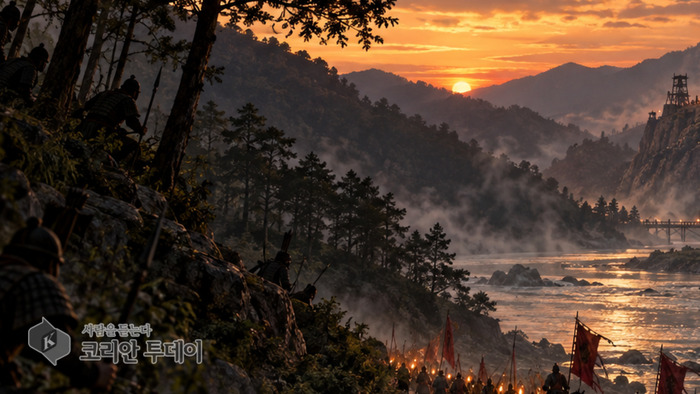
In the summer of 554, a king rode out at night with a few dozen guards to reach his son’s besieged army. He rode straight into an ambush laid by the ally he had trusted for a generation.
Since 433, the Korean kingdoms of Baekje and Silla had stood together against Goguryeo, the northern power. That alliance lasted roughly 120 years. In 553 Silla seized the lower Han River valley, the prize both kingdoms had just won together. The next year, King Seong of Baekje marched to take it back. He died at the Battle of Gwansanseong, and the alliance died with him.
Anyone who knows how Justinian’s “Eternal Peace” with Persia collapsed, or how the Hitler–Stalin pact ended, will recognise the pattern. What does a state owe an ally who has changed sides, and when does patience become a strategic error? Baekje answered with a battle, and lost a king.
🌍 Western Historical Parallel
In 554, Justinian’s general Narses was closing out the Gothic War in Italy, and the Eastern Roman Empire had seen its 532 “Eternal Peace” with Sasanian Persia broken by 540. A king dying on the battlefield had a Roman precedent as well: the emperor Valens fell at Adrianople in 378, a defeat that shook the empire’s confidence. King Seong’s death did the same to Baekje: a state built around a strong monarch suddenly lost its centre.
◆ The Ancient Landscape
The Korean peninsula in the mid-6th century was divided among three kingdoms: Goguryeo in the north, Baekje in the southwest and Silla in the southeast. Baekje lost its old capital Hanseong (near modern Seoul) to Goguryeo in 475 and retreated to Ungjin (Gongju). King Seong (r. 523–554) moved the court to Sabi (modern Buyeo) in 538, renamed the state “Southern Buyeo” and rebuilt royal power. His central ambition was to recover the Han River valley, the ancestral heartland and the gateway to the sea routes to China.
In 551, Baekje, Silla and Gaya allies drove Goguryeo out of the valley. Baekje took six commanderies downstream, Silla ten upstream. But in 552 Silla’s King Jinheung made peace with Goguryeo, and in 553 he seized Baekje’s downstream holdings and set up a new province, Sinju. Silla had even taken one of Seong’s daughters as a royal consort that same year to cement the alliance. Ally and rival had become the same state.
“The Baekje king Myeongnong, together with Garyang, attacked Gwansanseong… Kim Mu-ryeok, governor of Sinju, led the provincial troops into battle, and his deputy Godo of Samnyeonsan commandery struck swiftly and killed the Baekje king. All the troops pressed the advantage and won a great victory, beheading four ministers (jwapyeong) and 29,600 soldiers. Not a single horse returned.” (Silla’s account, condensed)
“The king planned to surprise Silla and personally led fifty infantry and cavalry, reaching Gucheon by night. Silla’s hidden troops rose up, and in the melee he was killed. He was given the posthumous title Seong (聖, ‘the Sage’).” (Baekje’s account, condensed)
◆ Same Era, Different Worlds
🏛️ China
The Northern and Southern Dynasties era. Northern Qi (550–577) and Northern Zhou (557–581) faced Liang and Chen in the south. In 554 Western Wei forces took Liang’s capital Jiangling. The Sui and Tang were still decades away. Each Korean kingdom courted a different Chinese court.
🗿 Byzantine Empire
Justinian (r. 527–565) was finishing the reconquest of Italy (Gothic War, 535–554) while Persia’s Khosrow I (r. 531–579) reopened the eastern front. Justinian’s Empire, like Baekje in 554, was stretched across two fronts.
⚔️ Western Europe
Merovingian Frankish kings ruled Gaul, and Frankish-Alemannic raiders were beaten in Italy around 554. In Britain, the Anglo-Saxon Chronicle records the battle of Beran Byrig in 556. Small warrior kingdoms were fighting over land, just like the Three Kingdoms.
🕌 Islamic World
Islam did not yet exist. Muhammad was born around 570, and the Caliphate’s conquests came in the 630s and after. Arabia sat between the Byzantine and Sasanian empires.
Image: Schematic of the Gwansanseong campaign (not to scale; based on the historical sources)
⚔️ Scene from That Day
“The fortress had been under pressure for months, and inside it was his son, Prince Chang. The king rode out to raise the army’s spirits. It was night. Horsemen and foot soldiers, about fifty in all, moved with torches lowered along the valley stream near Gucheon. Then the dark filled with shouting.”
“Silla’s ambush. The escort scattered and the king was taken. Japan’s Nihon Shoki records that King Seong said: ‘Every time I think of it, the pain reaches my very bones. I cannot live on in shame.’ Like Valens at Adrianople, he was a monarch who had staked everything on one day. What his son felt on the fortress wall, no source records.”
Note: this scene is a reconstruction built on the skeleton the Samguk Sagi and Nihon Shoki provide (night, Gucheon, a small escort, a Silla ambush).
◆ Uncovering Historical Truth
Gwansanseong lay in what is now Okcheon, North Chungcheong Province, a strategic point between Sabi and Silla’s rear. Seong gathered troops from Wa (Yamato Japan) and the Gaya confederacy and advanced with his son Chang. At first Baekje had the upper hand. Then Silla put the Sinju army from the newly won Han valley under Kim Mu-ryeok into the field, and the tide turned. Goguryeo, now Silla’s partner, meanwhile attacked Baekje’s Ungcheon fortress, leaving Baekje with a war on two fronts, much as Byzantium faced simultaneous Gothic and Persian wars.
The sources disagree on who killed the king. The Samguk Sagi names Godo, a deputy of Kim Mu-ryeok. The Nihon Shoki says a Silla stable slave named Godo (苦都). The Nihon Shoki also claims that Silla returned Seong’s body with honours but buried his head under the steps of a government hall, which, if true, was a deliberate political humiliation. Both sources are later compilations: the Nihon Shoki was completed in 720 and the Samguk Sagi in 1145. The archaeological record is less dramatic than the texts. Baekje’s mountain fortresses were much like the Roman limes forts: cheap to hold with few men, but useless without a field army to relieve them.
The consequences were immediate. The Samguk Sagi says four senior ministers and some 29,600 soldiers were killed. The number may be inflated, but Baekje’s leadership was clearly shattered. King Seong’s successor Wideok (Chang, r. 554–598) began his reign weak. Silla held the Han valley alone and, eight years later in 562, annexed the Gaya confederacy’s leader Dae Gaya. From then until Baekje fell in 660, about 106 years, the two never allied again. The “120 years” often quoted refers to the alliance itself (433–553), not the hostility that followed. In political terms, this was something like the Franks’ rise after they no longer needed Roman-era allies: the newly strong partner stopped sharing.
Wideok’s vengeance took the form of patience, ritual and diplomacy. In 567 he had a stone reliquary placed at the temple site at Neungsan-ri near his father’s tomb, inscribed with “King Chang, year 13”. In 577 he honoured a dead prince with the reliquary found at Wanghungsa. The reckoning with Silla passed to later kings. Baekje’s attack on Daeya Fortress in 642 was a later chapter. In 660, Silla, backed by Tang China, destroyed Baekje. Kim Yu-sin, who broke Baekje’s army at Hwangsanbeol, was the grandson of Kim Mu-ryeok, the victor of Gwansanseong.
Period
554 CE (Baekje King Seong year 32, Silla King Jinheung year 15)
Key Figures
King Seong, Prince Chang (Wideok), King Jinheung, Kim Mu-ryeok
Outcome
Seong killed; Silla’s account claims 29,600 Baekje dead
Legacy
Alliance ended; Silla controlled the Han valley
🔍 International Academic Perspectives
Korean/Asian Scholars
Most see Silla’s seizure of the lower Han in 553 as the trigger and the battle as a watershed for the Three Kingdoms, an international war involving Baekje, Silla, Goguryeo, Wa and Gaya. The date of Seong’s death is contested: July in the Samguk Sagi, 9 December in the Nihon Shoki.
Western Historians
English-language work, such as Jonathan Best’s study of Baekje’s early history and its translations of the Paekche records, stresses that most accounts come from Silla or Japanese sources written later, and that Baekje’s own narrative has largely been lost. Some suggest Seong’s campaign reflected tension with his own nobility, not only vengeance.
📖 Key Terms Explained
- Baekje (百濟, 백제)
- Ancient Korean kingdom (traditionally 18 BCE – 660 CE), one of the Three Kingdoms of Korea
- Na-Je Alliance (나제동맹)
- The Silla–Baekje military alliance against Goguryeo, formed in 433 and broken in 553–554
- Jwapyeong (좌평)
- Baekje’s highest-ranking ministers, comparable to senior counts or magnates at a Frankish court
- Samguk Sagi (삼국사기)
- “History of the Three Kingdoms,” compiled by Kim Busik in 1145, the oldest surviving Korean state history
- Nihon Shoki (日本書紀)
- Japan’s “Chronicles of Japan,” compiled in 720, which preserves many Baekje-related records
◆ Lessons for Today’s World
The Na-Je alliance was built on a shared threat, Goguryeo, not on shared ideals. When the threat receded and the spoils were divided, the partnership turned into competition. Silla recalculated its interests, and Baekje underestimated that it could. Compare that with NATO’s constant debate about burden-sharing, or Palmerston’s 1848 line that Britain has “no eternal allies and no perpetual enemies. Our interests are eternal and perpetual.”
The lesson is to trust allies but hedge. Keep a plan for the day the alliance fails, diversify diplomatic partners, and never let a single leader’s personal courage stand in for institutional strength. When a head of state is exposed at the front, the cost of a single mistake becomes the cost of the whole state.
| Aspect | Baekje Era | Modern Parallel |
|---|---|---|
| Geopolitics | Alliance broke over the division of the Han valley once Goguryeo receded | Alliances strain over burden-sharing when the common threat seems to fade; great-power rivalry (US–China–Russia) pulls partners in different directions |
| Military | Silla–Goguryeo rapprochement forced a two-front war on Baekje | Deterrence, multiple security partners and layered defences to avoid dependence on one ally |
| Culture | King Wideok used Buddhist temples and ritual to rebuild royal authority | Soft power such as K-Culture rebuilds national trust after crisis |
Image: Timeline of the Silla–Baekje alliance and the enmity after Gwansanseong (years drawn to scale)
📚 Diving Deeper
- Visit the Baekje Historic Areas (UNESCO World Heritage, 2015) in Buyeo, including the Neungsan-ri royal tombs, where a stone reliquary inscribed “King Chang, year 13” (567) and the famous gilt-bronze incense burner (found in 1993) were unearthed nearby.
- The Wanghungsa temple-site reliquary (excavated 2007) records that “King Chang of Baekje” founded the temple in 577 for a dead prince, Korea’s oldest known reliquary and an inscription as valuable to Korea as Sutton Hoo’s grave goods are to England.
- Further reading: Samguk Sagi, Silla Annals vol. 4 and Baekje Annals vol. 26; Nihon Shoki, Kinmei reign; Jonathan W. Best, “A History of the Early Korean Kingdom of Paekche.”
The Voice of Living History
King Seong retook the Han River, then lost it and his life to an ally’s recalculation. Gwansanseong teaches preparation more than revenge: cultivate alliances, but always chart the road for the day they end.
“The king fell on a mountain road, but the capital and temples he built at Sabi still remember that night.”
Previous Episode
Episode 9: King Seong’s Ambition – Moving the Capital to Sabi
Next Episode
Episode 11: The Smile of Baekje – The Seosan Maae Buddha Triad
The Korean Today “History Lives On” Series
The Baekje Chronicle (30 Episodes)
Bridging Ancient East Asia and the Modern World
© 2025 The Korean Today. All rights reserved.
This content is based on historical facts and presents balanced academic perspectives
for international readers.
THE KOREAN TODAY × WIA CODE
이 기사의 WIA Code

WIA Code 스캐너로 비추면 인터넷 없이 발행 사실과 위·변조 여부를 확인할 수 있습니다.
휴대폰 기본 카메라로 찍으면 스캐너 안내 페이지가 열립니다 — 기사 바로 열기
움직이는 코드(스트림) 한 장에 기사 전문(사진 포함)이 담겨 있습니다 — WIA Code 스캐너로 약 29초 비추면 폰에 저장되어 인터넷 없이도 읽을 수 있습니다. Stream.mp4 도 여기서 받습니다.
WIA Code · 코리안투데이


Leave a Reply