
A golden bottle small enough to rest on a palm rewrote the founding date of a temple by twenty-three years.
In the autumn of 2007, archaeologists at a temple site in Buyeo, South Korea, lifted three nested containers out of a stone-lined hole at the center of a vanished wooden pagoda. On the outermost bronze box, 29 characters had been engraved. The Samguk Sagi, Korea’s oldest surviving chronicle, said Wangheungsa was founded in 600 CE. The inscription showed that a pagoda was already being consecrated there in 577. For once, the object had corrected the book.
Imagine learning that Hagia Sophia’s foundation had been dated twenty years off in every history text, and then finding a signed cornerstone. Why did a king build this temple for a dead son, and how did it become the center of Baekje Buddhism?
🌍 Western Historical Parallel
When King Wideok of Baekje consecrated the pagoda in 577, Byzantium’s Emperor Justin II was ruling from Constantinople. Around 569, Justin sent a fragment of the True Cross to Radegund’s convent at Poitiers in Merovingian Gaul. Sacred relics in Christian Europe and the “sarira” of Buddhist Asia played the same role: a piece of the holy made physical, and a way for rulers to link their thrones to the sacred. In Baekje that role was performed under a wooden pagoda, in Gaul beneath an altar.
◆ The Ancient Landscape
King Wideok (Prince Chang) took the throne in 554, after his father, King Seong, was killed at the Battle of Gwansanseong against Silla. He inherited a wounded kingdom and a shaken monarchy, and he reigned for 45 years. Unable to reverse the military balance easily, he turned to Buddhism to rebuild royal authority and keep diplomacy alive. Wangheungsa was the centerpiece of that program.
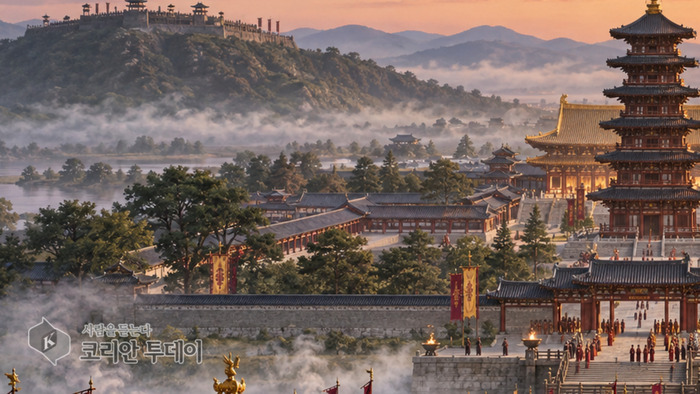
The temple stood on the south bank of the Baekma River (the Geum River), directly across the water from the capital Sabi (modern Buyeo) and its Busosan fortress. A king had to cross the river by boat to burn incense there, so the waterway became part of the ritual. In the same year as the pagoda consecration, 577, the Nihon Shoki records Baekje sending scriptures, a vinaya master, a meditation master, a nun, a ritual specialist, an image-maker and a temple-builder to Japan. This exchange culminated in the large 588 dispatch of craftsmen who helped build Japan’s first full-scale temple, Asukadera.
“Wangheungsa was completed. The temple stood at the water’s edge, its painted decoration grand and splendid. The king would often travel there by boat to offer incense.”
◆ Same Era, Different Worlds
🏛️ China
In 577 the Northern Zhou conquered Northern Qi and unified northern China. Emperor Wu of Zhou had banned Buddhism in 574, and the persecution reached the conquered Qi lands. While Baekje was consecrating a pagoda, temples in the north were being destroyed. Buddhism revived after the Sui dynasty was founded in 581.
🗿 Byzantine Empire
Justin II (r. 565-578) was fighting the Sasanian Empire in a war that ran from 572 to 591. Justinian’s Hagia Sophia (537) was about forty years old, and Sasanian Persia was ruled by Khosrow I (r. 531-579).
⚔️ Western Europe
The Lombards had entered Italy in 568, and the Merovingian Franks were divided among rival kings. In Britain, the Battle of Deorham in 577 marked Anglo-Saxon expansion. Sutton Hoo’s great ship burial was still about half a century away.
🕌 Islamic World
The Caliphate did not yet exist. Muhammad was a child of about seven in Mecca, and the great Arab expansion lay two generations ahead.
[Image: Conceptual plan of Wangheungsa. Gate, pagoda, hall and lecture hall stand on one north-south axis inside a cloister. Proportions simplified]
⚔️ Scene from That Day
“It was the fifteenth day of the second lunar month in 577, the day traditionally kept as the Buddha’s passing. As the mist lifted from the river, the king’s boat touched the far bank. At the center of the freshly tamped foundation stone, a small hole had been cut, and the chant of monks drifted low over the water.”
“Two relics had been prepared. When they were enshrined, the inscription later says, there were three. The king, standing before a pagoda built for a dead son, accepted the ‘work of the gods.’ Behind him a craftsman’s chisel was already tapping characters into the bronze.”
Note: this scene is a dramatized reconstruction based on the reliquary inscription and excavation facts. The details are imagined.
◆ Uncovering Historical Truth
The key find is a set of relic containers from the pagoda foundation. Inside a stone reliquary were a bronze box, a silver jar and a gold bottle, nested like Russian dolls. The bronze box carries a six-line, 29-character inscription: “In the year Jeongyu, on the 15th day of the 2nd month, King Chang of Baekje erected a temple for his deceased prince. He had intended to enshrine two relics, but through divine transformation they became three.” Jeongyu is 577, and Chang is King Wideok. It is the oldest securely dated Buddhist reliquary in Korea and is now designated National Treasure No. 327.
“In the year Jeongyu, on the 15th day of the 2nd month, King Chang of Baekje built a temple for his dead prince. He meant to bury two relics, but by divine transformation they became three.”
Text and artifact disagree. The Samguk Sagi says Wangheungsa was founded in the second year of King Beop (600), with 30 monks ordained, and completed in the 35th year of King Mu (634). The reliquary places the pagoda’s consecration 23 years earlier. The likeliest reading is a half-century national project, begun under Wideok, continued under Beop, and finished under Mu. A memorial for one prince grew into the royal temple of the whole dynasty. Compare the Roman and Byzantine habit of building imperial churches across several reigns, as with Justinian’s cathedral projects in the century before.
The architecture is distinctly Baekje. Excavations confirmed a “one pagoda, one hall” plan, with gate, wooden pagoda, main hall and lecture hall on a single north-south axis inside a cloister. This became the standard layout of Sabi-period Baekje temples. Picture a basilica whose nave points straight at one clear focal point. Here the focal point is the pagoda, a tomb-like relic tower that has become a tall wooden monument. From these wooden pagodas descends the line of Baekje stone pagodas, including those at Mireuksa and Jeongnimsa. Politically, the temple worked as a state ritual center for a monarchy shaken by King Seong’s death, in the way medieval European rulers used royal abbeys and coronation churches to bind crown and sacred order. Unlike feudal Western Europe, though, Baekje’s kings founded their temples inside a centralized, bureaucratic state modeled partly on Chinese institutions.
Period
Late 6th century (577 relic deposit) to 634 completion
Key Figure
King Wideok (Chang), King Beop, King Mu
Key Find
Three-layer reliquary (bronze, silver, gold) with a 29-character inscription
Legacy
Standard Baekje temple plan; craft exchange that shaped Japan’s Asukadera
🔍 International Academic Perspectives
Korean/Asian Scholars
The mainstream view treats 577 as the founding (start of construction and relic enshrinement). The 600 entry is read as the organization of the monastery under King Beop and 634 as completion. The “dead prince” is understood as Wideok’s son.
Alternative Readings
Some scholars treat the 600 record as a separate refoundation or a chronicle error. Others widen the motive beyond mourning a prince, seeing a wider effort by Wideok to rebuild royal legitimacy after his father’s death in battle. Western scholarship on Korean Buddhism tends to emphasize the temple’s role in Baekje-Japan transmission, a link the Nihon Shoki supports.
📖 Key Terms Explained
- Baekje (百濟, 백제)
- Ancient Korean kingdom (18 BCE-660 CE by traditional dating), one of the Three Kingdoms. It fell to a Silla-Tang alliance in 660.
- Sarira (사리)
- Relics of the Buddha or of holy monks, enshrined in pagodas. The Buddhist counterpart of Christian saints’ relics.
- One Pagoda, One Hall (1탑 1금당)
- A temple plan with a single pagoda and a single main hall aligned on one axis, typical of Baekje.
- Samguk Sagi (삼국사기)
- “History of the Three Kingdoms,” compiled in 1145 by Kim Bu-sik. It is the oldest surviving Korean chronicle, written centuries after Baekje fell.
◆ Lessons for Today’s World
Wangheungsa reappears in the Samguk Sagi in June 660, just before Baekje fell. The monks are said to have seen something like a ship’s mast drifting through the temple gate on the great waters. It is the last testimony to a scene in which river, boat and temple formed one landscape. Today only foundations remain, yet a tiny bottle underground corrected the age of the temple after more than 1,400 years.
The find changed how Korea treats religious architecture and heritage. In 2009 a 639 CE relic inscription came out of the West Pagoda at Mireuksa in Iksan, tightening the chronology of Baekje Buddhism further. Excavation, conservation and exhibition now work as one state effort, much as European nations protect medieval churches and archaeological sites. One caution: Wangheungsa is a national Historic Site (No. 427) but is not among the eight sites of the Baekje Historic Areas inscribed by UNESCO in 2015. Heritage continues wherever people keep digging in forgotten places, not only in the celebrated ones.
| Aspect | Baekje Era | Modern Parallel |
|---|---|---|
| Royal Legitimacy | Kings founded temples to secure authority and sacred sanction | States designate and protect heritage to sustain shared identity |
| Diplomacy & Craft | Monks and craftsmen sent to Japan (577, 588) | Joint heritage research and museum exchanges, like UNESCO cooperation |
| Culture | Relic devotion, mourning and the ordered temple axis | Conservation of sacred sites as spaces of memory, echoing Notre-Dame’s restoration |
[Image: The nested reliquary and Wangheungsa’s timeline, from ancient kingdom to modern heritage. Sizes and proportions are schematic]
📚 Diving Deeper
- The pagoda site was found in excavations by the National Research Institute of Cultural Heritage’s Buyeo branch, which began in 2000. The eighth campaign in 2007 was decisive. The Baekje Historic Areas (UNESCO, 2015) are the nearby heritage you can visit, though Wangheungsa is not among them.
- A comparable Korean find is the stone reliquary at Neungsan-ri temple in Buyeo, discovered in 1995. It is inscribed with a 567 CE dedication by a princess, King Wideok’s sister. In archaeological importance it stands to Baekje much as Sutton Hoo stands to Anglo-Saxon England, though the two are very different finds. The famous Baekje gilt-bronze incense burner came from the same temple, and it is our next episode.
- For further reading on Asukadera and Baekje craftsmen, see the Smithsonian’s Freer|Sackler symposium paper by Lee Byongho, and the Cambridge History of Japan for the Yamato court’s adoption of Buddhism. The Buyeo National Museum displays temple finds from the Baekje capital.
The Voice of Living History
Wangheungsa began in a king’s grief for a lost son and became a meeting place of a kingdom’s faith and craftsmanship. What the vanished temple left behind is not a great building but 29 characters and three small vessels. A small record can correct a large history, in Buyeo as anywhere.
“The pagoda across the river is gone, but the devotion that once enshrined a single relic still flows along Baekje’s waters.”
Previous Episode
Episode 11: The Smile of Baekje – The Seosan Rock-Cut Buddha Triad
Next Episode
Episode 13: The Baekje Gilt-Bronze Incense Burner – A World of Immortals
The Korean Today “History Lives On” Series
The Baekje Chronicle (30 Episodes)
Bridging Ancient East Asia and the Modern World
© 2025 The Korean Today. All rights reserved.
This content is based on historical facts and presents balanced academic perspectives
for international readers.
THE KOREAN TODAY × WIA CODE
이 기사의 WIA Code

WIA Code 스캐너로 비추면 인터넷 없이 발행 사실과 위·변조 여부를 확인할 수 있습니다.
휴대폰 기본 카메라로 찍으면 스캐너 안내 페이지가 열립니다 — 기사 바로 열기
움직이는 코드(스트림) 한 장에 기사 전문(사진 포함)이 담겨 있습니다 — WIA Code 스캐너로 약 31초 비추면 폰에 저장되어 인터넷 없이도 읽을 수 있습니다. Stream.mp4 도 여기서 받습니다.
WIA Code · 코리안투데이


Leave a Reply