
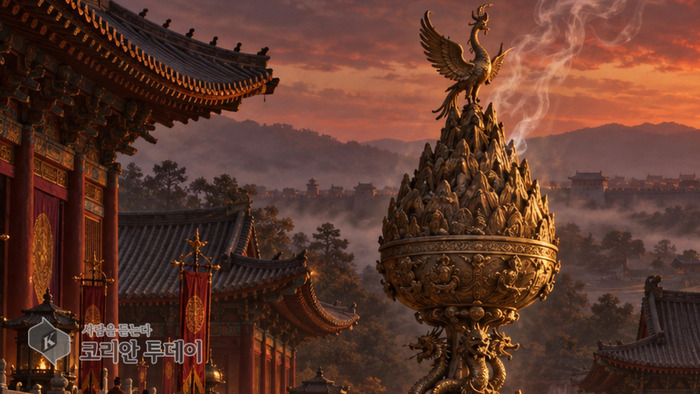
It stands about 62 centimeters tall and weighs 11.8 kilograms, yet it holds 74 mountain peaks, 16 human figures, 39 animals and a single phoenix. A Baekje craftsman built a universe inside a metal censer.
On December 12, 1993, at a construction site for a parking lot in Neungsan-ri, Buyeo, in South Korea, archaeologists found a metal object under the mud of an ancient temple site. As the mud was cleared away, a dragon holding up a lotus-shaped body appeared, then a lid crowded with mountain peaks, and at the very top a phoenix with spread wings. It became the Baekje Gilt-bronze Incense Burner. It was designated a National Treasure in 1996, and in December 2025 the Buyeo National Museum opened a building devoted to this single object, 32 years after its discovery.
Think of the sixth century, when Justinian’s Constantinople was raising the dome of Hagia Sophia. Did other courts across Eurasia also pour their cosmology into sacred objects? Baekje did, and the result is stranger than a Christian censer: a Buddhist temple’s ritual vessel that is covered in Taoist immortals’ mountains.
🌍 Western Historical Parallel
In 537 CE Justinian I (r. 527-565) consecrated Hagia Sophia, a monument that used architecture to model the cosmos. Baekje’s court did the same at object scale. Byzantine church censers were typically small vessels hung on chains, while the Baekje burner is a large, free-standing landscape. Across the sea in England, the early seventh-century ship burial at Sutton Hoo produced gold and garnet regalia; like the Baekje burner, it shows how an early medieval court expressed power through the finest metalwork it could command.
◆ The Ancient Landscape
In the mid-sixth century, China was divided between northern and southern dynasties, and Baekje traded envoys and ideas with the southern courts of Liang and Chen. King Seong (r. 523-554) moved the capital to Sabi, today’s Buyeo, and made Buddhism a pillar of the state. Then in 554 he was killed in the Battle of Gwansanseong against Silla.
His son King Wideok (r. 554-598) is understood to have founded a temple, Neungsan-ri, just outside the capital’s fortifications, between the city wall and the royal tombs, to comfort his father’s spirit and pray for the dynasty. A stone reliquary from the site is inscribed with a date corresponding to 567, the 13th year of King Chang (Wideok), when a princess enshrined relics there. The incense burner comes from this royal temple.
“South of the palace he dug a pond, drawing in water from twenty li away. He planted willows along all four banks and built an island in the middle, modeled on the immortal mountain of Bangjang.”
The text shows that Baekje’s court deliberately reproduced the mythic islands of the immortals in its gardens. The incense burner’s “immortal world” was not a foreign whim but part of a court culture.
◆ Same Era, Different Worlds
🏛️ China
The mountain-shaped “Boshanlu” censer was a Han dynasty fashion. As the Baekje burner took shape, China was moving from the Northern and Southern Dynasties toward reunification under the Sui (581) and Tang (618).
🗿 Byzantine Empire
Justinian’s reign (527-565) saw Hagia Sophia completed in 537. Early in the reign of Baekje’s King Wideok, the Byzantine Empire was likewise pouring imperial wealth into religious art.
⚔️ Western Europe
Frankish Merovingian kings and Anglo-Saxon rulers commissioned gold and garnet jewelry; the Sutton Hoo ship burial dates to the early seventh century.
🕌 Islamic World
Muhammad’s community emigrated to Medina in 622, and the early caliphate expanded from the 630s. This was a generation after the burner’s likely making, and shortly before Baekje’s fall in 660.
[Diagram: Structure of the Baekje Gilt-bronze Incense Burner – phoenix, mountain lid, lotus body, dragon base (schematic)]
⚔️ Scene from That Day
“It is December 12, 1993, and the ground at Buyeo is frozen. At a dig beside a parking-lot site, a researcher clears hardened earth and mud from a wooden tank that once held water. Green-corroded metal curves out of the muck. Then come a lotus petal, then the coil of a dragon.”
“No record explains why it was buried there. The favored explanation is that during the chaos of Sabi’s fall in 660, people at the temple hurriedly hid their most precious vessel. If so, the mud kept it safe for more than thirteen centuries, much as the Staffordshire soil kept its hoard for the Anglo-Saxons.”
Note: this scene is a reconstruction based on the excavation record and scholarly inference; it contains no invented dialogue or named individuals.
◆ Uncovering Historical Truth
The burner has three parts: a base, a body and a lid. On the base, a dragon lifts its head and grips the body in its jaws. The body is dressed in lotus petals. The lid rises in layered mountain ranges with streams, trees and rocks, where real animals such as tigers, deer, elephants and monkeys share the slopes with mythical beasts. At the summit a phoenix perches on a jewel with its wings spread, ringed by five musicians and five birds. Smoke holes are pierced through the lid, so burning incense makes mist rise between the peaks and the mountains look wreathed in cloud.
The form descends from the Han dynasty Boshanlu, a mountain-shaped censer tied to belief in the immortals’ islands in the eastern sea. Yet the Baekje piece far exceeds earlier Boshanlu in scale and composition. Lotuses, dragons, a phoenix and musicians turn it into something new, one in which Buddhist, Taoist and yin-yang thought share a single frame. Some scholars read the five peaks and five musicians as a symbol of Korea’s “five sacred mountains” and see three mountains depicted beneath the phoenix, a native cosmology layered on top of the imported one.
The technique is as remarkable as the design. It is a large bronze casting given a gold surface, most likely by traditional mercury-amalgam gilding. Fitting so many figures into one object demands segmented casting, fine finishing and assembly, which points to a state-organized royal workshop rather than a lone genius. In fact, the burner was found in a water tank inside a building thought to have been part of a workshop area. Politically, it can be read as the work of a court recovering from the shock of King Seong’s death and rebuilding legitimacy through religion and art. Compare the way Byzantine emperors used Hagia Sophia and the Carolingians and Merovingians used reliquaries: the state’s prestige was written in sacred objects, not just in armies.
Period
Late 6th to early 7th century CE
Key Figure
King Wideok (Chang), King Seong, anonymous Baekje craftsmen
Size
About 62 cm tall, 11.8 kg (roughly a small child’s height)
Discovery
December 12, 1993; National Treasure in 1996
🔍 International Academic Perspectives
Korean/Asian Scholars
The prevailing view ties the burner to ritual at the royal Neungsan-ri temple founded in 567 and dates it around King Wideok’s time. The lotus body reads as Buddhist and the lid as a Taoist immortal realm, evidence of blended beliefs. Some argue for a date as late as the early seventh century, and an amateur-scholar claim of the early sixth century has not been accepted by academics.
Western Historians
English-language studies of the burner, such as a 2024 article on how the Boshanlu form arose and changed, and studies of its Taoist iconography, focus on how the object reworks an inherited Chinese type. Debate continues over whether the lid should be read mainly as Taoist, as Buddhist, or as a native Baekje vision of sacred mountains.
📖 Key Terms Explained
- Baekje (百濟)
- Ancient Korean kingdom (traditionally founded 18 BCE, fell 660 CE), one of the Three Kingdoms of Korea
- Boshanlu (博山爐)
- A Han-dynasty censer shaped like a mountain, representing the mythical island home of the immortals
- Gilt-bronze
- Bronze covered with a thin layer of gold, traditionally applied with a mercury-gold amalgam that is then heated
- Tang Dynasty
- Chinese empire (618-907 CE) that emerged during Baekje’s late period; it later allied with Silla to destroy Baekje
◆ Lessons for Today’s World
Baekje’s craftsman did not choose between Buddhism and Taoism, nor did he simply copy a foreign model. He borrowed the Han Boshanlu form and recombined it with lotuses, a dragon, a phoenix and musicians into an object that had no precedent. Creativity here meant synthesis: taking different traditions and making a new value.
Modern examples are easy to find, from the way Korean popular culture blends traditional sound with global pop to how museums use 3D scanning and materials science to study heritage. The uncompromising precision of the burner’s workshop also has echoes in today’s precision manufacturing. Just as Hagia Sophia is read as a statement of Byzantine confidence, this burner is a statement of Baekje’s self-confidence, made in the aftermath of a lost king.
| Aspect | Baekje Era | Modern Parallel |
|---|---|---|
| Diplomacy | Exchange with southern Chinese courts; the throne asserts prestige through art | Cultural diplomacy, traveling museum exhibitions |
| Technology | Royal workshop: segmented casting and mercury-amalgam gilding | Precision manufacturing; scientific analysis and 3D restoration of heritage |
| Culture | Buddhist, Taoist and yin-yang ideas fused in one vessel | K-Culture’s genre-blending creativity |
[Diagram: From the ancient Baekje censer to modern Korea’s culture of fusion and craftsmanship]
📚 Diving Deeper
- Neungsan-ri temple site, part of the Baekje Historic Areas in Buyeo (a UNESCO World Heritage listing), lies between the capital’s fortress wall and the royal tombs. The reliquary carrying the 567 inscription was found there too.
- In archaeological weight, the burner invites comparison with Sutton Hoo: both are early medieval court treasures preserved by burial, revealing far-flung connections through their materials and motifs.
- Further reading: the Buyeo National Museum’s new dedicated hall (opened December 2025), the Smarthistory entry on the burner, and scholarship on its Taoist iconography and on the Boshanlu in the International Journal of Korean Art and Archaeology and the Journal of Chinese Imperial Art. For the wider region, the Cambridge History of China volumes on the Sui and Tang give context.
The Voice of Living History
In the wake of a lost war, a kingdom made not a weapon but a world. Baekje’s willingness to unite different beliefs in one vessel, and its craftsmen’s refusal to cut corners, speak to any age in which blending traditions and mastering technique decide who is heard.
“The censer waited in the mud for over thirteen centuries for smoke to rise again. The imagination of Baekje is still alive.”
Previous Episode
Episode 12: Wangheungsa – The Heart of Baekje Buddhism
Next Episode
Episode 14: Baekje Architecture – Technology Carried to Japan
The Korean Today “History Lives On” Series
The Baekje Chronicle (30 Episodes)
Bridging Ancient East Asia and the Modern World
© 2025 The Korean Today. All rights reserved.
This content is based on historical facts and presents balanced academic perspectives
for international readers.
THE KOREAN TODAY × WIA CODE
이 기사의 WIA Code

WIA Code 스캐너로 비추면 인터넷 없이 발행 사실과 위·변조 여부를 확인할 수 있습니다.
휴대폰 기본 카메라로 찍으면 스캐너 안내 페이지가 열립니다 — 기사 바로 열기
움직이는 코드(스트림) 한 장에 기사 전문(사진 포함)이 담겨 있습니다 — WIA Code 스캐너로 약 28초 비추면 폰에 저장되어 인터넷 없이도 읽을 수 있습니다. Stream.mp4 도 여기서 받습니다.
WIA Code · 코리안투데이


Leave a Reply