
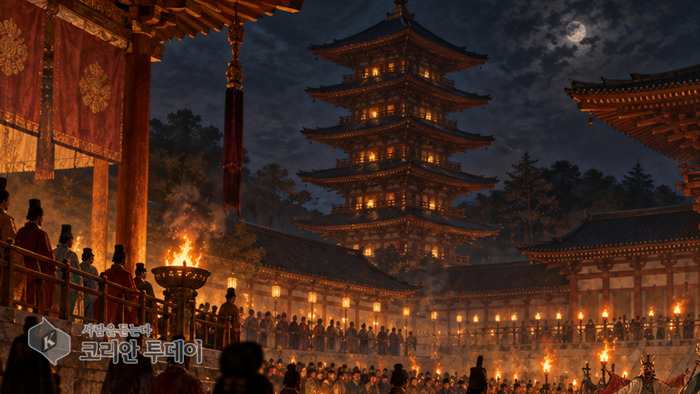
A masked man stood on a field in Sakurai, Japan. Behind him, faintly, still lingered the sunset over Baekje’s capital, Sabi.
Today, the world fills stadiums for K-pop’s precision choreography and spectacle. Fourteen centuries earlier, a dance and music tradition that crossed the sea from the Korean peninsula transformed a neighboring nation’s performing arts just as decisively. In 612 CE, a Baekje performer named Mimaji settled in Sakurai, Japan, and taught local boys a masked dance-drama called gigaku (伎樂).
What makes this story remarkable is that Baekje’s own chronicles never recorded it. The only surviving account comes from Japan’s Nihon Shoki. The culture that gave was forgotten by its own records; the culture that received remembered even the teacher’s name. That asymmetry is itself the story worth telling.
🌍 Western Historical Parallel
While Mimaji taught masked dance in Sakurai in 612 CE, Byzantine Emperor Heraclius was fighting for the empire’s survival against Persia, and in Mecca, the first revelations of Islam were beginning — much as itinerant monks and minstrels of Charlemagne’s later Carolingian court would carry Frankish liturgical music and legend across Western Europe two centuries afterward.
◆ The Ancient Landscape
In the early 7th century, Baekje was ruled by King Mu (r. 600–641 CE), who built grand temple complexes such as Wangheungsa and Mireuksa to anchor royal authority in Buddhist patronage. Baekje maintained active exchange with Southern Chinese dynasties and with Wa (early Japan), functioning as a cultural relay point across the East Asian maritime world — a role not unlike Venice’s later position between Byzantium and Western Europe.
In the 13th year of King Mu’s reign (612 CE), a Baekje man named Mimaji traveled to Japan. He had earlier studied gigaku, a masked dance-drama, in the “Wu” region — the Jiangnan area along the lower Yangtze, a heartland of Southern Chinese court culture. Upon arriving in Japan, he settled in Sakurai and gathered local boys to teach them the dance, laying the foundation for a performance tradition that would become central to court and temple ritual for generations.
“A man of Baekje named Mimaji came and settled [in Japan]. He said he had studied gigaku dance in Wu. He was made to live in Sakurai, and boys were gathered to be taught the gigaku dance.”
◆ Same Era, Different Worlds
🏛️ China
The Sui dynasty was collapsing and the Tang dynasty would be founded in 618 CE — the very Southern courtly culture Mimaji had studied was already becoming a relic of a fading age.
🗿 Byzantine Empire
Emperor Heraclius (r. 610–641) was locked in an existential war with Sassanid Persia, reorganizing the empire’s military and administrative structure to survive.
⚔️ Western Europe
Anglo-Saxon England was on the cusp of the Sutton Hoo ship-burial era (c. 620s CE), a period of rich, cosmopolitan craft exchange strikingly parallel to Baekje’s own court art.
🕌 Islamic World
Around 610 CE, the earliest revelations of Islam began in Mecca — the movement that would reshape the Middle East within a single generation.
[Image: gigaku’s transmission route — learned in Wu, carried through Baekje, taught in Sakurai, 612 CE]
⚔️ Scene from That Day
“Torches light an open field in Sakurai. A man in a carved wooden mask crouches, then leaps, to the beat of a drum. Go-ko’s clownish shuffle gives way to the imposing bound of Kongo, the guardian deity. The Japanese boys watching wide-eyed reflect more firelight than the torches themselves.”
“When the performance ends, Mimaji does not remove his mask before handing it to a boy. Language was never the point — gigaku was, from the start, a wordless drama told entirely in gesture.”
◆ Uncovering Historical Truth
Gigaku opened with a lion procession and unfolded through a cast of masked characters — Go-ko and Go-nyo (comic figures from “Wu”), the guardian deity Kongo, the bird-deity Garuda, the demon Konron, the strongman Rikishi, and the “drunken foreign king” Suiko-o. Each pantomimed Buddhist themes of karma and moral consequence in exaggerated, wordless gesture — theater designed to teach doctrine to an illiterate audience, not unlike medieval European mystery plays performed on church steps centuries later.
Physical evidence survives today: 7th–8th century gigaku masks are preserved at Horyuji Temple, Todaiji Temple, and the imperial repository Shosoin in Nara. Their exaggerated, foreign facial features trace a cultural lineage stretching from Baekje back through Central Asia to India — evidence of a trans-continental exchange network as extensive, in its own sphere, as the Silk Road connections linking Byzantium to Tang China.
Baekje’s own musical sophistication is attested by the Gilt-bronze Incense Burner of Baekje, unearthed in Buyeo, whose lid is crowned by five musician figures playing a wan-ham (pipa-type lute), a vertical flute, panpipes, a drum, and a stringed instrument. This blend of Central Asian and Chinese-derived instruments shows that Baekje already possessed a cosmopolitan court music system of its own — Mimaji was not simply relaying a foreign art form wholesale, but transmitting something Baekje had already absorbed and reworked, much as Byzantine artisans reworked Persian and Roman forms into something distinctly their own.
Period
Early 7th century, 612 CE (King Mu, year 13)
Key Figure
Mimaji (味摩之), also romanized Mimashi
Art Form
Gigaku — masked dance-drama
Legacy
Nara/Heian court and temple performing arts
🔍 International Academic Perspectives
Korean/Asian Scholars
The prevailing view holds that Mimaji learned a Southern Chinese (Wu-region) folk and mask-theater tradition, adapted it within Baekje’s own courtly and Buddhist performance culture, and then transmitted that Baekje-inflected form to Japan as a cultural intermediary.
Western Historians
Some scholars note that because Mimaji is described as having “studied in Wu,” he may have been an ethnic Chinese immigrant residing in Baekje rather than an ethnic Baekje native — a debate over identity that does not change Baekje’s documented role as the launching point of the transmission.
📖 Key Terms Explained
- Baekje (百濟)
- Ancient Korean kingdom (18 BCE – 660 CE), one of the Three Kingdoms of Korea, known for its maritime trade and role as a cultural bridge to Japan.
- Gigaku (伎樂)
- A wordless, masked processional dance-drama with Buddhist moral themes, flourishing in Japan’s Nara period (710–794 CE) before disappearing by the Kamakura era.
- Nihon Shoki (日本書紀)
- Japan’s second-oldest official chronicle, compiled in 720 CE, the sole surviving textual source for Mimaji’s story.
◆ Lessons for Today’s World
Gigaku flourished through Japan’s Nara period, declined as courtly tastes shifted in the Heian era, and had vanished entirely by the Kamakura period. Yet its traces — masks and a single chronicle entry — survived across fourteen centuries, and it is only through them that we can now reconstruct, in reverse, the international standing of Baekje’s own musical culture.
Today the world responds to K-pop’s precision choreography and stagecraft. Trace that lineage back far enough, and an anonymous Baekje performer stands at the root — someone who settled in a foreign land and taught its people movement and rhythm directly. Making culture take root abroad by training local people to reproduce and sustain it themselves is a strategy that has not fundamentally changed in fourteen hundred years.
| Aspect | Baekje Era | Modern Parallel |
|---|---|---|
| Mode of Transmission | A performer relocates and trains locals directly, apprentice-style | Digital platforms and viral challenges spread choreography instantly |
| Medium | Wordless masked drama and gesture | Choreography, visual staging, short-form video |
| Culture | Buddhist teaching conveyed through performance | Global spread of K-Culture performing arts |
[Image: from masked dance-drama to today’s synchronized global stage — one lineage of performing art]
📚 Diving Deeper
- The Gilt-bronze Incense Burner of Baekje at the Buyeo National Museum — its five musician figures, playing lute, flute, panpipes, drum, and string, are carved in remarkable detail at the crown of the burner.
- The 7th–8th century gigaku masks preserved at Japan’s Shosoin repository — comparable in significance to England’s Sutton Hoo hoard as a window onto cross-cultural artistic exchange.
- The National Gugak Center’s 2002 revival performance of gigaku — a modern attempt to resurrect a Baekje-linked masked drama silent for 1,300 years.
The Voice of Living History
It was never recorded in its own homeland, yet it was remembered for over a thousand years in the place it traveled to. The power of culture is proven not by whether it was written down at home, but by how far and how deeply it took root elsewhere.
“The face behind the mask is forgotten, but the dance it left behind endures.”
Previous Episode
Episode 14: Baekje’s Architecture – Techniques Transmitted to Japan
Next Episode
Episode 16: Baekje’s Science and Technology – Astronomy and Medicine
The Korean Today “History Lives On” Series
The Baekje Chronicle (30 Episodes)
Bridging Ancient East Asia and the Modern World
© 2025 The Korean Today. All rights reserved.
This content is based on historical facts and presents balanced academic perspectives
for international readers.
THE KOREAN TODAY × WIA CODE
이 기사의 WIA Code

WIA Code 스캐너로 비추면 인터넷 없이 발행 사실과 위·변조 여부를 확인할 수 있습니다.
휴대폰 기본 카메라로 찍으면 스캐너 안내 페이지가 열립니다 — 기사 바로 열기
움직이는 코드(스트림) 한 장에 기사 전문(사진 포함)이 담겨 있습니다 — WIA Code 스캐너로 약 26초 비추면 폰에 저장되어 인터넷 없이도 읽을 수 있습니다. Stream.mp4 도 여기서 받습니다.
WIA Code · 코리안투데이


Leave a Reply