
A single iron sword has carried a memory across 1,650 years, and two nations are still arguing over what it means.
The Seven-Branched Sword, a Japanese National Treasure housed at Isonokami Shrine in Nara, bears an inscription describing its presentation from a Baekje king to a Wa (early Japanese) ruler. Whenever Korea-Japan relations flare up politically, this sword resurfaces in the headlines. But what did Baekje and Wa actually exchange, sixteen centuries ago?
For over three centuries, from the 4th through the 7th century, Baekje and Wa were bound by something far more complex than one-way “cultural transmission.” Princes crossed the sea to live as hostages and envoys, scholars and artisans traveled back and forth, and in the final chapter, Wa’s fleets sailed to fight and fall alongside Baekje’s restoration army. Before judging this relationship by modern standards, it’s worth looking closely at what people actually exchanged.
🌍 Western Historical Parallel
When Baekje sent Crown Prince Jeonji to Wa in 397 CE as a diplomatic hostage, the Western Roman Empire was less than eighty years from its 476 CE collapse, and it was routinely exchanging royal hostages with Germanic peoples along the Rhine and Danube frontiers – a diplomatic language both worlds spoke fluently.
◆ The Ancient Landscape
By the mid-4th century, under King Geunchogo, Baekje had secured the Han River basin and absorbed the remnants of the Mahan confederacy, emerging as a key node in East Asian maritime trade. Around 369 CE, Baekje and Wa forces are recorded as jointly subduing polities in the Gaya confederacy region, and it was likely around this time that the Baekje court sent the Seven-Branched Sword to the Wa king (scholars remain split between a 369 CE and a 408 CE date for the sword’s manufacture).
As King Gwanggaeto of Goguryeo pushed south, Baekje needed Wa’s cooperation more urgently than ever. In 397 CE, King Asin sent his own heir, Crown Prince Jeonji, to Wa to cement the alliance – a hostage by modern definition, but at the time the strongest bond two royal houses could forge. In 461 CE, King Gaero dispatched his brother Gonji to Wa to reaffirm military cooperation; Gonji remained there for years, becoming a central figure for the Baekje émigré community in the Japanese archipelago.
“In the fifth month of summer, in the sixth year [397 CE], the king made peace with the kingdom of Wa and sent Crown Prince Jeonji there as a hostage.”
◆ Same Era, Different Worlds
🏛️ China
While Baekje courted Wa, China was split into Northern and Southern Dynasties. Baekje maintained tributary ties with the Southern courts (Eastern Jin, Song, Liang), absorbing continental culture it then relayed onward to Wa.
🗿 Byzantine Empire
By the time Baekje fell in 660 CE, Emperor Constans II ruled a Byzantine Empire locked in existential war with the Arab Caliphate – another old kingdom watching its regional order collapse.
⚔️ Western Europe
Frankish kings of the Merovingian dynasty, like Baekje’s rulers, relied heavily on marriage alliances and hostage exchange with neighboring peoples to secure fragile borders.
🌏 Wa (Yamato Japan)
Lacking a mature writing system or unified monarchy, Wa absorbed Chinese characters, Confucian classics, Buddhism, and fortification and shipbuilding techniques from Baekje as it built its own state.
[Image: The maritime corridor between Baekje and Wa, and the key exchange events of the 4th-7th centuries]
⚔️ Scene from That Day
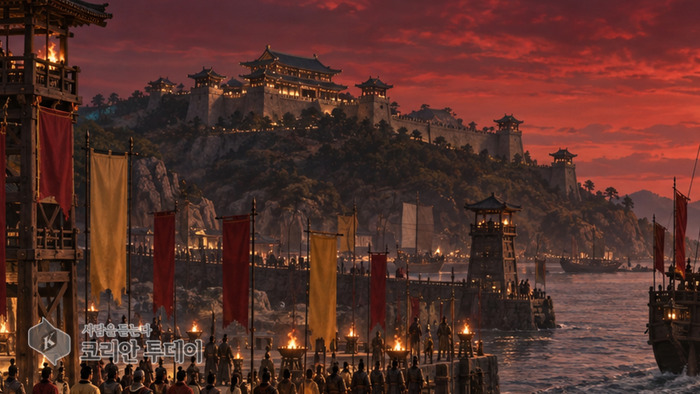
“Summer, 397 CE, a harbor at the mouth of the Han River. Crown Prince Jeonji, still a young man, forced himself not to look back as he left the palace. His father’s last words echoed in his ears: ‘You are not a hostage – you are a bridge between two kingdoms.'”
Torches lined the pier as robed officials bowed low, and scholars and craftsmen boarded the ship alongside him. As the sail rose, the prince could not have known that the shore he was sailing toward would become, in effect, a second Baekje.
◆ Uncovering Historical Truth
Reducing the Baekje-Wa relationship to “cultural transmission” misses its full complexity. Beginning with Crown Prince Jeonji’s crossing in 397 CE and Prince Gonji’s dispatch in 461 CE, the royal houses of Baekje and Wa became genuinely intertwined by blood – King Muryeong, later famous for his richly furnished tomb, is recorded in the Nihon Shoki as having been born on an island near Kyushu while his father Gonji was journeying to Wa.
The flow of culture was never one-directional in timing or certainty, either. The scholar Achiki is said to have brought horses and taught the classics in Wa on King Geunchogo’s orders, and Wani reportedly followed with copies of the Analects and the Thousand Character Classic. Yet the Thousand Character Classic’s traditionally credited author, the Liang-dynasty official Zhou Xingsi, lived in the late 5th to early 6th century – a chronological puzzle scholars address through the “two-cycle correction,” which holds that the Nihon Shoki’s early chronology was inflated by 120 years, placing Wani’s actual journey closer to the early 5th century rather than the traditional late 4th century date.
The transmission of Buddhism – traditionally dated to either 538 or 552 CE, when King Seong sent envoys bearing a Buddha statue and sutras – marks the formal starting point of Buddhism in Japan. This centuries-long exchange of people, scholarship, faith, and technology ended abruptly when Baekje fell to the combined Tang-Silla forces in 660 CE. Wa sent home the hostage prince Buyeo Pung and dispatched a large fleet to fight alongside Baekje’s restoration forces; their final, decisive defeat came at the Battle of Baekgang in August 663 CE – three years after the kingdom’s fall, not to be confused with it. The defeat effectively ended the Baekje restoration movement, and large numbers of Baekje refugees subsequently resettled in Wa, leaving a lasting imprint on early Japanese statecraft.
Period
4th-7th century CE
Key Figures
King Asin, Prince Jeonji, Prince Gonji, King Seong
Key Events
Seven-Branched Sword, hostage diplomacy, Buddhism, Battle of Baekgang
Legacy
Foundational contribution to early Japanese state formation
🔍 International Academic Perspectives
Korean/Asian Scholars
Baekje is broadly viewed as the source of advanced continental culture, with Wa absorbing statecraft, writing, and religion through sustained human and material exchange – a view shared across Korean and much of Japanese academia.
Western Historians
The older “Mimana Nihon-fu” theory, claiming Wa controlled parts of southern Korea in the 4th-6th centuries, is now largely rejected for lack of textual evidence; most current scholarship instead frames Baekje-Wa ties as a reciprocal, elite-level network rather than colonial control in either direction.
📖 Key Terms Explained
- Baekje (백제)
- One of Korea’s Three Kingdoms (18 BCE – 660 CE), controlling the southwestern Korean peninsula and a major Yellow Sea maritime power.
- Wa (倭)
- The contemporary Chinese and Korean name for the early Japanese polities of the Kofun period, centered on the Yamato court.
- Nihon Shoki
- Japan’s oldest official chronicle (720 CE), a key but chronologically debated source for Baekje-Wa history.
- Battle of Baekgang
- A naval battle in August 663 CE where allied Baekje-Wa forces were decisively defeated by Tang-Silla forces, ending Baekje’s restoration movement.
◆ Lessons for Today’s World
Korea-Japan relations are often flattened into a story of ancient, unbroken rivalry whenever political tensions flare. But the stories of Prince Jeonji, Prince Gonji, Wani, and Achiki show two societies once tightly interwoven at the elite level. Refusing to weaponize this shared history for present-day political point-scoring may be exactly what this old relationship asks of us today.
At the same time, the Battle of Baekgang offers a sober lesson: alliances are not permanent. Despite Wa’s large-scale military commitment, Baekje could not be restored – a reminder, for anyone weighing modern security alliances, that goodwill alone cannot guarantee a state’s survival.
| Aspect | Baekje Era | Modern Parallel |
|---|---|---|
| Geopolitics | Alliances secured by exchanging royal hostages | Treaties and summit-level security cooperation |
| Military | Joint Baekje-Wa fleet at the Battle of Baekgang | Trilateral Korea-US-Japan security cooperation |
| Culture | Transmission of writing, Buddhism, and craft technology | Global spread of K-culture |
[Image: A symbolic timeline from ancient material exchange to modern Korean cultural export]
📚 Diving Deeper
- The Wani Memorial Site in Yeongam, South Jeolla Province, commemorating the scholar’s legendary journey to Wa
- Asukabe Shrine near Osaka, traditionally said to enshrine Prince Gonji as a deity
- Cross-referencing the epitaph tablet from King Muryeong’s tomb against Nihon Shoki accounts
The Voice of Living History
The princes and scholars who crossed the sea left behind no record of conquest or subjugation – only the trace of two societies that, for three centuries, genuinely needed one another.
“The brother kingdoms are long gone, but the words, faith, and skills they exchanged remain with us still.”
Previous Episode
Episode 17: Baekje and China – Exchange with the Southern Dynasties
Next Episode
Episode 19: King Mu and Iksan – A Second Capital
The Korean Today “History Lives On” Series
The Baekje Chronicle (30 Episodes)
Bridging Ancient East Asia and the Modern World
© 2025 The Korean Today. All rights reserved.
This content is based on historical facts and presents balanced academic perspectives
for international readers.
THE KOREAN TODAY × WIA CODE
이 기사의 WIA Code

WIA Code 스캐너로 비추면 인터넷 없이 발행 사실과 위·변조 여부를 확인할 수 있습니다.
휴대폰 기본 카메라로 찍으면 스캐너 안내 페이지가 열립니다 — 기사 바로 열기
움직이는 코드(스트림) 한 장에 기사 전문(사진 포함)이 담겨 있습니다 — WIA Code 스캐너로 약 26초 비추면 폰에 저장되어 인터넷 없이도 읽을 수 있습니다. Stream.mp4 도 여기서 받습니다.
WIA Code · 코리안투데이


Leave a Reply