
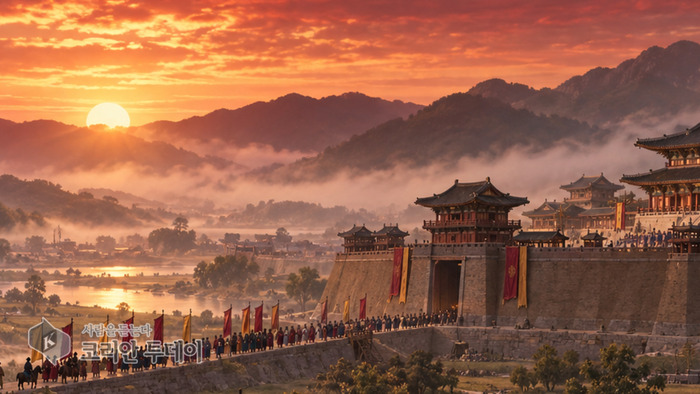
Fourteen centuries ago, a Korean king tried to move his capital — for reasons not so different from why South Korea built a new administrative city called Sejong.
Today’s South Korea wrestles with a familiar problem: everything — population, capital, opportunity — keeps concentrating in and around Seoul, while the provinces empty out. That question is not unique to the 21st century. In the 7th century, King Mu of Baekje (r. 600–641) poured resources into Iksan, the region traditionally linked to his own birth story, to build a counterweight to the entrenched aristocratic families of the capital, Sabi (modern Buyeo). The colossal ruins of Mireuksa Temple and the Wanggung-ri palace site still stand as proof of that effort.
No surviving chronicle states plainly, “King Mu moved the capital to Iksan.” Yet for nearly a century, historians have been unable to let go of the “Iksan relocation theory.” Why?
🌍 Western Historical Parallel
King Mu’s reign (600–641) almost exactly overlaps that of Byzantine Emperor Heraclius (610–641). While Heraclius was fighting the Sasanian Persians to save Constantinople, King Mu was quietly building a second seat of power far from his own capital’s overmighty nobles — two rulers on opposite ends of Eurasia, each wrestling with how far power could be trusted to a single center.
◆ The Ancient Landscape
Baekje had already moved its capital three times before King Mu’s reign: from Hanseong (around modern Seoul, on the Han River) in the 4th century, to Ungjin (Gongju) in 475, to Sabi (Buyeo) in 538. By the time Mu took the throne in 600, more than sixty years had passed since the Sabi relocation, and the capital’s powerful aristocratic clans — later remembered as the “Eight Great Clans” — had grown strong enough to constrain royal authority.
From early in his reign, King Mu turned his attention to the Iksan-Geumma region. At Wanggung-ri he built a large walled compound believed to be a palace complex, and just south of it, at the foot of Mireuksan, he raised Mireuksa, the largest Buddhist temple Baekje ever built. Roof tiles inscribed with “subu” (capital) and with the names of the Five Administrative Districts, unearthed at Wanggung-ri, suggest the site carried the status of a capital, not a mere detached villa.
“Princess Seonhwa, secretly, has already given her heart to another; at night she goes to hold young Seodong in her arms.” — the hyangga (vernacular verse) known as Seodongyo
◆ Same Era, Different Worlds
🏛️ China
Just as Mu took the throne, China was passing from the Sui to the Tang dynasty: Li Yuan founded Tang in 618, and Baekje had to quickly establish diplomatic ties with this new power.
🗿 Byzantine Empire
Emperor Heraclius (610–641) fought a existential war against Sasanian Persia, reclaiming Jerusalem’s relics only years before the rise of a new challenger from Arabia.
⚔️ Western Europe
The Merovingian Frankish kingdoms held sway over Gaul, ruling through regional palaces and itinerant courts not unlike Baekje’s shifting seats of power.
🕌 Islamic World
Muhammad died in 632; the Rashidun Caliphate that followed began an explosive expansion across Arabia, the Levant, and Persia within King Mu’s own lifetime.
[Image: Baekje’s shifting capitals and the position of Iksan (4th–7th centuries CE)]
⚔️ Scene from That Day
“As morning mist lifts over the Geumma plain, the silhouettes of a great wooden pagoda and twin stone towers rise at the foot of Mount Mireuk. The rasp of chisels fills the valley, while officials sent from Sabi walk the freshly raised palace walls, murmuring to one another.”
“In the distance, the king’s procession approaches. Beyond the reach of Sabi’s great clans, he was building a new Baekje here — a dream with three layers: a stronger throne, a rising generation of loyal officials, and command of the trade routes along the Geum River.”
◆ Uncovering Historical Truth
Excavations at Wanggung-ri confirmed that King Mu’s Iksan project was not legend but engineering fact — comparable in ambition, if not scale, to how Byzantine emperors fortified secondary strongholds against both external and internal threats. Ironically, when a temple was built over the old palace site after Baekje’s fall, it preserved the ruins beneath rather than destroying them; the foundations of the palace still lie under today’s Wanggung-ri five-story stone pagoda.
But a 2009 discovery shook the field: during the dismantling and restoration of Mireuksa’s West Pagoda, a gold sarira enshrinement plaque was found, dated to 639 CE (the 40th year of King Mu’s reign, the year Gihae). It records that the queen who enshrined the relics was “the daughter of Left Minister Sataek Jeokdeok” — not Princess Seonhwa, the Silla king’s daughter celebrated in the Seodong legend. The find suggests either that the legend was a later literary construction, or that King Mu had a Baekje-born queen alongside — or instead of — a Silla princess.
Iksan is also home to the “Twin Tombs” (Ssangneung), traditionally identified as the burial mounds of King Mu and his queen — roughly contemporary with England’s Sutton Hoo ship burial. A mere satellite villa would not normally double as a royal necropolis; Baekje’s court invested this single site with palace, temple, and tomb alike.
Period
Early-to-mid 7th century (600-641 CE)
Key Figure
King Mu, 30th ruler of Baekje
Key Event
Founding of Mireuksa, construction of Wanggung-ri palace
Legacy
Iksan as Baekje’s “second capital”; UNESCO listing in 2015
🔍 International Academic Perspectives
Korean/Asian Scholars
The majority view holds that, absent a written relocation record, Iksan functioned as a detached secondary capital meant to counter Sabi’s aristocratic clans, a project left unfinished at Mu’s death or reversed under his son, King Uija.
Alternative View
Given the scale of the Wanggung-ri walls, the “capital” roof-tile inscriptions, and the royal-grade Twin Tombs, a growing school argues a genuine relocation was well underway before being abandoned.
📖 Key Terms Explained
- Baekje (백제)
- Ancient Korean kingdom (traditionally 18 BCE – 660 CE), one of the Three Kingdoms of Korea alongside Goguryeo and Silla
- Hyangga
- Vernacular Korean verse written in Chinese characters used phonetically; the “Seodongyo” quoted above is among the oldest surviving examples
- Sataek Clan
- One of Baekje’s most powerful aristocratic lineages, later remembered among the kingdom’s “Eight Great Clans”
- Tang Dynasty
- Chinese empire founded in 618 CE, roughly contemporary with the Byzantine Heraclian dynasty
◆ Lessons for Today’s World
King Mu’s Iksan project was a 7th-century answer to a question every capital-heavy state eventually asks: how do you govern when everything — people, wealth, power — pools in one city? His answer was not full relocation, but building a genuine second center of gravity.
South Korea faces the same question today. Sejong Special Autonomous City, launched in 2012, and the country’s network of “innovation cities” are modern echoes of the Iksan strategy — attempts to relieve Seoul’s gravitational pull and rebalance national development, fourteen centuries after Baekje first tried it.
| Aspect | Baekje Era | Modern Parallel |
|---|---|---|
| Politics/Security | Need to counterbalance Sabi’s great clans with a new power base | Need to ease Seoul-area concentration and address regional decline |
| Military/Trade | Control of Geum River shipping lanes for southern trade and defense | High-speed rail and highways linking regional hub cities |
| Culture/Spirit | Maitreya (Mireuk) Buddhist ideal of building a new Buddha-land | Vision of a “regional era” and balanced national development |
[Image: Baekje’s Iksan strategy compared with modern balanced-development policy]
📚 Diving Deeper
- The 2009 gold sarira plaque from Mireuksa’s West Pagoda, a royal donor’s inscription, was later designated a National Treasure of South Korea.
- Iksan’s Twin Tombs (Ssangneung) are, by tradition, the only Baekje royal tombs located outside the kingdom’s recognized capitals — comparable in mystery to England’s Sutton Hoo burial.
- Wanggung-ri and Mireuksa, together with Baekje sites in Gongju and Buyeo, were inscribed as the “Baekje Historic Areas” UNESCO World Heritage Site in 2015.
The Voice of Living History
The thirty-odd years King Mu poured into Iksan never reached completion. But an unfinished dream is not the same as a failed one. The palace foundations and stone pagodas he left behind have spent fourteen centuries proving that a single center is never the only answer.
“Even an unfinished relocation leaves a place that keeps asking us: where will we build our own new center today?”
Previous Episode
Episode 18: Baekje and Wa – Nations of Brothers
Next Episode
Episode 20: King Uija – Sage of the East or Ruler of a Fallen Kingdom?
The Korean Today “History Lives On” Series
The Baekje Chronicle (30 Episodes)
Bridging Ancient East Asia and the Modern World
© 2025 The Korean Today. All rights reserved.
This content is based on historical facts and presents balanced academic perspectives
for international readers.
THE KOREAN TODAY × WIA CODE
이 기사의 WIA Code

WIA Code 스캐너로 비추면 인터넷 없이 발행 사실과 위·변조 여부를 확인할 수 있습니다.
휴대폰 기본 카메라로 찍으면 스캐너 안내 페이지가 열립니다 — 기사 바로 열기
움직이는 코드(스트림) 한 장에 기사 전문(사진 포함)이 담겨 있습니다 — WIA Code 스캐너로 약 26초 비추면 폰에 저장되어 인터넷 없이도 읽을 수 있습니다. Stream.mp4 도 여기서 받습니다.
WIA Code · 코리안투데이


Leave a Reply