
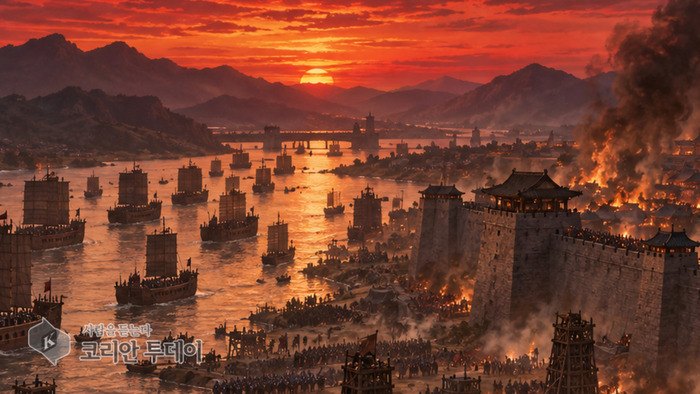
He was praised as the “Zengzi of the East” at his coronation. Twenty years later, he was remembered as the king who lost a kingdom.
Few rulers in Korean history are judged as harshly and inconsistently as King Uija of Baekje (義慈王, r. 641-660). At his accession he was hailed for his filial piety and brotherly devotion, earning the epithet “Zengzi of the East” – a reference to Confucius’s most virtuous disciple. Yet today his name is inseparable from two words: “three thousand court ladies” and “downfall.”
Is it fair to judge nearly two decades of rule by its final catastrophic years alone – the way modern leaders are so often reduced to their worst crisis? Uija’s story forces that question, and it echoes far beyond Korea, into how Rome remembered its last emperors and how Byzantium judged its own.
🌍 Western Historical Parallel
When Uija took the Baekje throne in 641, Byzantine Emperor Constans II (r. 641-668) was ascending in Constantinople at almost the exact same moment – both young rulers inheriting empires under mounting external pressure, both destined to see their capitals besieged within their reigns.
◆ The Ancient Landscape
In 641, King Mu of Baekje – the same king who had built a second capital at Iksan (see Episode 19) – died, and his son Uija ascended the throne. Mid-seventh-century East Asia was a region in flux: the Tang dynasty in China was consolidating a unified empire after Sui’s collapse, while on the Korean peninsula, Goguryeo, Baekje, and Silla remained locked in relentless three-way rivalry.
In 642, just a year into his reign, Uija personally led an army into Silla territory and captured more than forty fortresses, including Mihu Fortress. He then gave General Yunchung – brother of his newly appointed chief minister Seongchung – ten thousand troops to seize Daeyaseong, a critical Silla stronghold in the south. It fell. The victory announced Baekje’s military resurgence to all of East Asia – but it also planted a seed of vengeance that would return to destroy the kingdom eighteen years later.
“He served his parents with filial devotion and his brothers with affection; the people of that time called him the Zengzi of the East.”
◆ Same Era, Different Worlds
🏛️ China
Emperor Gaozong of Tang took the throne in 649, and it was his court that ultimately decided to invade Baekje – with Empress Wu Zetian already gaining influence behind the scenes.
🗿 Byzantine Empire
Constans II fought to hold the empire together against Arab expansion, a defensive struggle mirroring Baekje’s own losing race against Tang-Silla momentum.
☪️ Islamic World
In 656, Caliph Uthman was assassinated, triggering the First Fitna – an eerily similar timeframe to Baekje’s own descent into internal discord under Uija.
🗾 Japan
The Taika Reform of 645 began centralizing Japan’s government. After Baekje’s fall, Prince Buyeo Pung would seek Japanese backing for a restoration attempt.
[Image: The Tang-Silla pincer converging on Sabi, with the Battle of Hwangsanbeol marked (660 CE)]
⚔️ Scene from That Day
“On the ninth day of the seventh lunar month, 660 CE, at the plain of Hwangsanbeol: General Gyebaek gathered his five thousand. ‘King Goujian of Yue once crushed seventy thousand men with five thousand,’ he told them. ‘Today we repay our kingdom with death.’ Before the fifty-thousand-strong Silla army closed in, he killed his own wife and children rather than let them face enslavement.”
Four times, this last stand – not unlike Leonidas at Thermopylae – broke a force ten times its size. On the fifth assault, galvanized by the death of the young Hwarang warrior Gwanchang, the Silla army overwhelmed them completely. Sabi’s fate was already sealed.
◆ Uncovering Historical Truth
The fall of Daeyaseong in 642 came back to haunt Baekje in an unexpected way. Among the dead in that fortress were Goldaso, daughter of the powerful Silla noble Kim Chunchu, and her husband Kim Pumseok, the fortress commander. Grief-stricken, Kim Chunchu spent years shuttling between Goguryeo and Tang China in relentless diplomacy, and in 648 he finally secured a military pact with Emperor Taizong of Tang – the Silla-Tang alliance that would end Baekje. One battlefield victory had, twenty years later, engineered the kingdom’s death sentence.
The Samguk Sagi records Uija’s later decline in striking detail. In 656, chief minister Seongchung was imprisoned – and died there – after criticizing the court’s descent into extravagance and dissipation; another minister, Heungsu, was exiled. Before his death, Seongchung left a warning: block any invading land army at Tanhyeon Pass and any naval force at the mouth of the Baekgang (Gibeolpo) river. When war actually came, the court distrusted the same advice coming from the exiled Heungsu, and both chokepoints were left undefended.
In July 660, days after Gyebaek’s last stand at Hwangsanbeol, Sabi fell. Uija fled to Ungjin fortress but soon surrendered, and was taken captive to the Tang capital of Luoyang, where he died that same year. Was the collapse a moral failure of one man, or the inevitable outcome of facing an overwhelming, coordinated two-front invasion? Historians still argue the point.
Reign
641-660 CE
Key Figures
Uija, Gyebaek, Seongchung, Kim Chunchu
Key Battles
Daeyaseong (642), Hwangsanbeol (660)
Outcome
Fall of Baekje, 660 CE
🔍 International Academic Perspectives
Traditional View
Following the Samguk Sagi closely, Uija’s late-reign decadence and his purge of loyal ministers fractured the ruling elite and left the kingdom’s defenses hollow.
Revisionist View
Modern scholars argue the fall owed more to an overwhelming combined force (roughly 130,000 Tang plus 50,000 Silla troops) and a strategic failure than to personal moral collapse – and that the Silla-authored chronicle had every incentive to vilify the losing king.
📖 Key Terms Explained
- Baekje (백제)
- One of Korea’s Three Kingdoms (traditionally dated 18 BCE-660 CE), it fell under Uija, its final ruler.
- Zengzi of the East (海東曾子)
- An honorific comparing Uija to Zengzi, the disciple of Confucius renowned for filial piety – roughly equivalent to calling a Western ruler “the new Marcus Aurelius.”
- Silla-Tang Alliance
- A 648 CE military pact between Silla and Tang China that jointly conquered Baekje in 660 and Goguryeo in 668.
◆ Lessons for Today’s World
Mainstream historians now agree the legend of “three thousand court ladies” was a later literary exaggeration, likely coined for poetic meter rather than as a factual count – Baekje’s entire population at its fall is estimated at roughly three million, making three thousand palace women in one court implausible. Yet the legend outlived the facts for over a millennium.
That a vivid but unverified story can eclipse a more complicated truth is not a uniquely ancient problem – it is the same dynamic driving misinformation in today’s media environment. And the way Uija is remembered – reduced to his final catastrophe rather than his full record – is a pattern modern leaders, from CEOs to heads of state, would recognize instantly.
| Aspect | Baekje Era | Modern Parallel |
|---|---|---|
| Geopolitics | Diplomatic isolation blind to a forming Silla-Tang alliance | National survival hinging on alliance networks and intelligence |
| Military | Ignored strategic warnings; key mountain and river passes left undefended | Early-warning systems and decisive crisis response |
| Culture | Gyebaek’s last stand at Hwangsanbeol | Communities rallying together under existential threat |
[Image: Uija’s contradictory legacies mapped onto modern leadership discourse]
📚 Diving Deeper
- Nakhwaam Rock and Goransa Temple in Buyeo, South Korea – the legendary setting of the “three thousand court ladies” story
- The Hwangsanbeol battlefield site and Gyebaek’s memorial shrine in Nonsan
- Comparative readings of the Samguk Sagi’s Baekje Annals against Japan’s Nihon Shoki for cross-referenced accounts of Baekje’s final years
The Voice of Living History
A king’s twenty years were a long story of wisdom and failure, triumph and defeat intertwined. History prefers to remember only the final chapter – but a fair judgment demands reading the whole book.
“The Zengzi of the East and the fallen king were, in the end, the very same man.”
Previous Episode
Episode 19: King Mu and Iksan – Another Capital
Next Episode
Episode 21: Baekje and Goguryeo – From Brothers to Enemies
The Korean Today “History Lives On” Series
The Baekje Chronicle (30 Episodes)
Bridging Ancient East Asia and the Modern World
© 2025 The Korean Today. All rights reserved.
This content is based on historical facts and presents balanced academic perspectives
for international readers.
THE KOREAN TODAY × WIA CODE
이 기사의 WIA Code

WIA Code 스캐너로 비추면 인터넷 없이 발행 사실과 위·변조 여부를 확인할 수 있습니다.
휴대폰 기본 카메라로 찍으면 스캐너 안내 페이지가 열립니다 — 기사 바로 열기
움직이는 코드(스트림) 한 장에 기사 전문(사진 포함)이 담겨 있습니다 — WIA Code 스캐너로 약 28초 비추면 폰에 저장되어 인터넷 없이도 읽을 수 있습니다. Stream.mp4 도 여기서 받습니다.
WIA Code · 코리안투데이


Leave a Reply