
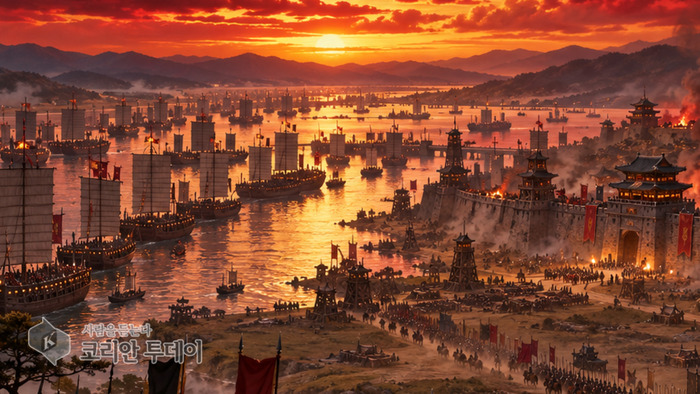
A state rarely dies from a single defeat. It dies when, after the defeat, no one trusts anyone anymore.
On the 18th day of the seventh lunar month of 660 CE, the last king of Baekje knelt before a Tang general. His kingdom, traditionally founded in the late first century BCE, had survived for roughly seven centuries by moving its capital from Hanseong to Ungjin and then to Sabi. This time, there was nowhere left to move.
Only about ten days passed between the defeat of General Gyebaek at Hwangsanbeol and the surrender of King Uija. Why did a mature, sophisticated kingdom collapse so quickly? And was the king surrendered by his enemies, or by his own commander? Think of Constantinople in 1453 or Rome in 410: the interesting question is never only how the walls fell, but why no one came to defend them.
🌍 Western Historical Parallel
In the same decades, the Byzantine Empire under the Heraclian dynasty was losing Syria and Egypt to the Rashidun and Umayyad caliphates. Like Baekje, Byzantium faced a rising power that had been underestimated until its armies were already inside the gates. The difference: Byzantium kept its capital and rebuilt; Baekje’s capital fell within days.
◆ The Ancient Landscape
The mid-seventh century belonged to Tang China. Founded in 618, Tang crushed the Eastern Turks in 630 and then turned east. Repeated invasions of Goguryeo had failed, so Tang changed its strategy: strike Goguryeo’s rear by eliminating Baekje first. Silla’s diplomat Kim Chunchu read the opportunity precisely and secured a military alliance with Tang in 648, a full twelve years before the war. The diplomatic battle was won long before the military one.
In 660, the Samguk Sagi records a Tang fleet under Su Dingfang of roughly 130,000 men, and a Silla army of about 50,000 led by Kim Yu-sin. The Tang landed at Gibeolpo, the mouth of the Geum River in today’s South Chungcheong region, while Silla broke Gyebaek at Hwangsanbeol (near modern Nonsan) and marched on Sabi (modern Buyeo). A pincer movement from sea and land, coordinated across hundreds of kilometres of water.
“King Uija fled to the northern border with Crown Prince Hyo. When Su Dingfang besieged the city, the king’s second son Tae proclaimed himself king and held firm. When Su ordered his men to climb the parapet and raise the Tang banners, Tae panicked, opened the gate and begged for his life.” (paraphrased translation)
◆ Same Era, Different Worlds
🏛️ China
Emperor Gaozong’s Tang, continuing Taizong’s expansion toward the Western Regions and the Korean peninsula. Conquering Baekje was step one in encircling Goguryeo.
🗿 Byzantine Empire
After the age of Justinian and Heraclius, the empire was defending its core against the caliphates. The Sasanian Persian Empire had already collapsed by around 651.
⚔️ Western Europe
The Merovingian Frankish kingdoms were fragmenting under powerful palace mayors, while Anglo-Saxon kingdoms competed in England. Nothing resembled Baekje’s centralized, literate bureaucracy.
🕌 Islamic World
The Umayyad Caliphate, established in 661, was consolidating a vast new empire stretching from Egypt to Central Asia.
[Image: Conceptual map of the sea-and-land pincer on Baekje’s capital, July 660 CE (not to scale)]
⚔️ Scene from That Day
“Sails stretched endlessly along the Geum River. On Sabi’s parapets, soldiers watched the water in silence. News of Gyebaek’s five thousand, who never came home from Hwangsanbeol, had already reached the city.”
“At dawn the king slipped out with his heir, heading north to Ungjin. His second son Tae held out as self-proclaimed king until Tang banners rose on the wall. Five days later, in Ungjin, the commander the king trusted stepped close to him. It was less a siege than a betrayal, the kind that ends dynasties from the inside, like a Roman general opening a gate.”
◆ Uncovering Historical Truth
The skeleton of events is this. After Hwangsanbeol in early July, the allied army advanced on Sabi. On the 13th day of the seventh lunar month, King Uija left Sabi for the fortress of Ungjin. Sabi soon fell, and on the 18th the king surrendered at Ungjin. The Samguk Sagi says Su Dingfang then took the king, Crown Prince Hyo, princes Tae, Yung and Yeon, 88 ministers and generals, and 12,807 commoners to the Tang capital. From the Tang landing to the end of the capital took only about ten days, a collapse far faster than Rome’s drawn-out decline.
New light on the scene came from a tomb epitaph of Yei Sikjin, a Baekje commander who later served Tang, discovered in China. It describes from the Tang side how Yei Sikjin, in charge of the Ungjin area, brought the king in. This fits the Samguk Sagi’s line that a general named Yei seized the king and surrendered, and suggests the surrender happened amid internal defection. By contrast, the famous “three thousand court ladies” leaping from Nakhwaam cliff is a much later tradition and is not found in sources of the period. Treat it as legend, much like the stories of Boudica’s last stand that grew in the telling.
The deeper cause was political. King Uija came to the throne in 641 and took more than forty Silla fortresses early on, but his later reign saw aristocratic infighting and loss of talent. The Samguk Sagi preserves that ministers Seongchung and Heungsu urged blocking the enemy at the Baek River (Gibeolpo) and Tanhyeon pass, advice that went unheeded. This was no feudal system of independent lords: Baekje was a centralized, Buddhist-Confucian state with a ranked bureaucracy. That centralization was also its fatal weakness, because once decisions failed at the top, the fortress network could not act alone.
Period
July 660 CE (lunar calendar)
Key Figures
King Uija, Su Dingfang, Kim Yu-sin, Yei Sikjin
Scale
~180,000 allied troops, comparable to a major Byzantine campaign army
Military
Amphibious landing plus overland assault, a combined-arms operation rare for its age
🔍 International Academic Perspectives
Korean/Asian Scholars
Most stress the combination of diplomatic isolation, elite division and the Silla-Tang alliance, and caution that the image of a dissolute Uija owes much to the victors’ records. Whether he was seized or chose to surrender is still debated.
Western Historians
English-language scholarship generally frames the war as part of Tang’s wider strategy against Goguryeo, comparing it to how Justinian’s wars reshaped the Mediterranean. Because Baekje left few of its own texts, Western historians rely heavily on Silla and Chinese sources.
📖 Key Terms Explained
- Baekje (백제, 百濟)
- Ancient Korean kingdom, traditionally founded 18 BCE and destroyed in 660 CE; one of the Three Kingdoms of Korea.
- Sabi (사비)
- Baekje’s last capital, in modern Buyeo, from 538 CE. A planned city with a fortress wall, comparable in role to Constantinople.
- Tang Dynasty
- Chinese empire (618-907 CE), contemporary with the Byzantine Empire and the early caliphates.
- Samguk Sagi
- “History of the Three Kingdoms,” compiled in 1145 by Kim Busik, Korea’s oldest surviving official history. Written centuries later by Goryeo scholars, so it reflects Silla-centered sources.
◆ Lessons for Today’s World
Silla was the weaker party, yet it drew in a superpower as an ally. Baekje leaned on Goguryeo and Yamato Japan but never turned those ties into forces that would arrive in time. Modern alliances such as NATO or the EU show the same rule: a commitment is only as strong as the forces actually prepared to move in a crisis, and credible deterrence is built long before the crisis.
The second lesson is internal trust. Seongchung’s and Heungsu’s warnings were ignored, and at the end a commander handed over his king. Today’s governments and corporations alike need channels that carry bad news upward. And historians remind us to read the winners’ portrait of the losers with a measure of skepticism.
| Aspect | Baekje Era | Modern Parallel |
|---|---|---|
| Geopolitics | Silla-Tang alliance upends the Three Kingdoms balance | Shifting US-China-Russia alignments reshape regional security |
| Military | Fortress defense bypassed by a sea landing | Modern deterrence and multi-domain defense |
| Culture | Buddhist-Confucian culture that later shaped Japan’s Asuka era | K-Culture’s global influence |
[Image: Causes of Baekje’s fall mapped to lessons for modern states]
📚 Diving Deeper
- The Baekje Historic Areas in Gongju, Buyeo and Iksan were inscribed as a UNESCO World Heritage Site in 2015. The five-story stone pagoda at Jeongnimsa Temple site in Buyeo still carries an inscription by the Tang commander celebrating the conquest.
- Baekje’s Gilt-bronze Incense Burner, found at Neungsan-ri in 1993, is as striking a find as the Sutton Hoo treasures of Anglo-Saxon England, and from nearly the same age.
- For further reading, see the Samguk Sagi Baekje and Silla Annals and studies of the Yei Sikjin epitaph; for the wider setting, the Cambridge History of China volume on Sui and Tang.
The Voice of Living History
Sabi’s gates opened in July 660, but the cracks had formed long before: warnings that never arrived, an alliance never built, an elite that no longer trusted itself. Nations seldom fall from the outside first.
“The walls fell, but Baekje did not end. From the ruins, Boksin and Dochim raised the banner once more.”
Previous Episode
Episode 22: The Battle of Hwangsanbeol – Gyebaek’s 5,000 Last Stand
Next Episode
Episode 24: The Baekje Restoration Movement – Boksin and Dochim
The Korean Today “History Lives On” Series
The Baekje Chronicle (30 Episodes)
Bridging Ancient East Asia and the Modern World
© 2025 The Korean Today. All rights reserved.
This content is based on historical facts and presents balanced academic perspectives
for international readers.
THE KOREAN TODAY × WIA CODE
이 기사의 WIA Code

WIA Code 스캐너로 비추면 인터넷 없이 발행 사실과 위·변조 여부를 확인할 수 있습니다.
휴대폰 기본 카메라로 찍으면 스캐너 안내 페이지가 열립니다 — 기사 바로 열기
움직이는 코드(스트림) 한 장에 기사 전문(사진 포함)이 담겨 있습니다 — WIA Code 스캐너로 약 32초 비추면 폰에 저장되어 인터넷 없이도 읽을 수 있습니다. Stream.mp4 도 여기서 받습니다.
WIA Code · 코리안투데이


Leave a Reply