
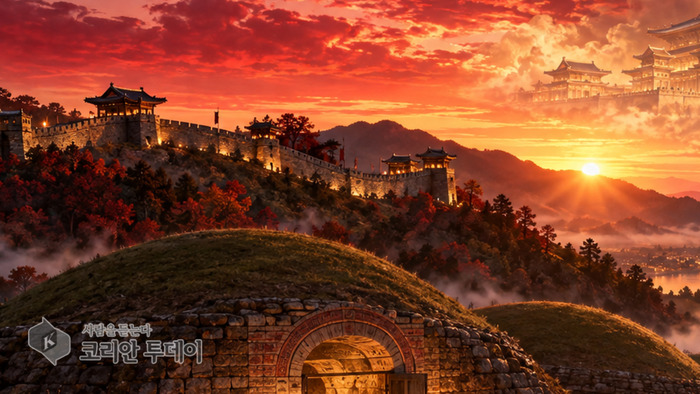
In the summer of 1971, a drainage ditch dug during the monsoon season uncovered a king who had slept underground for some 1,400 years.
After the fall of the capital Sabi in 660 CE, Baekje survived in written history only thinly. The Samguk Sagi was compiled from the perspective of the Korean states that outlasted it, and almost no Baekje-authored chronicle survives. The vivid face Baekje shows the world today is largely the work of the shovel, not the archive.
Think of Howard Carter opening Tutankhamun’s tomb in 1922, or the 1939 discovery of the Sutton Hoo ship burial in England. Korea had its own such moment in Gongju. Who dug, when, and with what motives? This episode traces a century of rediscovery, from colonial-era looting to UNESCO inscription in 2015.
🌍 Western Historical Parallel
Baekje moved its capital to Sabi (modern Buyeo) in 538, just a year after Emperor Justinian completed the Hagia Sophia in Constantinople in 537. King Muryeong, whose tomb was found in 1971, reigned from 501 to 523, a generation when the Western Roman Empire had already fallen and Frankish and other successor kingdoms were taking shape. The Convention that created the UNESCO World Heritage system was adopted in 1972, only a year after Muryeong’s tomb came to light.
◆ The Ancient Landscape
In 475, Goguryeo’s assault cost Baekje its capital Hanseong, and the court relocated south to Ungjin (modern Gongju). In 538 it moved again to Sabi (modern Buyeo). For roughly 180 years these two cities in today’s South Chungcheong Province were the heart of the kingdom. After Sabi fell in 660, palaces, temples and royal tombs lay buried and forgotten.
Modern investigation began under Japanese colonial rule. Between 1927 and 1933 the Songsan-ri tombs in Gongju were handled by Karube Jion and the Government-General Museum. Karube, a schoolteacher, dug large numbers of tombs, and the museum’s own artifact cards record his activity as unauthorized digging. The records have scholarly value, but the scattered finds and lost context can never be fully recovered. In 1933 the Government-General Museum formally investigated Tomb No. 6.
“King Muryeong stood eight cheok tall, with eyes as fine as a painting; he was benevolent and generous, and the hearts of the people turned to him.” (paraphrase of the chronicle’s description of the king)
◆ Same Era, Different Worlds
🏛️ China
During Muryeong’s reign China was divided in the Northern and Southern Dynasties. Baekje traded actively with the Southern Liang, and its brick-chamber tomb style reflects that influence. The Tang did not yet exist; it would be Tang that helped end Baekje in 660.
🗿 Byzantine Empire
Justinian I completed the Hagia Sophia in 537, while Baekje was building its new capital at Sabi.
⚔️ Western Europe
Frankish and other Germanic successor kingdoms ruled former Roman lands. The Sutton Hoo ship burial in England dates from a century later, around the early 7th century.
🕌 Islamic World
Islam had not yet emerged in Muryeong’s day. By 660 the early Caliphate was already expanding rapidly across the Middle East, a very different world from the Baekje court.
[Image: Timeline of Baekje’s rediscovery, 1927-2015]
⚔️ Scene from That Day
“July 1971, Songsan-ri, Gongju. Workers dig a drainage channel to stop water seeping into Tomb No. 6. A shovel strikes something hard: a wall of neatly laid bricks. As the damp soil falls away, an arched brick entrance appears.”
“Once the seal is opened, a stone guardian beast meets the eyes first in the dark. On the floor lie epitaph tablets naming a king and queen. For the first time in about 1,400 years the occupant is identified in writing, as with an inscribed Egyptian cartouche. The excavation was hurried, a regret scholars still voice today.”
◆ Uncovering Historical Truth
The Tomb of King Muryeong was found by chance in 1971 during drainage work at Songsan-ri Tomb No. 6. About 4,600 items in 108 categories were recovered, and 12 are designated National Treasures. Crucially, an epitaph identifies the occupant, making it the only ancient royal tomb in Korea whose owner is known with certainty. The tablet records that King Sama, that is Muryeong, died in 523, confirming the Samguk Sagi in stone. Few Western finds offer so clean a match between an excavated burial and a named ruler.
On 12 December 1993, a gilt-bronze incense burner was unearthed at the Neungsan-ri temple site in Buyeo. Standing 61.8 cm tall and weighing about 11.85 kg, this National Treasure No. 287 is dated to the late 6th century, probably under King Wideok. A lotus-shaped body supported by a dragon carries mountains, immortals, musicians and animals, fusing Buddhist and Daoist imagery. If Sutton Hoo gives us the helmet and purse lid of an Anglo-Saxon king, this is Baekje’s counterpart in artistry. It is held at the National Museum of Buyeo.
Society also built ways of remembering. In April 1955 Buyeo held a rite honoring three loyal ministers, Seongchung, Heungsu and Gyebaek, and consoling the spirits associated with Nakhwaam cliff. Renamed the Baekje Cultural Festival from its 11th edition in 1965, it was held in both Gongju and Buyeo from 1966, alternated between them from 1979, and has been jointly hosted since 2007. A ritual of mourning gradually became a heritage-tourism festival.
On 4 July 2015, at its 39th session in Bonn, the World Heritage Committee inscribed the Baekje Historic Areas. They comprise eight components: Gongsanseong and the Songsan-ri tombs in Gongju; Gwanbuk-ri and Busosanseong, the Neungsan-ri tombs, Jeongnimsa Temple Site and the Naseong city wall in Buyeo; and the Wanggung-ri site and Mireuksa Temple Site in Iksan. The Committee cited the sites as evidence of exchange among ancient Korea, China and Japan, of advances in building technology, and of the spread of Buddhism.
Period
Ungjin-Sabi era (475-660 CE); rediscovery 1927-2015
Key Figure
King Muryeong; King Wideok
Sites
8 UNESCO components across Gongju, Buyeo and Iksan
Finds
About 4,600 grave goods; a 61.8 cm gilt-bronze censer
🔍 International Academic Perspectives
Korean/Asian Scholars
Colonial-era surveys left baseline data but mixed in unauthorized digging and colonialist interpretation, so they need critical re-examination. Post-liberation research has rebuilt Baekje history on its own terms, and some scholars regret how hurried the 1971 excavation was.
Western Historians
Heritage scholars in the West debate a familiar tension, much as with Stonehenge or Pompeii: tourism and development can erode the authenticity they are meant to celebrate. We note this as a general debate in heritage studies rather than a specific published verdict on Baekje.
📖 Key Terms Explained
- Baekje (百濟)
- Ancient Korean kingdom, one of the Three Kingdoms, traditionally founded in 18 BCE and ending in 660 CE with the fall of Sabi
- Ungjin and Sabi
- Baekje’s capitals from 475 and from 538, modern Gongju and Buyeo
- Jiseok (epitaph tablet)
- Stone tablets placed in a tomb naming the deceased, comparable to a Roman funerary inscription
◆ Lessons for Today’s World
Heritage does not end at the moment of excavation. The confusion around Muryeong’s tomb taught that how you dig matters as much as what you dig. Today, rather than reopening chambers, conservators lean toward non-destructive survey technology.
Like Europe’s World Heritage cities, Gongju and Buyeo now balance identity, local economy and conservation under visitor pressure. Shared stewardship of sites that record cross-border exchange is also a quiet lesson for modern East Asia, where Korea, China and Japan share a heritage that no single nation owns.
| Aspect | Baekje Era | Modern Parallel |
|---|---|---|
| Meaning of heritage | Royal tombs, temples and palaces as state authority | Shared World Heritage of humanity |
| Exchange | Technology and Buddhism traded with Southern China and Wa (Japan) | Joint Korea-China-Japan research and traveling exhibitions |
| Culture | Refined Buddhist-Daoist aesthetics | Heritage tourism and K-Culture’s search for roots |
[Image: From ancient kingdom to a World Heritage landscape in modern Korea]
📚 Diving Deeper
- Visit the Tomb of King Muryeong and the royal tombs at Songsan-ri, Gongju, where a replica gallery shows the interior, plus Gongsanseong Fortress and the Buyeo sites.
- The Neungsan-ri temple site also yielded the Changwang-dated stone reliquary, a key source on Baekje Buddhism; the Baekje incense burner is often compared in importance to Sutton Hoo’s finds.
- See the National Museums of Gongju and Buyeo, and the annual Baekje Cultural Festival each autumn; for scholarship, consult the English-language volumes on early Korea and East Asia from major university presses.
The Voice of Living History
A kingdom vanished, but the land remembered. A single drainage ditch and a car-park construction site gave a kingdom its face back. To protect heritage is to remember who we are, wherever we live.
“The breath of Baekje, awakened from the earth, still lives beneath the skies of Gongju and Buyeo.”
Previous Episode
Episode 26: The Baekje Diaspora
Next Episode
Episode 28: Studying Baekje – Contrasts with the Nihon Shoki
The Korean Today “History Lives On” Series
The Baekje Chronicle (30 Episodes)
Bridging Ancient East Asia and the Modern World
© 2025 The Korean Today. All rights reserved.
This content is based on historical facts and presents balanced academic perspectives
for international readers.
THE KOREAN TODAY × WIA CODE
이 기사의 WIA Code

WIA Code 스캐너로 비추면 인터넷 없이 발행 사실과 위·변조 여부를 확인할 수 있습니다.
휴대폰 기본 카메라로 찍으면 스캐너 안내 페이지가 열립니다 — 기사 바로 열기
움직이는 코드(스트림) 한 장에 기사 전문(사진 포함)이 담겨 있습니다 — WIA Code 스캐너로 약 29초 비추면 폰에 저장되어 인터넷 없이도 읽을 수 있습니다. Stream.mp4 도 여기서 받습니다.
WIA Code · 코리안투데이


Leave a Reply