
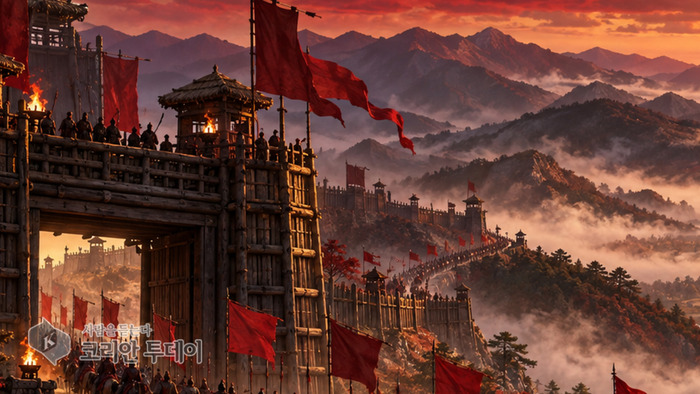
What happens when a boy raised as a hostage in a rival court grows up to wear a crown?
In the early fifth century, Silla was a modest kingdom in the southeast of the Korean peninsula, ruled by kings who still bore the title maripgan. In 400 CE, a Goguryeo army sent by King Gwanggaeto drove back Wa and Gaya forces that had pressed on Silla. The rescue was also a leash: a small state that survives on a larger neighbor’s soldiers rarely stays fully independent. Silla’s royal house responded by swapping princes as hostages with Goguryeo, Wa and Baekje, and by learning, painfully, how to balance one patron against another.
Silseong spent years as a hostage in Goguryeo before taking the throne. His successor Nulji overthrew him and spent his reign loosening Goguryeo’s grip. It is a story that Europeans will recognize: Rome, too, raised barbarian princes in its courts, and later paid the price.
🌍 Western Historical Parallel
While Silseong and Nulji maneuvered, Rome itself was shaken: the Visigoths under Alaric, himself a man who had served in Roman armies, sacked the city in 410. Hostage-taking was a standard tool of Roman diplomacy; the future Hun leader Attila is said to have spent part of his youth as a hostage at the Roman court, though sources on this are thin. Like Silla, Rome learned that a hostage can return as a friend, or as a conqueror.
◆ The Ancient Landscape
Silla sat around modern Gyeongju in southeastern Korea. To its north lay Goguryeo, the great power of Manchuria and northern Korea under Gwanggaeto (r. 391-413) and his son Jangsu (r. 413-491). To its west was Baekje, and across the sea lay Wa, the polity of the Japanese archipelago. China was fractured, which left room for Goguryeo’s rise.
According to the Samguk Sagi, King Naemul sent Silseong to Goguryeo as a hostage in 391. When Naemul died, Silseong took the throne in 402 and, in turn, sent Naemul’s sons abroad: Misahun to Wa in 402 and Bokho to Goguryeo in 412. In 417 Naemul’s eldest son Nulji killed Silseong and became king. That is roughly the same decade in which Alaric’s Visigoths were sacking Rome, and the Western Empire was nearing its last decades.
(Paraphrase) Resenting that King Naemul had sent him to Goguryeo as a hostage, Silseong sent Naemul’s sons abroad once enthroned. When Nulji’s reputation grew, he tried to eliminate him, but was himself killed by Nulji.
◆ Same Era, Different Worlds
🏛️ China
The Eastern Jin fell in 420 and the Liu Song followed, opening the Northern and Southern Dynasties. Northern Wei unified the north in 439. (The Sui and Tang came much later.)
🗿 Byzantine Empire
Theodosius II (r. 408-450) built the great land walls of Constantinople. (Justinian and Heraclius belong to later centuries.)
⚔️ Western Europe
Rome was sacked in 410, and Germanic kingdoms began to settle inside the empire’s former provinces. The Western Empire ended in 476.
🕌 Islamic World
Islam did not yet exist. The region was dominated by the Sasanian Persian Empire. The Caliphate’s expansion began only in the 630s.
[Image: Schematic of hostage movements and diplomacy around Silla, early 5th century CE]
⚔️ Scene from That Day
“(Reconstruction) Winter, 418. Beyond the gates of a Goguryeo fortress, the envoy Bak Jesang spurs his horse. Beside him, hunched low, rides Prince Bokho, a hostage for years. Hoofbeats gather behind them.”
“(Reconstruction) Then Jesang crosses the sea to Wa, puts Misahun on a boat for home, and stays behind. Think of a Roman legate who stays at the barbarian court so the hostage can escape: the Samguk Sagi says he died without yielding.”
◆ Uncovering Historical Truth
Silseong’s rise shows how deeply Goguryeo shaped Silla’s court. A man who spent about a decade in the Goguryeo capital became king, then used the same hostage system to remove rivals. This resembles Rome’s client-king system, in which allied rulers were raised or propped up by the empire. Silseong’s gamble failed because Nulji, who remained in Silla, won the people. In 417 Nulji killed him and took the throne.
Archaeology preserves the shadow. A bronze bowl (ho-u) from the Hououchong tomb in Gyeongju carries an inscription dated “eulmyo year,” read as 415 CE, naming Gwanggaeto. It was made in Goguryeo and found in a Silla tomb. Some scholars link it to the hostage Prince Bokho; yet most now date the tomb itself to the early 6th century, so the bowl may have been kept for generations. Think of Roman silver found in Scandinavian graves: an object tells of contact, not necessarily of the moment it was buried.
Nulji pursued two paths: recovering the hostages through Bak Jesang, and building an alliance with Baekje. In 433 he made peace with King Biyu of Baekje, and in 434 the two exchanged gifts, laying the foundations of the Nala Alliance (Silla-Baekje). Goguryeo’s King Jangsu had moved his capital to Pyongyang in 427, pushing south. The alliance resembles the shifting coalitions among post-Roman Germanic kingdoms, but there was no overarching empire to be loyal to. Buddhism also arrived in Silla through Goguryeo in Nulji’s era, according to tradition, although sources disagree on the date.
Period
Early to mid 5th century CE (402-458)
Key Figures
Silseong, Nulji, Bak Jesang
Diplomacy
Hostage exchanges, 433 alliance with Baekje
Comparison
Roman client kings and foederati
🔍 International Academic Perspectives
Korean/Asian Scholars
The mainstream view holds that Silseong came to power with Goguryeo backing, that Goguryeo also intervened in Nulji’s accession, and that Silla then worked to escape its influence.
Source-Critical Views
The Samguk Yusa gives different names and dates for the hostages (Mihae to Wa in 390, Bohae to Goguryeo in 419). Some scholars therefore treat the Bak Jesang story as partly legendary and the exact dating as uncertain. Western scholarship on early Silla remains limited.
📖 Key Terms Explained
- Maripgan
- The title of Silla’s kings in this era, roughly “senior chief,” before the later adoption of the Chinese-style title wang (king).
- Nala Alliance
- The Silla-Baekje alliance formed in 433 against Goguryeo’s southward expansion.
- Samguk Sagi / Samguk Yusa
- Korea’s two main medieval sources on the Three Kingdoms, compiled in the 12th and 13th centuries respectively.
◆ Lessons for Today’s World
Nulji’s choice was not “Goguryeo or Baekje.” He kept channels open to the stronger neighbor while building a partnership with another, widening his options. Like the Baltic states or Finland, small states next to great powers tend to survive by never depending on a single patron, and by investing in capable diplomats.
Today’s South Korea faces a similar dilemma: security ties to the United States, economic ties to China. The Silla lesson is not neutrality, but flexibility: keep multiple partners, and keep your own decision-making.
| Aspect | Silla Era | Modern Parallel |
|---|---|---|
| Geopolitics | Balancing Goguryeo, Baekje and Wa | Navigating US-China rivalry |
| Diplomacy | Hostage returns, 433 alliance | Multilateral and supply-chain diplomacy |
| Culture | Bak Jesang’s loyalty, adopting Buddhism | K-Culture as soft power |
[Image: From Silla’s pragmatic diplomacy to modern Korea’s strategic position]
📚 Diving Deeper
- Gyeongju Historic Areas (UNESCO World Heritage) and the National Gyeongju Museum, home to Silla treasures including the Hououchong bronze bowl.
- Compare the inscription on the Goguryeo-made bowl with Sutton Hoo’s imported Byzantine silver: both show how far prestige objects travelled.
- Further reading: Samguk Sagi (Silla annals and the biography of Bak Jesang), Samguk Yusa, and the Cambridge History of Early Inner Asia and East Asia surveys on the Korean states.
The Voice of Living History
The shadow of a great power cannot be avoided, but what a small state learns inside it, and which friends it makes, can be chosen. Silla grew up in Goguryeo’s shadow and prepared for its own independence.
“The tree that roots in shade grows deepest.”
Previous Episode
Episode 3: King Naemul – The True Beginning of Silla
Next Episode
Episode 5: King Jijeung’s Reforms – The Birth of “Silla”
The Korean Today “History Lives On” Series
The Silla Chronicle (35 Episodes)
Bridging Ancient East Asia and the Modern World
© 2025 The Korean Today. All rights reserved.
This content is based on historical facts and presents balanced academic perspectives
for international readers.


Leave a Reply