
The Dementia Care Center (Director Kim Young-ran) of Michuhol-gu District (Mayor Kim Jung-sik) in Incheon has extended its network of medical institutions for early dementia screening to neighborhood clinics. On the 21st, the center signed early dementia screening agreements with two more clinic-level medical institutions, Shin Dong-jin Neurology Clinic and Malgeun Brain Neurology Clinic. This brings the total number of partner hospitals for early dementia screening in Michuhol-gu to 13.
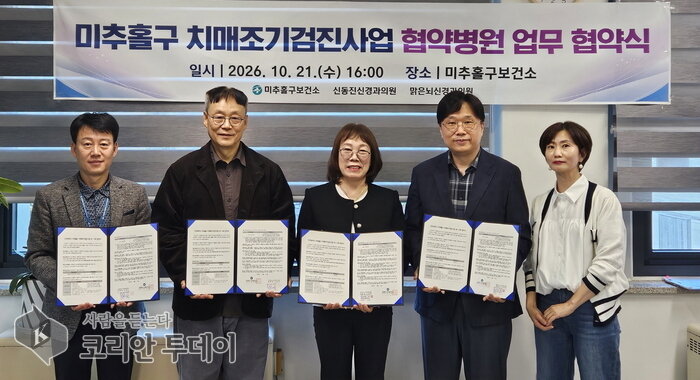 [The Korean Today] Early dementia screening agreement signing © Reporter Kim Mi-hee |
The agreements aim to help prevent dementia among local residents and detect it early. Until now, the center had maintained agreements with 11 medical institutions, including general hospitals, to provide detailed diagnoses for residents suspected of having dementia. The existing partner institutions are Gotbaro Hospital, International St. Mary’s Hospital, New Sungmin Hospital, Ain Hospital, Incheon Medical Center, Incheon Veterans Hospital, Incheon Sarang Hospital, Incheon Red Cross Hospital, Inha University Hospital, Juan Nanuri Hospital and Hyundai Ubis Hospital.
What sets this expansion apart is that clinic-level medical institutions have joined the partner network. With neurology clinics close to residents’ homes added to a screening and diagnosis system that had centered on general hospitals, residents can now get tested and diagnosed more easily in their own neighborhoods. The center expects the agreements to contribute significantly to treating dementia at the right time and keeping symptoms from getting worse.
The program has set eligibility rules and procedures. Any resident who has not yet been diagnosed with dementia or mild cognitive impairment can receive early dementia screening free of charge. Residents only need to bring an ID card and visit the center at 20 Gyeongin-ro 34beon-gil.
Screening proceeds in three stages. Residents first take a Stage 1 cognitive screening test, and those found to have cognitive decline move on to a Stage 2 diagnostic test, which can be taken at the center or at a partner hospital. A Stage 3 differential test to identify the cause follows, using CT, MRI and blood tests, and is conducted in conjunction with partner hospitals.
Dementia is known as a condition in which earlier detection and management can slow its progression and ease the burden on patients and their families. Even when people notice a decline in cognitive function, however, they tend to put off screening if testing facilities are far away or the procedures are complicated. With nearby clinics now part of a system that runs from screening tests through detailed examinations, the barrier for elderly residents and their families to begin screening is expected to come down considerably.
“Through these agreements, we have further strengthened our cooperation with local medical institutions and created an environment in which residents can receive prompt and systematic screening,” Director Kim Young-ran said. “We will continue to do our utmost to prevent dementia and detect it early among local residents.”
With the number of partner medical institutions rising to 13, Michuhol-gu’s dementia management system now spans both general hospitals and neighborhood clinics. How much participation in early screening rises, and whether the partner network actually leads to timely treatment, are expected to be the yardsticks for measuring the program’s results.
[ Reporter Kim Mi-hee: incheonsouth@thekoreantoday.com ]
Become a Local Ambassador Apply as Branch Director The Korean Today — Nam-Incheon
 |



답글 남기기