
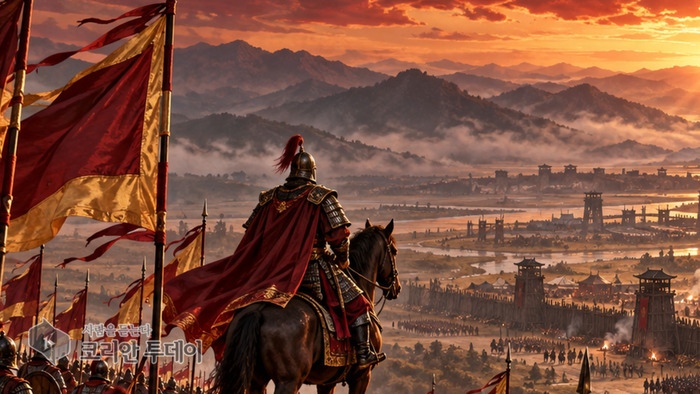
The great-grandson of a conquered king became the supreme commander of the conquering state. Belisarius served a Roman emperor; Kim Yu-sin served a kingdom that had absorbed his own.
Kim Yu-sin (595-673) descended from the last king of Geumgwan Gaya, a small confederation that surrendered to Silla in 532. Silla welcomed the Gaya royals into its aristocracy as “true bone” nobles, yet they remained outsiders. From that position, he spent roughly half a century commanding Silla’s armies and helped bring down Baekje and Goguryeo. He is the clearest example in early Korean history of competence and trust overcoming a birth-rank barrier.
Why would a rigid caste society hand its survival to a general from a vanquished house? And what does it take to hold that trust for decades? Western readers will recognize the question from the careers of Belisarius and Stilicho.
🌍 Western Historical Parallel
While Kim Yu-sin was commanding Silla’s armies, Emperor Heraclius (r. 610-641) was fighting Persia and then facing the first Arab conquests in the Byzantine East. A generation earlier, Justinian’s general Belisarius had reconquered North Africa and Italy for the empire. Like Belisarius, Kim Yu-sin was a state’s indispensable soldier. Unlike Belisarius, who ended his life under imperial suspicion, he kept the court’s confidence until his death.
◆ The Ancient Landscape
In the late 6th and early 7th centuries the Korean peninsula was a three-way struggle among Goguryeo (north, into today’s Manchuria), Baekje (southwest) and Silla (southeast, around modern Gyeongju). Silla was the weakest. In 642 a Baekje assault captured Daeya Fortress (near modern Hapcheon), one of Silla’s western strongholds. Meanwhile, China had been reunified: the Tang dynasty rose in 618 and soon looked east.
Tradition says Kim Yu-sin became a Hwarang (“flower youth,” an elite young warrior corps) around the age of 15 and led a band called the Dragon Flower Disciples. In 629, under King Jinpyeong, he fought as a mid-level commander at the Goguryeo fortress of Nangbi, where he is said to have charged into the enemy line and taken a general’s head, lifting Silla’s morale. Soon after he joined forces with Kim Chunchu (the future King Muyeol, Episode 13). If Chunchu drew the blueprint of unification, Yu-sin built it.
“I have heard that when you shake the collar the whole coat falls straight, and when you pull the main rope the whole net spreads open. I will be that collar and that rope.”
◆ Same Era, Different Worlds
🏛️ China
The Tang (founded 618) expanded under Emperors Taizong (r. 626-649) and Gaozong (r. 649-683) and campaigned against Goguryeo. Silla pulled this superpower into its war plans.
🗿 Byzantine Empire
Heraclius (610-641) defeated Sasanian Persia, then lost Syria and Egypt to the Arabs. Justinian’s reconquest wars (a generation earlier) had overstretched the empire.
⚔️ Western Europe
Frankish kings such as Dagobert I (d. c. 639) ruled fragmented realms, and Anglo-Saxon kingdoms (the Sutton Hoo ship burial dates to the 620s) were still forming.
🕌 Islamic World
After Muhammad’s death in 632, the early caliphs overran Sasanian Persia and much of the Byzantine East within a generation.
[Image: Schematic of Silla’s campaigns against Baekje and Goguryeo (660-668 CE)]
⚔️ Scene from That Day
“July 660, the plain of Hwangsanbeol. Some 5,000 Baekje defenders have dug in behind three camps that choke the road. Silla’s army of about 50,000 charges four times and is thrown back four times. In the command tent the silence is heavy.”
“Then, as the Samguk Sagi tells it, two young Hwarang, Ban-gul and Gwanchang, ride alone into the enemy line and die. The Silla ranks, seeing it, surge forward under drums and war cries, and the Baekje camps break. The man commanding was Yu-sin, 65 by Western reckoning, a gray-haired veteran in the manner of a Roman legate who has seen it all.”
◆ Uncovering Historical Truth
His strength was not swordsmanship alone. After Daeya Fortress fell in 642, Kim Chunchu went to Goguryeo to seek help, and Yu-sin is said to have waited at the border with 3,000 troops, vowing to invade if Chunchu was not back in 60 days. Diplomacy backed by a ready army was the core of the Chunchu-Yu-sin partnership. It was sealed by marriage: Yu-sin’s sister Munhui became Chunchu’s consort, tying the two houses together, much as Merovingian and Carolingian alliances were built through marriage.
The 660 campaign was a joint operation with Tang. The Tang general Su Dingfang crossed the sea while Silla marched overland, converging on Baekje’s capital, Sabi (modern Buyeo); Baekje fell that summer. Around 662, Yu-sin helped sustain the Goguryeo front by delivering grain across winter terrain to the Tang army near Pyongyang. After Goguryeo fell in 668, King Munmu granted him the unique rank of Taedaegakgan, a title above Silla’s normal ladder. Archaeologically, a tomb in Seoak-dong, Gyeongju, traditionally attributed to him, has a ring of twelve zodiac guardian reliefs; the attribution is not certain.
The trust also had a structural logic. Silla ranked people by the “bone-rank” system, a hereditary hierarchy somewhat like a caste-and-estate order. As a Gaya-descended true-bone noble, Yu-sin could never be king, which made him a safer supreme commander than a rival royal would have been. He died in 673 at age 79, while Silla was still fighting its former Tang ally (670-676), so completing unification fell to his successors. The 9th-century king Heungdeok is said to have posthumously honored him as “Great King Heungmu.”
Period
Late 6th to late 7th century CE (595-673)
Key Figure
Kim Yu-sin, with Kim Chunchu and King Munmu
Key Events
Nangbi (629), fall of Baekje (660), fall of Goguryeo (668)
Military
Combined arms with Tang land and sea forces; elite Hwarang cadres
🔍 International Academic Perspectives
Korean/Asian Scholars
Treat him as Silla’s foremost military leader and the practical engine of unification; the Samguk Sagi gives him three chapters of biography, more than any other individual.
Western Historians
Scholars such as Richard McBride argue that his biography reflects the agendas of its sources, notably the account compiled by his descendant Kim Jang-cheong, so legend and politics are woven into the record.
📖 Key Terms Explained
- Silla (新羅)
- Ancient Korean kingdom, traditionally dated 57 BCE to 935 CE; it unified most of the peninsula in the 7th century.
- Gaya (伽耶)
- A confederation of small city-states on the southern coast; Geumgwan Gaya surrendered to Silla in 532.
- Hwarang (花郎)
- Silla’s “flower youth,” an elite corps of aristocratic young men trained in martial skills and ethics.
- Taedaegakgan (太大角干)
- An honorary supreme rank created above Silla’s normal officials; roughly like a “Grand Marshal.”
- Tang Dynasty
- Chinese empire (618-907 CE), contemporary with the Byzantine Empire under Heraclius and his successors.
◆ Lessons for Today’s World
Silla’s small state survived by aligning with a distant great power, a pattern that echoes the logic of modern alliances such as NATO, where smaller states trade strategic dependence for security. The partnership of a diplomatic planner and a trusted field commander also resembles the best civil-military pairings of modern governments.
The cautionary side is just as modern. Silla’s Tang ally became its adversary within two years of Goguryeo’s fall, a reminder that coalitions end when the common enemy does. And a single hero’s reputation, written down by descendants, needs critical reading.
| Aspect | Silla Era | Modern Parallel |
|---|---|---|
| Geopolitics | Three Kingdoms rivalry; Tang as external great power | Middle powers balancing among US, China and Russia |
| Military | Joint land-sea operations with Tang | Combined commands and alliance deterrence |
| Culture | Hwarang ethos, Buddhist-Confucian blend | K-Culture and K-Defense soft and hard power |
[Image: From ancient general to modern leadership lessons]
📚 Diving Deeper
- Gyeongju Historic Areas (UNESCO World Heritage) hold Silla’s capital remains; the tomb attributed to Kim Yu-sin lies in the Seoak-dong area, with zodiac reliefs around its base.
- A legend says he beheaded his own horse after it carried him, drunk, to a courtesan’s house; whether true or not, it became a parable of self-discipline. For royal-burial comparison, see Silla’s gold-crown tombs, often compared to Sutton Hoo.
- Further reading: the Samguk Sagi biographies of Kim Yu-sin; Richard McBride, “Hidden Agendas in the Life Writings of Kim Yusin” (1998); The Cambridge History of China volumes on Sui and Tang for the wider context.
The Voice of Living History
An outsider became the pillar of a victorious state through consistency and duty, not birthright. Every society that asks who deserves command can find its answer, and its warning, in his life.
“Hold the collar, and the whole coat hangs true.”
Previous Episode
Episode 13: King Muyeol Kim Chunchu, Architect of Unification
Next Episode
Episode 15: The Conquest of Baekje, Victory of 660
The Korean Today “History Lives On” Series
The Silla Chronicle (35 Episodes)
Bridging Ancient East Asia and the Modern World
© 2025 The Korean Today. All rights reserved.
This content is based on historical facts and presents balanced academic perspectives
for international readers.

답글 남기기