
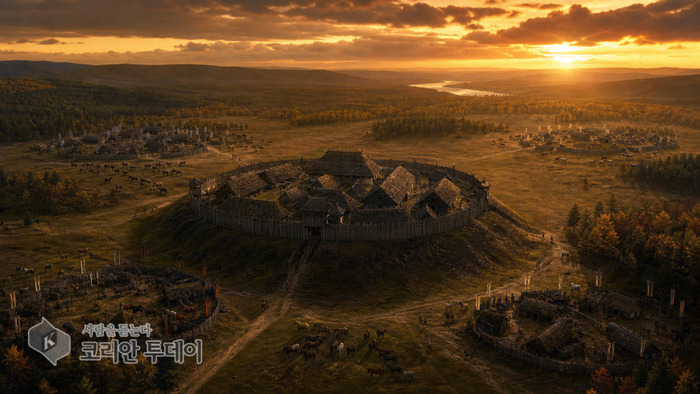
There was a king – but half the kingdom did not belong to him.
Buyeo, one of the earliest states to rise in the Songhua River basin of Manchuria, had a king who looked nothing like the absolute monarchs we usually imagine. Four roads radiated out from the royal center in four directions – the Sachuldo, or “Four Outgoing Roads” – and each was governed by an official whose title was borrowed from livestock: Maga (Horse-Ga), Uga (Ox-Ga), Jeoga (Pig-Ga), and Guga (Dog-Ga).
By modern standards it sounds like a strange kingdom – a king who let his own nobles rule most of his territory, and who was personally blamed whenever the harvest failed. But was it really so strange? Or was this one of the oldest surviving blueprints for an idea we still wrestle with today: never letting one person hold all the power?
🌍 Western Historical Parallel
While Buyeo’s four Ga governed their own quarters of the kingdom, Rome was living through its own “Crisis of the Third Century” (235-284 CE), and beyond its frontier, Germanic peoples such as the Goths, Franks, and Alemanni were organizing themselves in a strikingly similar way: kings who held real but limited power, checked by tribal chiefs and armed assemblies of free men – a structure Tacitus had already described in his Germania more than a century earlier.
◆ The Ancient Landscape
Ironically, much of what we know about Buyeo’s political structure survives thanks to a neighboring rival. When the Wei general Guanqiu Jian campaigned against Goguryeo in 244-245 CE, detailed intelligence about the peoples of the northeast – Buyeo among them – reached the Chinese court. That intelligence was later folded into the “Treatise on the Eastern Barbarians” in the Sanguozhi (Records of the Three Kingdoms), compiled by the historian Chen Shou in the late 3rd century. Buyeo itself had risen in the Songhua River basin by around the 2nd-4th century BCE at the latest, and endured as a regional power until it was absorbed into Goguryeo in 494 CE.
What the Treatise on the Eastern Barbarians records is a genuinely unusual system of government. Below the king, six official titles were all named after domestic animals: Maga (horse), Uga (ox), Jeoga (pig), Guga (dog), plus daesa, daesaja, and saja. Of these, the four animal-named “Ga” each independently governed one of the Sachuldo – the four routes radiating outward from the royal capital. The larger domains ruled several thousand households; the smaller ones, several hundred.
“The state has a king. All its officials are named after the six domestic animals: Maga, Uga, Jeoga, Guga, daesa, daesaja, and saja… Each Ga separately governed one of the Sachuldo – the greater ruling several thousand households, the lesser several hundred.”
◆ Same Era, Different Worlds
🏛️ China
The 3rd century CE, when the Han dynasty had collapsed and Wei, Shu, and Wu fought for supremacy. It was Wei’s campaign into the northeast that left us our clearest written record of Buyeo.
🗿 Rome and Beyond
Rome’s Third-Century Crisis, and beyond its Rhine and Danube frontiers, Gothic and Frankish confederations governed by kings whose power depended on the consent of warrior-nobles – not unlike Buyeo’s Ga.
⚔️ Korean Peninsula
To Buyeo’s south, Goguryeo was locked in its own wars with Wei, while smaller Samhan polities in the south were still loose confederations without a single centralized king.
🌏 Japan
The Japanese archipelago was home to the Yamatai confederation and other small polities, again ruled less by a single monarch than by a coalition of local chiefs.
[Image: The royal center of Buyeo and the four Sachuldo routes governed by Maga, Uga, Jeoga, and Guga (391-668 CE map convention adapted for context)]
⚔️ Scene from That Day
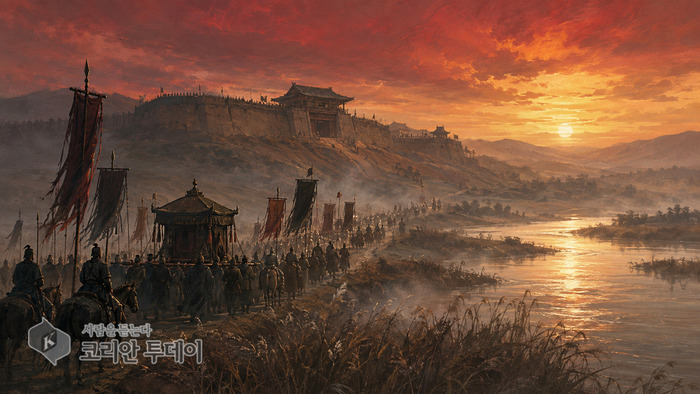
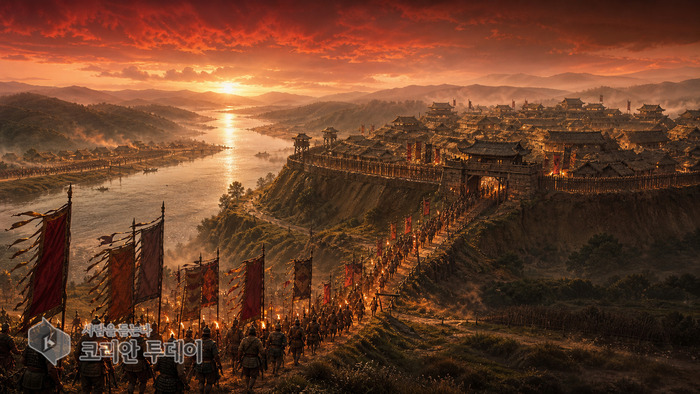
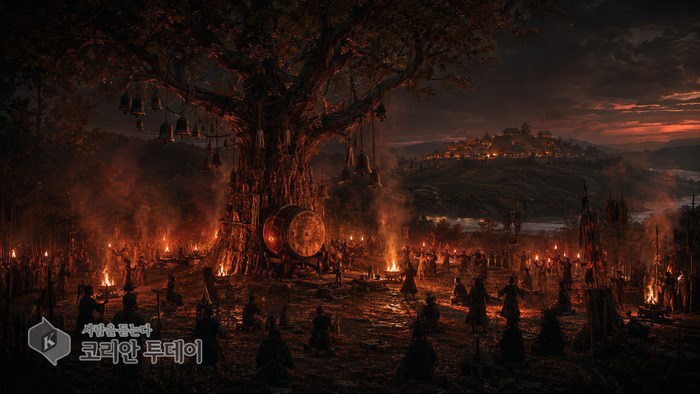
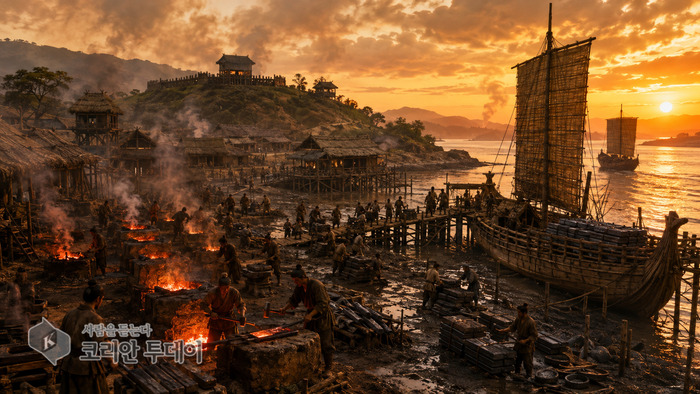
“For two months the autumn sky had refused to clear. In the open ground before the royal residence, Maga and Uga, Jeoga and Guga arrived one by one, each trailing his own retinue of armed men. The grain stores were emptying. The earth had cracked open like old leather.”
“It was Uga, the eldest among them, who finally spoke, his voice low: ‘Heaven’s anger falls on us because the king’s virtue has failed.’ No one contradicted him. The king said nothing – and understood, once again, that his throne rested precariously on the armies and loyalties held by four other men.”
◆ Uncovering Historical Truth
The titles Maga, Uga, Jeoga, and Guga carry more meaning than they first appear to. Horses, oxen, pigs, and dogs were the principal livestock the people of Buyeo raised. The Sanguozhi specifically notes that the people of Buyeo “excelled at raising livestock” – evidence that Buyeo was not a purely nomadic society but a mixed agricultural-pastoral one. That the ruling titles were drawn from livestock strongly suggests each Ga originally rose to power as the head of his own pastoral community, a local strongman whose authority was rooted in land and herds rather than granted by the crown.
The essence of the Sachuldo system was that the king never ruled the whole kingdom directly. He governed only the central district around his own residence; the four surrounding routes belonged, in practice, to Maga, Uga, Jeoga, and Guga, each commanding his own troops and administering his own territory. In wartime, each Ga led his own soldiers into battle rather than following a unified royal army – and each could exert real influence over who succeeded to the throne. The king was, in effect, first among several powerful equals – not a monarch who ruled unconditionally above them, much like an early medieval European king who depended on the loyalty of his dukes and counts.
This structural weakness is nowhere more visible than in Buyeo’s response to famine. The Sanguozhi records: “In the old customs of Buyeo, when irregular flood and drought kept the five grains from ripening, the fault was always laid on the king – some said he should be replaced, others that he should be killed.” Harsh as this sounds to modern ears, it reveals a king who held a priestly authority mediating between heaven and earth, yet whose legitimacy had to be perpetually re-earned through tangible results – a good harvest. Kingship in Buyeo was not handed down from heaven unconditionally; it survived only for as long as the four Ga, and the people beneath them, chose to accept it.
Recorded
Late 3rd century CE (Sanguozhi)
Key Powers
Maga, Uga, Jeoga, Guga
System
Sachuldo (Four Outgoing Roads)
Significance
Transition from confederated to centralized kingship
🔍 International Academic Perspectives
Mainstream View
Most Korean historians see the Sachuldo as a textbook example of an early “confederated kingdom,” where regional strongmen jointly elevated a king – and Buyeo’s monarchy remained comparatively weaker than the later, more centralized Goguryeo or Baekje.
Alternative View
Because the Sanguozhi itself calls the king-blaming custom an “old custom (舊夫餘俗),” some scholars argue the practice was already fading by the 3rd century, and that Buyeo’s kingship was in fact in the midst of gradually consolidating power.
📖 Key Terms Explained
- Buyeo (부여, 夫餘)
- Ancient kingdom centered on the Songhua River basin in Manchuria, active from roughly the 2nd-4th century BCE until it was absorbed by Goguryeo in 494 CE; regarded in Korean tradition as an ancestral state behind the founding myths of both Goguryeo and Baekje.
- Sachuldo (사출도, 四出道)
- Literally “Four Outgoing Roads” – the four administrative-military territories radiating from Buyeo’s royal center, each governed independently by one of the four Ga.
- Sanguozhi (삼국지, 三國志)
- “Records of the Three Kingdoms,” a Chinese historical text compiled by Chen Shou in the late 3rd century CE, whose “Treatise on the Eastern Barbarians” is the single most important surviving primary source on early Buyeo society.
◆ Lessons for Today’s World
Nearly two thousand years later, the underlying question has not gone away: is an organization stronger when one person holds every lever, or when several leaders each carry independent responsibility for their own domain? Buyeo’s Sachuldo is one of the oldest surviving blueprints for the second model – a power-sharing structure where division heads, not a single owner, hold the reins.
Just as division presidents and overseas subsidiary heads in a modern conglomerate carry independent profit-and-loss accountability, Maga, Uga, Jeoga, and Guga each answered for the success or failure of their own Sachuldo. And just as Buyeo’s king ultimately bore the blame when the harvest failed, today’s boards of directors hold CEOs accountable when results fall short. Sharing power and bearing responsibility have always traveled together – then as now.
| Aspect | Buyeo & Samhan Era | Modern Parallel |
|---|---|---|
| Governance | King ruled only the center; four Ga governed the Sachuldo independently | Headquarters and subsidiaries/divisions share authority and P&L |
| Military/Crisis | Each Ga raised and led his own troops in wartime | Each division or regional office responds independently to local crises |
| Accountability | Famine meant the king himself faced calls for removal | Poor performance means the CEO faces the board’s judgment |
[Image: Buyeo’s decentralized Sachuldo structure mapped onto a modern corporate divisional structure]
📚 Diving Deeper
- The title “Ga” is believed to echo forward into later Korean history, in titles like Goguryeo’s Sangga and Gochuga, suggesting Buyeo’s governing vocabulary left a lasting imprint on the states that followed it.
- Archaeologists have surveyed earthen fortress sites and tombs around the Changchun area of present-day Jilin Province, China, believed to lie near Buyeo’s ancient capital – ongoing excavation continues to supplement the sparse textual record.
- Whether the “four” in Sachuldo referred to a literal four-way geographic division or a more symbolic directional concept remains an open question among specialists.
The Voice of Living History
No throne in Buyeo’s royal capital, and no organization today, is ever truly complete on its own. The courage to share power, and the willingness to share the responsibility that comes with it – that is the question the Sachuldo still puts to us.
“Four roads, four Ga – what they divided between them was not only power, but responsibility.”
Previous Episode
Episode 1: Five Dragons on the Songhua River – The Founding of Buyeo
Next Episode
Episode 3: Yeonggo – Welcoming Heaven in the Depths of Winter
The Korean Today “History Lives On” Series
The Buyeo & Samhan Chronicle (13 Episodes)
Bridging Ancient East Asia and the Modern World
© 2025 The Korean Today. All rights reserved.
This content is based on historical facts and presents balanced academic perspectives
for international readers.
THE KOREAN TODAY × WIA CODE
이 기사의 WIA Code

WIA Code 스캐너로 비추면 인터넷 없이 발행 사실과 위·변조 여부를 확인할 수 있습니다.
휴대폰 기본 카메라로 찍으면 스캐너 안내 페이지가 열립니다 — 기사 바로 열기
움직이는 코드(스트림) 한 장에 기사 전문(사진 포함)이 담겨 있습니다 — WIA Code 스캐너로 약 25초 비추면 폰에 저장되어 인터넷 없이도 읽을 수 있습니다. Stream.mp4 도 여기서 받습니다.
WIA Code · 코리안투데이


Leave a Reply