
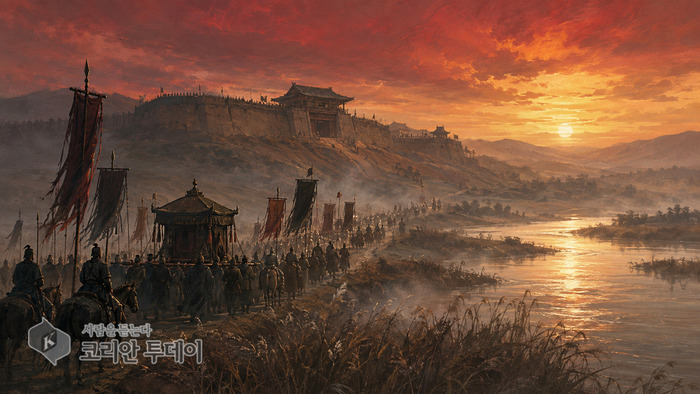
Open a map of South Korea today and you will still find Buyeo County, South Chungcheong Province. The kingdom called Buyeo, however, had already vanished by 494 CE.
Over twelve previous episodes, we traced the rise and fall of Buyeo on the Manchurian plains and the 78 small polities that once dotted southern Korea. We watched Baekje, Silla, and Gaya emerge from that world. This is the final episode of the series.
Why does a name outlive the kingdom that carried it? How did Buyeo become the shared ancestral claim of two rival royal houses, Goguryeo and Baekje? And how did “Samhan” – originally three separate confederacies – come, seven centuries later, to mean “the whole of our nation”? Let’s follow what the vanished left behind.
🌐 Western Historical Parallel
Much as the Eastern Roman (Byzantine) Empire claimed the name and legitimacy of a fallen Rome after 476 CE, Baekje reclaimed the name of a vanished Buyeo when it renamed itself “Nambuyeo” (South Buyeo) in 538 CE. On both ends of Eurasia, successor states asserted legitimacy by reviving the name of the power they claimed to continue.
◆ The Ancient Landscape
In 494 CE, Buyeo – weakened by pressure from the northern Mulgil (Wuji) people and prolonged internal strife – collapsed quietly. Its last king led his family and people to surrender to King Munjamyeong of Goguryeo. The Samguk Sagi records this as a bloodless absorption: the end of a state that had dominated the Manchurian plains for roughly five centuries.
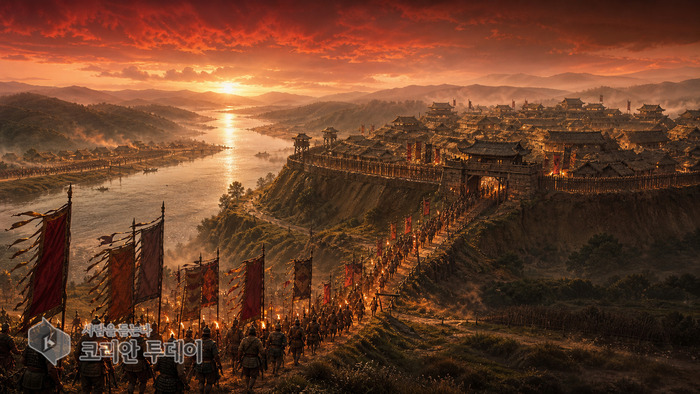
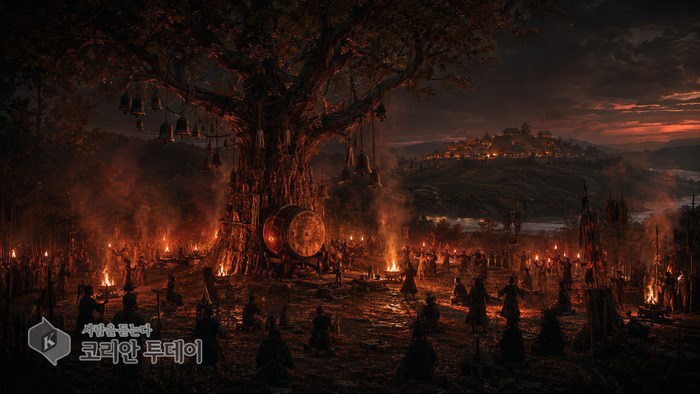
Yet Buyeo did not disappear. Jumong, Goguryeo’s founder, had migrated south from the Buyeo royal house, and Goguryeo’s state ritual “Dongmaeng” carried forward the worship of Buyeo’s founding god Dongmyeong. Baekje, too, claimed descent from Buyeo. The two kingdoms competed over the same ancestral claim – a rivalry that peaked in 538 CE, when King Seong of Baekje moved the capital from Ungjin (modern Gongju) to Sabi (modern Buyeo) and renamed the state “Nambuyeo,” South Buyeo. Forty-four years after Buyeo’s fall, its name returned as an official state title.
“Its lineage came from Buyeo, the same source as Goguryeo, and so the clan took Buyeo as its surname.”
“In spring, the capital was moved to Sabi (also called Sobu-ri), and the state was renamed Nambuyeo.”
◆ Same Era, Different Worlds
🏛️ China
Around the same years Buyeo fell (493-494 CE), Emperor Xiaowen of Northern Wei abandoned the old Xianbei capital of Pingcheng and forced a move to Luoyang, staking a new dynastic identity on the symbolic old capital of the Central Plains.
🗿 Byzantine Empire
After the Western Roman Empire fell in 476 CE and the Ostrogothic Kingdom rose in Italy in 493 CE, the Eastern Roman Empire under Justinian sought to reclaim the name and territory of “old Rome” – a mirror of Baekje’s own claim on Buyeo.
⚔️ Western Europe
Clovis I united the Frankish tribes from 481 CE, building a new kingdom on the ruins of Roman Gaul – much as Goguryeo and Baekje each built new states on the ruins of Buyeo.
🌏 Japan
In the mid-6th century (sources differ between 538 and 552 CE), King Seong of the newly renamed Nambuyeo formally transmitted Buddhism to Yamato Japan – a fading dynasty becoming, instead, a civilizational root for its neighbor.
[Image: Buyeo’s lineage flowing into both Goguryeo and Baekje (Nambuyeo)]
⚔️ Scene from That Day
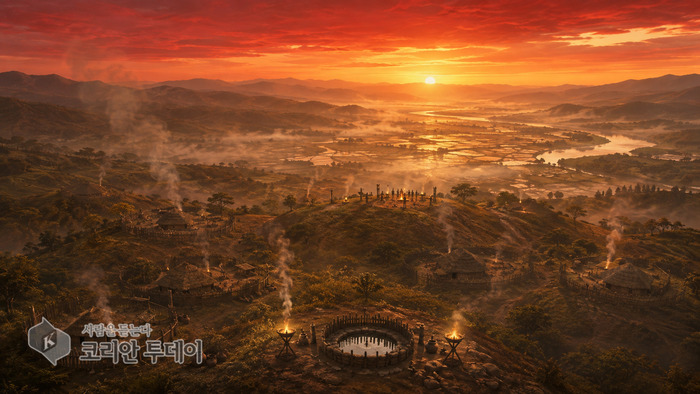
“Spring, 538 CE. A procession leaves the palace at Ungjin and follows the Geum River toward the plains of Sabi. The walls of the new capital still smell of raw earth. King Seong stands before his new palace beneath Mount Busosan and unrolls a decree.”
“‘From this day, the state shall be called Nambuyeo.’ A murmur runs through the court. In place of the name Baekje, he has revived a name that vanished from Manchuria five centuries earlier – not a retreat, but a declaration that his house, and no other, was the true heir of Buyeo.”
◆ Uncovering Historical Truth
The rivalry over Buyeo’s legacy was political calculation as much as memory. Goguryeo built its founding legitimacy on direct descent from the Buyeo royal line; Baekje went a step further and restored the name itself. During the unstable Ungjin period (475-538 CE), when royal authority had been badly shaken, “true heir of Buyeo” was exactly the symbolic capital Baekje needed against Goguryeo’s rival claim.
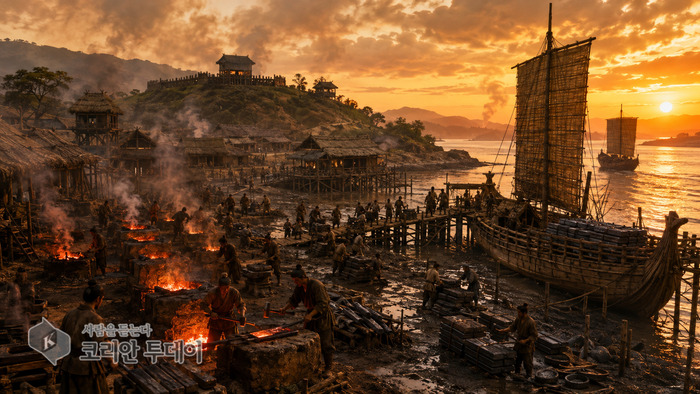
The Samhan story unfolded differently. Baekje grew out of the Mahan confederacy, the Gaya league out of Byeonhan, and Silla out of Jinhan. Each followed its own path – until, in the late 7th century, Silla toppled Baekje (660 CE) and then Goguryeo (668 CE) and unified the peninsula. The old word “Samhan” was reborn with new meaning. In 669 CE, King Munmu’s state letter to Tang China spoke only of having “pacified two enemy states”; by 686 CE, the Cheongju Uncheon-dong stele already declared that the ruler had “unified the Samhan and expanded the realm.” In the span of less than two decades, scholars argue, “Samhan” came to mean the entire unified territory – the concept later known as Samhan-iltong, “unification of the Three Han.”
What makes this striking is that Buyeo and Samhan began as entirely unrelated lineages – Buyeo a Yemaek state in Manchuria, Samhan a separate set of confederacies in southern Korea. Yet these two threads fed into Goguryeo and Baekje on one hand, and Baekje, Silla, and Gaya on the other, so that the eventual Three Kingdoms carried two distinct origin narratives at once. It was Buyeo and Samhan together that filled the roughly five centuries between the fall of Gojoseon (108 BCE) and the full emergence of the Three Kingdoms.
Period
c. 2nd century BCE – late 7th century CE
Key Events
Fall of Buyeo (494 CE), renaming to Nambuyeo (538 CE)
Key Figures
King Munjamyeong, King Seong, King Munmu
Living Traces
Buyeo County today, the Samhan-iltong concept
🔍 International Academic Perspectives
Korean/Asian Scholars
Most accept the Samguk Sagi account that Baekje’s royal house descended from Buyeo migrants, treating the Buyeo clan name as a genuine reflection of that lineage.
Comparative Historians
Others note that other sources record earlier Baekje royal surnames (Hae, U), and read the Buyeo clan name – much like Rome’s own foundation legends tracing to Troy – as a legitimizing narrative shaped in the Sabi period’s rivalry with Goguryeo.
📖 Key Terms Explained
- Buyeo (夫餘)
- An ancient state in Manchuria (c. 2nd century BCE – 494 CE), claimed as ancestral by both Goguryeo and Baekje.
- Samhan (三韓)
- The three confederacies of southern Korea – Mahan, Byeonhan, and Jinhan – ancestral to Baekje, Gaya, and Silla respectively.
- Samhan-iltong (三韓一統)
- The concept, formed between roughly 669 and 686 CE, that “Samhan” referred to the entire unified Korean realm after Silla’s unification.
◆ Lessons for Today’s World
We still see founding generations vanish while their spirit survives in the names and cultures of their successors. Buyeo was no different. Its kingdom fell, but its name became an asset so valuable that two separate royal houses each claimed it as their own inheritance.
Samhan-iltong followed a similar arc. A word that once described three competing regions became, through the event of unification, a term for the entire nation – so thoroughly that “Samhan” remained a common way to refer to the whole Korean peninsula well into the late Joseon period. A name born of division became, in the end, the language of unity.
| Aspect | Buyeo & Samhan Era | Modern Parallel |
|---|---|---|
| Legitimacy | Two royal houses compete over “true heir of Buyeo” | Institutions compete over founding-generation legacy |
| Power of a Name | Buyeo’s name revived as a state title, 44 years later | A defunct name resurfaces in a successor’s identity |
| Semantic Expansion | “Samhan” grows from three regions to a whole nation | A regional or founding name expands into national identity |
[Image: Mahan, Byeonhan, and Jinhan flowing through the Three Kingdoms into the idea of Samhan-iltong, and onward to today]
📚 Diving Deeper
- Busosanseong Fortress and the five-story stone pagoda at Jeongnimsa Temple site in Buyeo still mark the ground plan of the Nambuyeo-era Sabi capital.
- The gilt-bronze incense burner excavated from the Neungsan-ri tombs shows how independently Baekje’s culture developed after Buyeo.
- The Cheongju Uncheon-dong stele is considered the earliest surviving inscription to use the phrase “unification of the Samhan.”
The Voice of Living History
Between Gojoseon and the Three Kingdoms lie roughly five centuries that often look empty on a timeline. Buyeo, on the Manchurian plains, and Samhan, in southern Korea, filled them. Without either, Goguryeo, Baekje, Silla, and Gaya would never have taken the shape we know.
“A kingdom may fall, but its name survives to become the next generation’s root.”
Previous Episode
Episode 12: From 78 States to Three Kingdoms – The Birth of Baekje, Silla, and Gaya
Series Note
This concludes the 13-part Buyeo & Samhan Chronicle
The Korean Today “History Lives On” Series
The Buyeo & Samhan Chronicle (13 Episodes)
Bridging Ancient East Asia and the Modern World
© 2025 The Korean Today. All rights reserved.
This content is based on historical facts and presents balanced academic perspectives
for international readers.
THE KOREAN TODAY × WIA CODE
이 기사의 WIA Code

WIA Code 스캐너로 비추면 인터넷 없이 발행 사실과 위·변조 여부를 확인할 수 있습니다.
휴대폰 기본 카메라로 찍으면 스캐너 안내 페이지가 열립니다 — 기사 바로 열기
움직이는 코드(스트림) 한 장에 기사 전문(사진 포함)이 담겨 있습니다 — WIA Code 스캐너로 약 23초 비추면 폰에 저장되어 인터넷 없이도 읽을 수 있습니다. Stream.mp4 도 여기서 받습니다.
WIA Code · 코리안투데이


Leave a Reply