
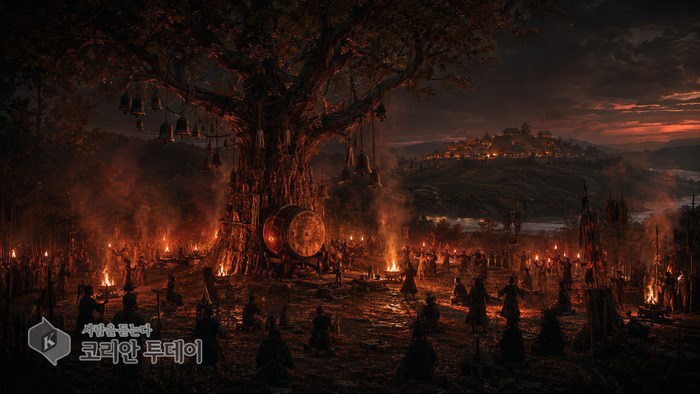
Two thousand years ago on the southern Korean peninsula, a fugitive who reached the great tree at the village’s edge was safe the instant he crossed its shadow. No king, no soldier, no sword could follow him in.
We take for granted that a constitutional court can rule against a president, or that a sitting lawmaker cannot be arrested mid-session except in flagrante delicto. The idea of a “sanctuary” beyond the reach of power is not a modern invention. The people of Samhan had already split political rule – held by chiefs called Sinji and Eupcha – from the office of sacred ritual, held by a separate figure called the Cheongun, and placed the Cheongun’s domain entirely outside the ruler’s sword.
Why would a society deliberately split its power in two, rather than concentrate it in one ruler? And how closely does that ancient division resemble the “checks and balances” we still fight to protect today?
🌍 Western Historical Parallel
The Romans knew a version of this too. As early as the legendary founding of Rome, Romulus is said to have established an “Asylum” on the Capitoline Hill – sacred ground where fugitives from anywhere could take refuge and be protected. Centuries later, Greek cities practiced “asylia,” granting inviolability to anyone who reached a temple, altar, or sacred grove. Sodo belongs to the same universal human instinct: some ground must be beyond the sovereign’s reach.
◆ The Ancient Landscape
From roughly the 1st century BCE to the 3rd century CE, the south-central Korean peninsula was home to 78 small statelets – 54 in Mahan, 12 in Jinhan, and 12 in Byeonhan – none yet unified under a single strong monarchy. Each was ruled from a central town, its “gukeup,” by chiefs bearing titles such as Sinji, Heomcheuk, Beonye, Salhae, or Eupcha.
But alongside this political ruler, each state appointed a separate figure to preside over sacrifices to the heavenly god – the Cheongun. The Cheongun officiated at a special sacred settlement called the Sodo. This account survives in the Records of Wei, Book of the Eastern Barbarians, Chapter on Han (the “Han-jo”), compiled by the Chinese chronicler Chen Shou (陳壽, 233-297) around the late 3rd century – effectively the only contemporary written source on Samhan society, recorded by a neighboring civilization observing an unfamiliar people firsthand.
“In each state, one person is appointed to preside over sacrifices to the heavenly spirits; he is called the Cheongun. Each state also has a separate settlement, called Sodo. A great tree is raised there, hung with bells and a drum, to serve the spirits. Anyone who flees into it is never sent back – and for this reason, banditry has grown common.”
◆ Same Era, Different Worlds
🏛️ China
When Chen Shou recorded the Sodo in the late 3rd century, the mainland had just emerged from the Three Kingdoms era of Wei, Shu, and Wu, and its reunifying Jin dynasty was already sliding toward chaos. Samhan’s 78 statelets kept their own order through it all.
🗿 Roman Empire
Between 235 and 284 CE, Rome cycled through more than twenty emperors in the “Crisis of the Third Century,” an age of military anarchy. Amid that chaos, Rome’s own tradition of sanctuary – the Capitoline Asylum – endured as an idea, if not always in practice.
⚔️ Yamatai, Japan
The very same Wei chronicle records that around 239 CE, Queen Himiko of Yamatai sent envoys to the Wei court. Unlike Samhan, Himiko herself fused ritual and political authority in one person – a mirror-image contrast to Samhan’s deliberate separation of the two.
🕌 Han Dynasty Sphere
Further west, the fading Han commanderies still administered parts of the northern peninsula, giving Samhan’s southern statelets a front-row view of a continental empire’s slow unraveling – a lesson in what happens when central power alone holds everything together.
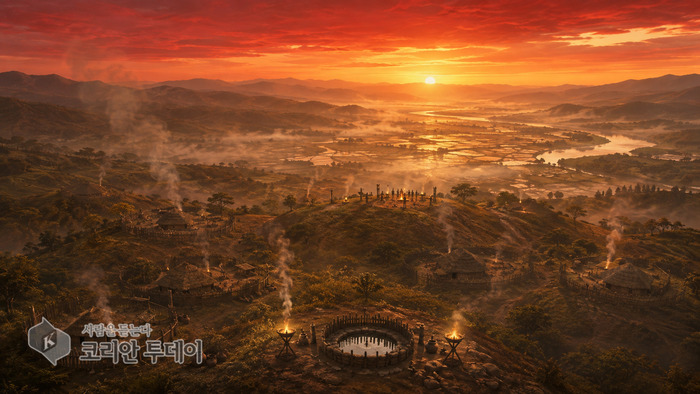
[Image: The boundary between the ruler’s Gukeup and the inviolable Sodo, sanctuary of the Cheongun]
⚔️ Scene from That Day
“A man runs, lungs burning, toward the tree hung with bells. Behind him a soldier’s shout cuts the air. The instant the tree’s shadow touches his feet, the soldier stops dead.”
“The raised sword freezes mid-air. Beyond this line lies the Cheongun’s ground – not even the chief’s word reaches here. The soldier turns back, swallowing his rage, as the drum beneath the tree keeps beating, low and steady.”
◆ Uncovering Historical Truth
The real significance of Sodo and Cheongun is not romantic mystery but a hard political fact: Samhan society had achieved a genuine separation of religion and state. Its predecessor, Gojoseon, was a fused theocracy – its founder-king Dangun Wanggeom’s very name bundles priest and ruler into one office. Samhan split that bundle apart, assigning secular power (Sinji, Eupcha) to the Gukeup and sacred power (the Cheongun) to a separate settlement altogether.
This was no mere division of labor. The Sodo under the Cheongun’s authority was, in effect, extraterritorial – beyond the reach of the chief’s soldiers, so that even a fleeing criminal could not be retrieved once inside. Chen Shou noted disapprovingly that this “encouraged banditry,” but read the other way, his complaint is itself proof the sanctuary’s inviolability actually held in practice: even the powerful respected a boundary they had agreed not to cross.
This faith was also a festival. After sowing in the fifth month, Samhan communities sacrificed to the spirits and drank, sang, and danced in great crowds day and night; after the harvest in the tenth month, they did the same, giving thanks for the year’s abundance. Scholars broadly agree that this communal ritual – crossing class and settlement boundaries alike – survives today in the village guardian shrines and totem poles (“sotdae”) still found at Korean village entrances.
Period
~1st century BCE – 3rd century CE
Key Offices
Cheongun (priest) & Sinji/Eupcha (chief)
Key Concept
Sodo & separation of religion and state
Legacy
Village shrines & totem poles (sotdae)
🔍 International Academic Perspectives
Mainstream View
Sodo and Cheongun represent a matured evolution of heaven-worship dating to the Bronze and Iron Ages, and their coexistence with secular chiefs is read as evidence that Samhan society had grown politically more differentiated than Gojoseon’s theocracy.
Cautionary View
Some historians caution that Chen Shou, an outside observer, may have exoticized or editorialized an unfamiliar custom, and that no archaeological site has yet been conclusively identified as a literal Sodo – so text and material evidence must not be conflated too quickly.
📖 Key Terms Explained
- Samhan (삼한)
- The “Three Han” confederacies – Mahan, Jinhan, Byeonhan – 78 small statelets on the southern Korean peninsula, roughly 1st century BCE to 3rd century CE
- Records of Wei / Wei Zhi (魏志)
- The Chinese dynastic history section covering neighboring “barbarian” peoples, compiled by Chen Shou in the late 3rd century CE – the primary source for Sodo, Cheongun, and Queen Himiko alike
◆ Lessons for Today’s World
In June 1987, during South Korea’s pro-democracy uprising, riot police besieging Myeongdong Cathedral ultimately never forced their way inside. The symbolic weight of a sacred space stopped state power in its tracks – a scene that echoes, almost exactly, a soldier turning back from the shadow of the Sodo’s great tree two thousand years earlier.
The same logic underlies a constitutional court ruling independently of a president’s wishes, or a legislator immune from arrest during a session except when caught in the act. A line power agrees not to cross on its own – that is the oldest inheritance Sodo left behind: the ancestor of “checks and balances” itself.
| Aspect | Buyeo & Samhan Era | Modern Parallel |
|---|---|---|
| Politics | Secular rule (Sinji, Eupcha) separated from sacred authority (Cheongun) | Separation of powers; independent constitutional courts |
| Military/Diplomacy | A fugitive inside the Sodo could not be seized even by the chief’s soldiers | Diplomatic immunity; parliamentary arrest immunity |
| Culture | Village-wide heaven-worship festivals every May and October | Local festivals; surviving folk shrines and totem poles |
[Image: How the ancient idea of “ground power cannot touch,” born in Sodo, passed through folk religion and modern history into today’s institutions]
📚 Diving Deeper
- Excavations at sites like Dahori in modern Changwon reveal Byeonhan’s material culture, though no site has yet been definitively identified as a literal Sodo ritual ground.
- The “sotdae” totem poles and guardian posts still standing at Korean village entrances are widely interpreted as a transformed survival of the Sodo’s sacred-tree worship.
- The same Wei Zhi chapter records the customs of Buyeo, Goguryeo, Okjeo, Dongye, and Wa (Japan) side by side, letting readers compare Sodo against a whole region’s belief systems at once.
The Voice of Living History
Two thousand years ago, the people of Samhan already understood something we still relearn today: a community survives not by handing all power to one ruler, but by drawing a line that even the powerful agree never to cross.
“That a place exists beyond the sword’s reach – that, itself, is the oldest proof a society had matured.”
Previous Episode
Episode 10: The Twelve States of Byeonhan – Ruling the Sea with Iron
Next Episode
Episode 12: From 78 States to Three Kingdoms – The Birth of Baekje, Silla, and Gaya
The Korean Today “History Lives On” Series
The Buyeo & Samhan Chronicle (13 Episodes)
Bridging Ancient East Asia and the Modern World
© 2025 The Korean Today. All rights reserved.
This content is based on historical facts and presents balanced academic perspectives
for international readers.
THE KOREAN TODAY × WIA CODE
이 기사의 WIA Code

WIA Code 스캐너로 비추면 인터넷 없이 발행 사실과 위·변조 여부를 확인할 수 있습니다.
휴대폰 기본 카메라로 찍으면 스캐너 안내 페이지가 열립니다 — 기사 바로 열기
움직이는 코드(스트림) 한 장에 기사 전문(사진 포함)이 담겨 있습니다 — WIA Code 스캐너로 약 22초 비추면 폰에 저장되어 인터넷 없이도 읽을 수 있습니다. Stream.mp4 도 여기서 받습니다.
WIA Code · 코리안투데이


Leave a Reply