
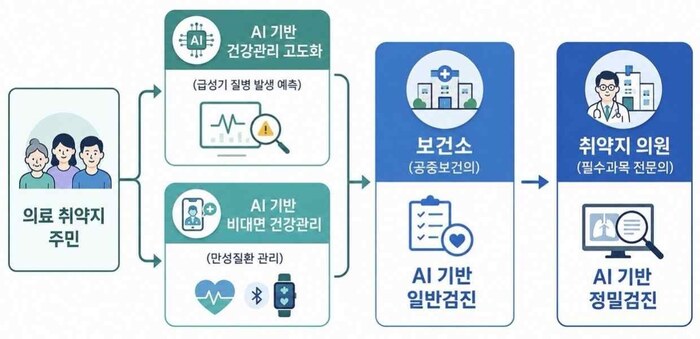
The government confirmed a pan-governmental “AI Primary Care Strategy” on Aug. 6 at the 12th National Policy Coordination Meeting chaired by the prime minister. Drawn up jointly by the Ministry of Health and Welfare, the National AI Strategy Committee, the Ministry of Science and ICT and other related agencies, the strategy is built around the goal of “AI that protects life, medical innovation that everyone enjoys.” It comprises three strategies — AI-driven medical innovation that citizens can feel in daily life, a nationwide digital foundation for AI medical innovation, and a sustainable AI healthcare ecosystem — along with 12 priority tasks. At its core are the distribution of AI support tools, or packages, that assist clinical care at public health centers and branch health clinics nationwide as well as primary care facilities in underserved areas, and the construction of a “public healthcare AI expressway” linking 72 designated regional responsible medical institutions across the country.
 [코리안투데이] Courtesy of the Ministry of Health and Welfare © 송정숙 기자 |
Behind the strategy lies a growing mismatch between the pace of demand for medical care and the pace of its supply. As the country enters a super-aged society, demand is rising quickly, yet gaps in regions short of medical personnel and disparities between regions are widening instead of narrowing. According to government data, 730 branch health clinics in towns and townships — 59.5 percent of the total — had no public health doctor assigned in 2025, and that figure is projected to rise to 1,083, or 86.9 percent, by 2027. The scale is too large to be filled by hiring more personnel alone. That is why the government has framed the strategy as a full-fledged starting point for using artificial intelligence to close gaps in regional, essential and public healthcare.
The first changes that citizens are likely to notice will come at neighborhood medical facilities. The primary care AI support tools to be introduced at local public health organizations and primary care providers in underserved areas will assist in reading X-rays and other images, automatically record the content of consultations, and support the management of chronic disease. In island and mountainous areas short of medical staff, an “AI-based non-face-to-face home care collaboration” service will be piloted, in which visiting nurses consult with remotely located physicians on the basis of patient information analyzed by AI. The measure opens a path for residents who have difficulty traveling to distant hospitals to receive a doctor’s care at home.
In emergency medicine, delays in patient transport are the target. To reduce so-called emergency room refusals, in which ambulances cannot find a hospital willing to accept a patient, the government will pilot a tentatively named “integrated emergency AI platform” in the Daegu area in the second half of this year before expanding it in phases. The platform will use real-time AI analysis to support everything from ambulance transport to the selection of an appropriate hospital. The government will also upgrade the emergency medical information network so that hospitals’ treatment capacity can be checked in real time to enable timely transport, and will develop a “smart emergency room” that assists with in-department decisions such as patient triage and monitoring.
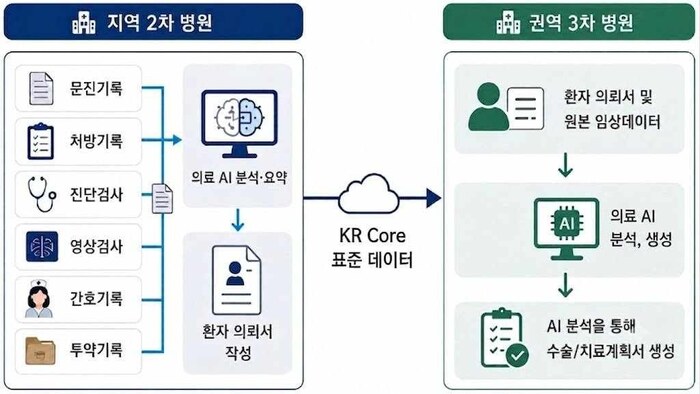
Patient records, too, will travel beyond hospital walls. Building on the “My Health Record” (PHR) system, the government plans to establish a framework for sharing medical records and imaging such as CT and MRI scans between hospitals, easing the inconvenience of copying images onto CDs and repeating the same tests each time a patient changes hospitals. A “national AI health assistant” will also be introduced to explain prescriptions and checkup results in everyday language and to provide tailored health guidance. On the research and development side, a “K-AI drug development platform” will be built to speed the development of innovative new drugs, including treatments for rare and intractable diseases, and the national bio big data project will first open data on 120,000 people in the second half of this year, expanding to more than 700,000 by 2029 and more than 1 million by 2032.
Investment in infrastructure will proceed in parallel. For regional public hospitals that have found it financially difficult to adopt advanced AI, a “public healthcare AI expressway” connecting responsible medical institutions to a national GPU-based “public healthcare AI platform” will open on a pilot basis at nine sites in the second half of this year, expanding to 30 sites in 2027 and to all 72 by 2029. Aging computer systems at regional medical centers will be replaced with cloud-based systems, and the government will pursue an “AI intelligent hospital information system” that supports the entire process from arrival to discharge, along with regional “AI specialized hospitals.” Full-scale development of a “Korean medical AI” — based on domestic clinical data and homegrown AI models built on the national healthcare data hub — will begin in 2027. A proposed Digital Healthcare Act will also be pursued to overhaul rules on restrictions on data use, prevention of leaks, and oversight and supervision.
Institutional design intended to embed the technology in the field is also among the tasks. The government will establish an appropriate reimbursement system for medical services that use AI, and alongside the current approach of paying for the use of individual AI medical technologies, it will broadly review a system that evaluates and rewards the clinical outcomes of AI technology. It will expand R&D investment at regional national university hospitals and create regional AX hubs linked to local specialty industries such as bio-healthcare and robotics. On safety, the government will draw up ethical guidelines for medical AI and tentatively named “healthcare security guidelines,” and will work to cultivate and attract AI and bio-health talent at home and abroad. Internationally, it plans to establish a World Health Organization AI hub in Korea and to announce a tentatively named “AI Healthcare Seoul Declaration” on the occasion of the fifth World Bio Summit in October 2026.
“AI is a tool for filling the gaps in regional, essential and public healthcare and for protecting people’s lives,” Health and Welfare Minister Jung Eun-kyeong said. “With the adoption of this AI Primary Care Strategy, we will work with the National AI Strategy Committee, the Ministry of Science and ICT and other related agencies to carry out the strategy without a hitch, so that everyone can experience AI-driven medical innovation anywhere in the country.” Observers say the strategy’s success will ultimately hinge on the speed of implementation, which will become clear in the pilot projects, and on whether supporting systems covering reimbursement, ethics and security can keep pace with conditions on the ground.
 [코리안투데이] Courtesy of the Ministry of Health and Welfare © 송정숙 기자 |
강서 편집국 | gangseo@thekoreantoday.com
 |
 |
THE KOREAN TODAY × WIA CODE
이 기사의 WIA Code

WIA Code 스캐너로 비추면 인터넷 없이 발행 사실과 위·변조 여부를 확인할 수 있습니다.
휴대폰 기본 카메라로 찍으면 스캐너 안내 페이지가 열립니다 — 기사 바로 열기

움직이는 코드는 스트림입니다 — WIA Code 스캐너로 약 77초 비추면 기사 전문(사진 포함)이 폰에 저장되어 인터넷 없이도 읽을 수 있습니다.
WIA Code · 코리안투데이



Leave a Reply