
A tree-planting movement that Incheon citizens launched to curb yellow dust from Mongolia has grown, over 19 years, into a model of international environmental cooperation between cities. Incheon Metropolitan City (Mayor Park Chan-dae) announced that it plans to share the achievements of its ‘Incheon Forest of Hope’ project with the international community at the 17th Conference of the Parties (COP17) to the United Nations Convention to Combat Desertification (UNCCD), held in Mongolia this year.
 [코리안투데이] A view of the ‘Incheon Forest of Hope’ created in Songinokhairkhan district, Mongolia © 장형임 기자 |
The UNCCD is a leading United Nations international environmental convention that addresses desertification, land degradation and drought. At this conference, Incheon will present how a movement that began with the voluntary participation of citizens developed into a long-term cooperative project between local governments, along with its afforestation results and a sustainable management approach in which local residents and future generations take part. This shows that the ‘Incheon Forest of Hope’ has gone beyond simply planting trees abroad to become a cooperation model in which local governments, citizens and local residents jointly resolve environmental problems that transcend national borders. It is also a case demonstrating that the actors responding to the climate crisis need not be limited to nations and international organizations, but can extend to cities and citizens.
The project began in 2008 at the hands of Incheon’s citizens. At the time, civil society groups such as the Incheon Round Table and the YMCA raised 335 million won to reduce desertification in Mongolia and the yellow dust flowing into Incheon, and this dedication bore fruit by 2010 in the planting of 52,000 trees in the Bayannuur and Sergelen areas of Mongolia. The citizen-driven movement later developed into a public-private cooperation project, and in the first phase, which ran from 2013 to 2017, 63,000 trees were planted across 45 ha in the Dashinchilen soum area.
To place the project on a stable footing, Incheon signed an agreement with the Ulaanbaatar City Environment Agency in 2018 and launched the second phase. It is a long-term project to create a 100 ha forest in the Songinokhairkhan district by 2027. To date, the forest created totals 157 ha and more than 250,000 trees have been planted, an area equivalent to about 220 soccer fields.
Incheon did not stop at planting trees but placed weight on laying a foundation for the forest to sustain itself locally. The afforestation site was originally barren land where waste had been dumped and trees struggled to grow. Incheon surveyed the local natural environment, soil and water-supply conditions and selected tree species suited to Mongolia’s environment, such as Scots pine, Korean pine, larch and Siberian elm. It also secured 15-year land-use rights from Ulaanbaatar and put in place infrastructure including a nursery, greenhouses, wells, a management office and irrigation pipes, establishing a system to supply seedlings stably on-site and to manage them even after planting. As a result of installing fences to prevent trees from being damaged by grazing livestock and combining climate-adjusted irrigation and management, the tree survival rate within the afforestation site is holding at about 78%. This year Incheon plans to plant about 6,000 Korean pines across 10 ha at the Songinokhairkhan afforestation site, and in 2027 it will plant an additional 8,500 trees across 10 ha to complete the second phase.
The project carries special meaning for Incheon residents. Mongolia is a major source of yellow dust in Northeast Asia, and as desertification worsens, its effects cross borders and reach Korea’s air environment. In particular, Incheon, located on the west coast bordering the continent, is a region that receives transboundary air pollution such as yellow dust and fine particulate matter relatively early. Restoring Mongolia’s degraded land is therefore not mere overseas aid but a preemptive climate-response investment that reduces yellow dust and expands carbon sinks, protecting the environment of both Incheon and Northeast Asia.
Incheon manages this project as a carbon-sink expansion task under the 《2045 Incheon-Style Carbon Neutrality Strategy》 and as a greenhouse-gas-reduction, gender-responsive budget project. According to the Incheon Institute, the forest created through this year is estimated to absorb about 1,620 tons of carbon dioxide, an amount that offsets the carbon emitted in one year by about 350 internal-combustion passenger cars. As one of Incheon’s flagship official development assistance (ODA) projects included in the Office for Government Policy Coordination’s comprehensive plan for international development cooperation, it is distinctive in that it realizes environmental restoration, carbon neutrality, international development cooperation and city diplomacy within a single project.
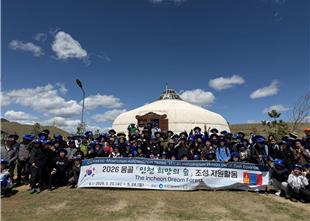
Another achievement of the ‘Incheon Forest of Hope’ lies in the participation of citizens, students and local residents of both countries throughout the process. Incheon holds tree-planting events, environmental education and afforestation-technology exchanges in Mongolia each year, and this year too about 100 people, including Incheon students and citizens and Mongolian students, planted trees together and shared the need to respond to the climate crisis. Over the past 19 years, a total of 797 people have taken part in creating the forest. Tree-planting events in which young people of both nations participate serve as living environmental education through which future generations come to recognize the climate crisis as their own issue, and as a stage for people-to-people diplomacy linking the two cities; leaving afforestation technology and facilities on-site so that residents manage the forest themselves also sets it apart from one-off support.
The ‘Incheon Forest of Hope’ was introduced as an outstanding case in the United Nations Environment Programme (UNEP) international assessment of fine particulate matter, and in 2025 it became known to the international community as a case of sustainable urban development. Sharing its achievements at this year’s UNCCD Conference of the Parties is expected to serve as an opportunity to spread Incheon’s experience as a model of international environmental cooperation that other cities and countries can draw on. Ahead of the close of the second phase, Incheon will comprehensively analyze the achievements to date and the operational status of the afforestation site to review whether to proceed with a third phase. As Mongolia is proposing additional afforestation sites, the city plans to determine the direction of future cooperation by examining the sustainable management of the sites, local self-reliance and carbon-absorption effects.
Yoon Eun-ju, head of Incheon’s Environmental Safety Division, said, ‘The Incheon Forest of Hope is a meaningful project in which a single tree planted by citizens became city policy and grew into international environmental cooperation carried out by two nations together,’ adding, ‘We will share the experience and achievements accumulated over 19 years with the world at the UNCCD Conference of the Parties, and present new possibilities for cooperation between cities in responding to the climate crisis.’ She continued, ‘Going forward, as the host city of the GCF headquarters and a global environmental city, Incheon will expand practical climate action created together by citizens and the international community.’
지역 홍보대사 신청 기자양성과정 신청 코리안투데이 지부장 신청 코리안투데이 인천강화
THE KOREAN TODAY × WIA CODE
이 기사의 WIA Code

WIA Code 스캐너로 비추면 인터넷 없이 발행 사실과 위·변조 여부를 확인할 수 있습니다.
휴대폰 기본 카메라로 찍으면 스캐너 안내 페이지가 열립니다 — 기사 바로 열기

움직이는 코드는 스트림입니다 — WIA Code 스캐너로 약 19초 비추면 기사 전문(사진 포함)이 폰에 저장되어 인터넷 없이도 읽을 수 있습니다.
WIA Code · 코리안투데이


Leave a Reply