
100 Years Ago Today – October 12, 1925 (Monday)
10:10 PM KST (1:10 PM UTC) – As you wind down your day, reflect on a century of history
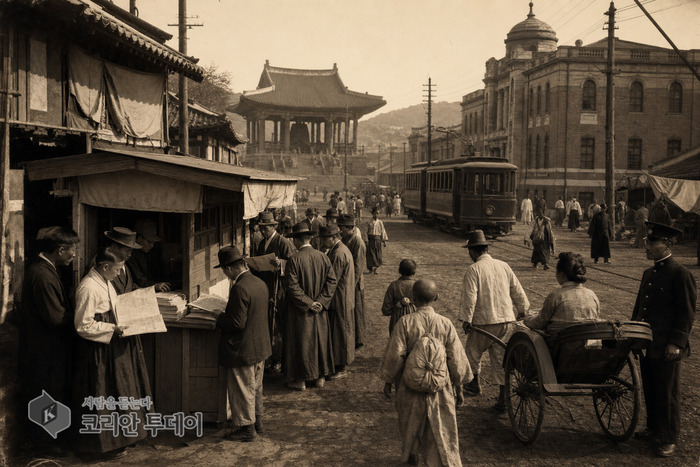
It is Monday, October 12, 1925, in Gyeongseong, colonial Korea. No confirmed weather record survives for this specific day, though by the lunar calendar the city sat between the cold-dew and frost-descent points of late autumn. Families who had lost their homes in the catastrophic summer floods were still without shelter as winter approached. By early morning, crowds gathered along Jongno street, newspapers in hand, trading word of news just arrived from Shanghai.
Korea Under Colonial Rule
Gyeongseong was still absorbing the aftermath of the Eulchuk Flood, the catastrophic summer disaster in which the Han River twice rose past ten meters, displacing more than 40,000 people in what would later be remembered as the worst flood of 20th-century Korea. The colonial Government-General had ordered the Yongsan embankments raised by five to ten cheok and barred new construction in the low-lying Ichon-dong district outside them, but as winter neared, displaced families still had nowhere permanent to live. Official reserve funds fell short, and much of the relief effort depended on donations collected by newspapers, youth associations, and the Flood Relief Society formed for the purpose.
That same day, word from Shanghai was also circulating through Gyeongseong’s streets: Lee Sang-ryong, elected head of state (Gukmuryeong) of the Provisional Government just weeks earlier, was struggling to assemble a cabinet. He had sought to draw armed independence leaders from Manchuria into his government, but critics worried that pulling them all to Shanghai would leave a dangerous vacuum on the Manchurian front. Newspapers also continued reporting the results of the simplified national census completed earlier that summer, which had counted Korea’s population at 19.52 million. No specific price or market data for this date could be confirmed.
East Asia in Turmoil
Beyond Gyeongseong, tension surrounding the Hyeongpyeongsa — the association formed by butcher-caste (baekjeong) and yangban activists together to fight caste discrimination — had not subsided. Two months earlier, anti-Hyeongpyeongsa mobs had attacked a branch office in Yecheon, North Gyeongsang Province, prompting the national headquarters to call on members nationwide to converge there. What began in Jinju had spread into branches across the peninsula, each now holding meetings to decide how to respond. Word of the Provisional Government’s troubles, and of conditions at home, was also filtering — with delay — to Korean communities in Manchuria, Jiandao, Hawaii, and the American mainland.
The World Stage
Elsewhere, the world was consumed by its own crises. In Locarno, Switzerland, Germany’s Gustav Stresemann, France’s Aristide Briand, and Britain’s Austen Chamberlain were in the tenth day of negotiations over a treaty to guarantee the security of the Rhineland — talks that would conclude on October 16. That same day, Germany and the Soviet Union signed a trade agreement opening new economic ties between them. In Paris, police clashed with communist demonstrators, leaving two dead and roughly seventy arrested, including Communist Deputy Jacques Doriot. In Panama, six hundred American troops landed at the request of President Rodolfo Chiari to put down a tenant farmers’ strike.
Colonial Parallels
Korea’s predicament in October 1925 was not unique. In Ireland, the Boundary Commission — tasked with redrawing the border between the Free State and Northern Ireland — was about to convene the meetings, from October 13 to 17, that would produce its fateful (and ultimately suppressed) award. In British India, the non-cooperation and Swaraj movements Gandhi had built continued to press, unevenly, for self-rule. Each colonial or post-colonial society was negotiating, in its own register, the same question Korea’s exiled leaders were: who gets to decide a nation’s future when its people are divided by geography, class, or foreign occupation.
Person of the Day: Lee Sang-ryong
Born in 1858 into a scholarly yangban family in Andong, Lee Sang-ryong (pen name Seokju) liquidated his family estate and went into exile in Manchuria after Korea’s annexation, refusing to live under colonial rule. There he helped lead the Seoro Gunjeongseo and later the Jeongui-bu, two of the most significant armed independence organizations operating from Manchurian bases. At sixty-seven, he was chosen in September 1925 as the Provisional Government’s first Gukmuryeong — the closest equivalent to a head of state under its post-impeachment cabinet system. But reconciling Shanghai’s political factions with Manchuria’s armed movement proved difficult, and by October his cabinet remained unformed — a struggle that would ultimately end in his resignation the following January.
Understanding Daily Life
On an ordinary Monday morning, Gyeongseong returned to its routines: trams ran between Jongno and Namdaemun, students carried their book-wrapped satchels to school, and shopkeepers opened for the day’s trade. Beneath that routine, though, ran the unresolved anxieties of the season — flood-displaced families facing winter without shelter, and a fledgling government-in-exile still searching, more than two weeks after its formation, for a cabinet that could hold its two wings together.
Century Mirror
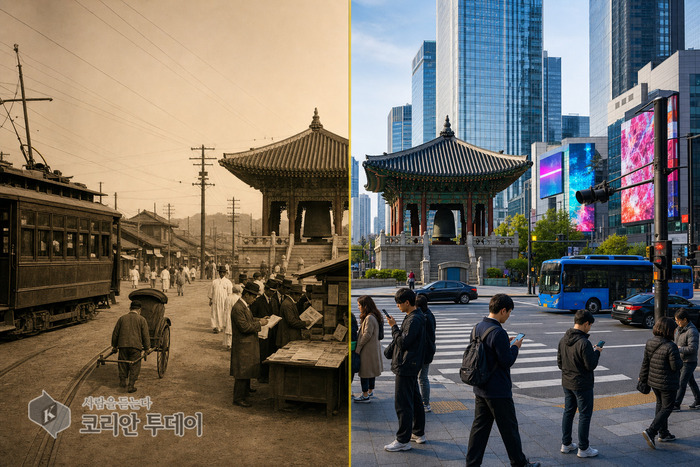
A hundred years ago, a stateless people elected the head of their government in exile — an unpaid, thankless post accepted out of duty rather than ambition. Korea’s population then stood at roughly 19.52 million; South Korea’s alone is estimated at about 51.75 million today. What was once a fragile hope, sustained by people willing to give up everything for a government that barely existed, is now an ordinary democracy whose leaders are chosen by direct vote. The distance between those two facts is the whole of this century.
Tomorrow, October 13, is Tuesday — a day for law and order. We’ll look at how the Hyeongpyeongsa conflict in Yecheon is being handled in the courts, and what enforcement news comes out of Gyeongseong. Join us again tomorrow at 10:10 PM KST.






Leave a Reply