
|
4. Differences and Connections Between Life’s First and Second Acts
✍️ Director, We Are Self-Healing Lifelong Education Institute ⏱️ 8-minute read
“If the first act is about duty, the second act is about choice.” Many people view life’s second act simply as time after retirement, but it’s actually a completely different paradigm of living. Today, let’s systematically explore the fundamental differences between life’s first and second acts, and the bridges that naturally connect these two chapters.
First Act Characteristics: Structured Life Patterns
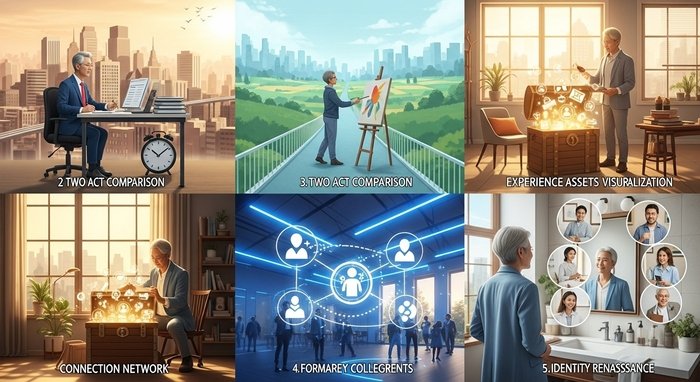
Life’s first act is largely about living according to social expectations and obligations. Following a predetermined course of education-employment-marriage-parenting-promotion, where family and social responsibilities take priority over personal freedom.
 |
Time Structure: Rigid schedules centered on work, childcare, and obligations (Average 50-60 hours per week)
Decision Making: Family and social expectations take priority (Limited personal choice)
Goal Setting: Success pursuit based on external standards (Promotion, salary, social status)
📌 Key Point: Stability and responsibility are top priorities
Life’s first act is like being an actor following a predetermined script. The role is clear but freedom is limited. However, the experiences and achievements from this period become the solid foundation for life’s second act.
Second Act Characteristics: A New Paradigm of Freedom and Choice
Life’s second act shows a completely different pattern. Freed from most social obligations, the opportunity now opens to redesign life according to personal values and meaning.
 |
🚀 New Possibilities in Life’s Second Act
- Time Ownership: Freedom to allocate time as you desire
- Value Realization: Opportunity to pursue meaning and fulfillment over money
- Deeper Relationships: Ability to focus on genuine human connections
- Creative Challenges: Courage and leisure to explore new fields and hobbies
However, Life’s Second Act Also Brings New Challenges
Freedom brings the burden of choice. Without predetermined paths, many feel lost and confused about direction. Additionally, new challenges emerge such as financial insecurity, health issues, and social isolation.
⚡ Major Challenges in Life’s Second Act
- Identity Confusion: Fundamental questions about “Who am I now?”
- Lack of Purpose: Helplessness due to unclear goals and motivation
- Social Disconnection: Loss of workplace belonging and isolation
- Economic Pressure: Anxiety about reduced fixed income and uncertain future
Important Bridges Connecting the Two Acts
Life’s first and second acts are not completely disconnected. The key to a successful second act lies in how to connect and utilize the experiences and capabilities built during the first act.
| Connection Elements | Utilization Methods |
|---|---|
| Accumulated Expertise | Transition to consulting, mentoring, education fields |
| Professional Network | Building new business opportunities and partnerships |
| Leadership Experience | Participation in non-profit organizations or community activities |
| Problem-Solving Abilities | Pursuing entrepreneurship or new projects |
| Financial Foundation | Capital for stable investment and new challenges |
Practical Methods to Strengthen the Connections
Conscious effort is needed to effectively utilize first act assets in the second act. The following methods can help strengthen the bridges between the two acts.
First, redefining experiences. Reinterpret past failures and difficulties as valuable assets. For example, workplace stress experience can be tremendously helpful in counseling or coaching fields.
Second, restructuring relationships. Develop existing work-centered relationships into personal and meaningful connections. Regular gatherings or new activities can deepen relationship quality.
Third, knowledge transfer. Passing on the know-how and wisdom accumulated during the first act to younger generations contributes to both personal fulfillment and social value creation.
Core Principles for Successful Life Transition
• Maintain Continuity: Naturally connect past and present without disconnection
• Gradual Change: Pursue gradual transition rather than sudden change
• Rediscover Values: Maintain consistency in core values even in new environments
Real Cases: Examples of Successful Transitions
Many people are actually designing meaningful second acts based on their first act experiences. Mr. A, who worked as a banker for 30 years, started a financial consulting business for small business owners after retirement, while Ms. B, who dedicated her career to education, now operates a lifelong education institute focusing on senior education.
What they have in common is that they didn’t deny their past experiences but transformed them into new values. Based on the expertise and trust built during their first act, they’re contributing to society in freer and more meaningful ways.
🎯 This Week’s Action Items
- List the three most valuable assets from your first act
- Plan ways to develop relationships with former colleagues and acquaintances
- Explore 2-3 new fields where you can utilize your unique expertise
Life’s first and second acts are different stages, but ultimately part of one continuous life. When you accept the past as a current asset rather than denying it, you can design a richer and more meaningful second act. Look forward to seeing how your precious experiences will shine on this new stage.
 |
W
Director, We Are Self-Healing Lifelong Education Institute
Life’s Second Act Design and Lecture Expert
40 years of experience in lifelong education and career counseling
Operating personalized life design and self-healing programs
Korea Today Life Design Column | Life’s Second Act Guide for Those Dreaming of New Beginnings
This column provides general life design information and cannot replace personalized counseling for individual circumstances.
For specific Life’s Second Act design, please seek assistance from We Are Self-Healing Lifelong Education Institute.






Leave a Reply