
[Day 4] Three Cups in the Peach Garden
January · *Stars Gather* | about 3 min read

Through the night, two more peach blossoms had opened. At the hour of dawn, while the dark still covered half the road, Liu Bei walked out earliest. After giving his mother one spoonful more than usual of rice gruel, he passed through the gate empty-handed, for the first time not carrying two pairs of unsold straw sandals. His step was slower than yesterday. Today was a day for not hurrying.
At the center of the peach garden, a small altar of white stone had been set. Upon it stood a single stick of incense, its fire not yet lit. To the left and right, a black ox and a white horse had been led forward by the hands of a ritual attendant. The two animals were quiet — a quiet that seemed, dimly, to know what they were for that morning.
Guan Yu arrived next. His face was that of a man who had smoothed his beard one more time than yesterday. Toward Liu Bei, who had come earlier beneath the blossoming tree, he bowed his head deeply, without a word. That bow was not the grain of a greeting. It was the posture of setting down a name that had been held in silence for five years.
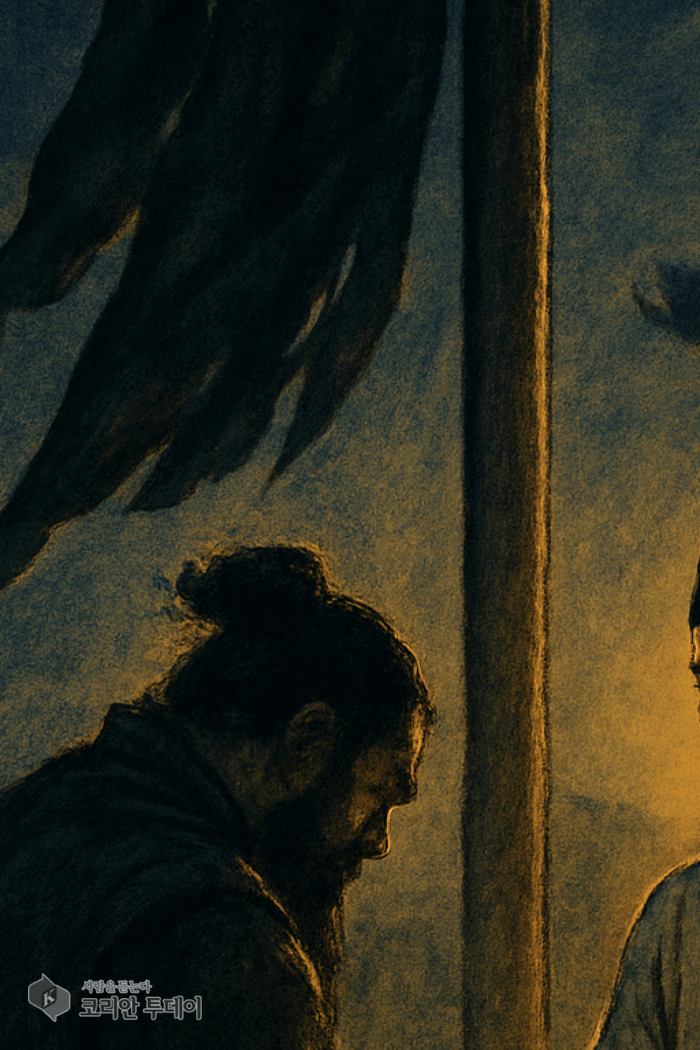
Zhang Fei came last. Unlike his usual self, the sound of his step was barely heard. His rough voice, this morning alone, had been folded quietly behind his own back.
The three men stood side by side before the altar of white stone. Zhang Fei lit the single stick of incense. A thin thread of smoke rose from its tip. The road by which that smoke passed between the peach petals and climbed looked like a narrow bridge.
Zhang Fei poured the wine first. He poured, one by one, into three cups in turn, not letting any overflow. Liu Bei’s cup, Guan Yu’s cup, Zhang Fei’s own cup. When he poured into the last cup, Zhang Fei’s hand trembled slightly. To pour his own cup with his own hand was, for him too, a first-time thing in this life. Until today, his cup had always been one poured by another, or one he had himself turned aside.

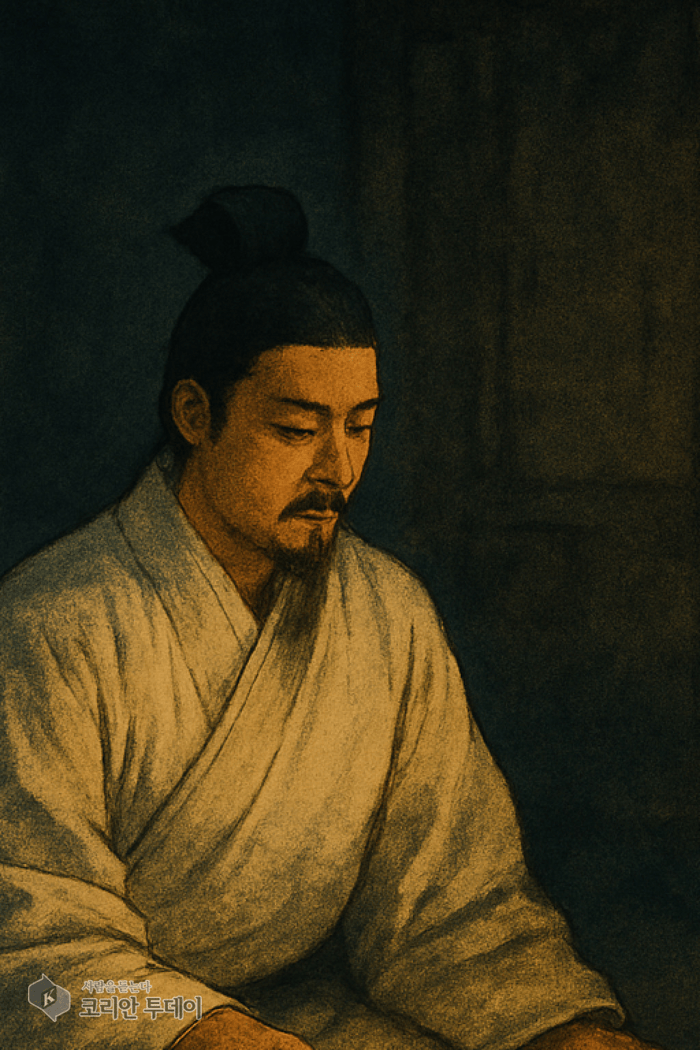
Liu Bei brought out the first line. His voice was not loud. Yet within it was the sound of a sprout rising, for the first time, from the root of a sentence grown in silence for twenty-eight years.
“Liu Bei (劉備), Guan Yu (關羽), Zhang Fei (張飛). Though these three men bear different surnames, today we bind ourselves as brothers. Let us make our will one and our strength one — let us rescue the man in hardship and hold up the man in peril. Above, we shall repay the state; below, we shall bring ease to the common people. We do not ask to be born in the same year, the same month, the same day — we ask only to die together in the same year, the same month, the same day. May Heaven and Earth look down upon this heart.”
At the end of each clause, a single blossom petal fell, slowly — one at a time, without any wind — upon the shoulders of the three.
Guan Yu lifted his cup second and offered it to Heaven and Earth. The grain of five winters’ snow inside his two eyes was melting. “After five years, this name has found its seat again. Setting it down at today’s seat, I shall conceal it no more.”
Zhang Fei lifted his cup last. His rough voice, folded quietly, came out in a low grain. “This younger brother’s cup is the first cup he has poured today with his own hand. When this cup is emptied, this younger brother’s forearm will stand behind the two elder brothers.”
The three drank together. The emptying of the three cups happened as one grain, at a single stroke. Upon the altar the single stick of incense burned on quietly to its end.
By the grain of elder-before-younger (長幼有序), Liu Bei was placed as the eldest; Guan Yu as the middle; Zhang Fei as the youngest. The twenty-eight-year Liu Bei became the elder brother; the long-bearded-to-the-chest Guan Yu became the second; the thunder-voiced Zhang Fei became the third. The three names of sworn brotherhood were planted at the center of the peach garden.
The fourth dawn of Book 1 opened quietly upon the small altar of white stone at the center of the peach garden. The three characters Doweonmaeng (桃園盟, the peach-garden oath) were being planted as a seed — a grain of dying together on the same year, the same month, the same day. The sigh before the posting (Day 2) and the long beard that reached the chest (Day 3) gathered into one grain upon the seat of three cups in the peach garden.
—

📌 Knowing Apart — History (正史) vs Romance (演義)
🟢 The Records of the Three Kingdoms (Shu Shu, Biographies of the Former Ruler, of Guan Yu, and of Zhang Fei) records plainly that Liu Bei, Guan Yu, and Zhang Fei slept upon a single bed together and bore themselves in the grain of brothers. The phrase “affection like brotherhood” (恩若兄弟) is a core record of the Biography of Guan Yu. 🟡 No side-text cited by Pei Songzhi (裴松之) transmits the specific scene of an altar in a peach garden, the exact rite of sacrificing one black ox and one white horse, or the specific wording of the oath of the “same year, same month, same day.” 🟠 The specific composition (the altar, the incense, the sacrifice, the oath at three cups in the peach garden) is wholly an adaptation of Romance of the Three Kingdoms chapter 1. This commentary follows that Romance composition, while rendering the sentence of the oath close to its canonical form. 🟠 The specific decision of birth-order brotherhood by elder-before-younger is also an adaptation of Romance. 🔴 The three-character creation Doweonmaeng (桃園盟) and the mirror reading by which Zhang Fei’s hand trembles as he pours his own cup with his own hand for the first time are reconstructions of this commentary. The character-creation line has reached, today, its fourth seat.
“✒️ A Word from the Commentator — Dr. Yeon Samheum
There is a seat on which one asks not to be born on the same year, the same month, the same day, yet asks only to die together on the same year, the same month, the same day. The quietest weight of that oath lies within the single tremble of the hand of a man who has poured his own cup by his own hand. Upon your own hand this dawn, is there perhaps a posture of pouring your own cup with your own hand? Might you look, quietly, into the weave of that pouring?
🌍 That Year, on the Other Side of the Earth…
In the spring of 169 CE, upon one dawn at Rome’s Marcus Aurelius‘ camp by the Danube, it is said that the emperor, the son of a general whose father had passed, and an exiled foreign captain — three men in all — stood before a low altar. The emperor poured three cups of wine, and the three drank together. The Latin phrase foedus trium (the oath of three men) was, it is said, inscribed on the record of the camp that dawn. On the dawn when, at the eastern edge, the oath of three cups in the peach garden was made before the altar of white stone, at the western edge the oath of three by the Danube was likewise standing before an altar in the same manner.
📅 Tomorrow, Day 5: A Deed with No Name
“On a day after the oath, the three entered beneath the banner of the righteous militia. A first battle took place; a deed was raised. Yet the name of that deed did not reach the ledger of the county office.” — Sam H. Yeon, Ph.D.
Commentary — Yeon Samheum, the Commentator · Sam H. Yeon, Ph.D. · 延三欽博士


Leave a Reply