
[Day 36] The Dust on the Road to Meiwu
March · *The Woman Beneath the Moonlight* | about 3 min read

On the morning of the next day, above the dust of a carriage leaving the western gate of Chang’an, a sigh turned back toward the palace to the east. Dong Zhuo’s order had come down early to the residence. One carriage stood at the head, and behind it some hundreds of escort troops followed. The ministers formed the sending-off line as far as ten li beyond the western gate.
In the felt-carriage sat Diaochan. Her face showed only halfway past the silk blind. Her two eyes hung half-lowered; her lips half-closed. Yet the gaze beyond that half-opening was seeking one person upon the road outside the western gate of Chang’an this morning.
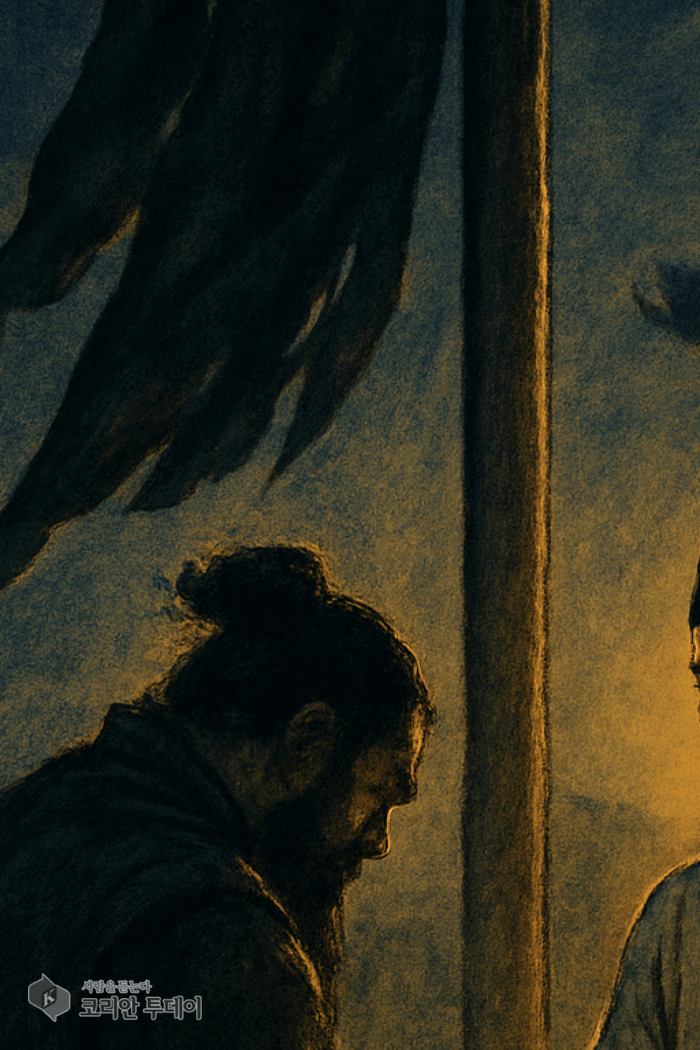
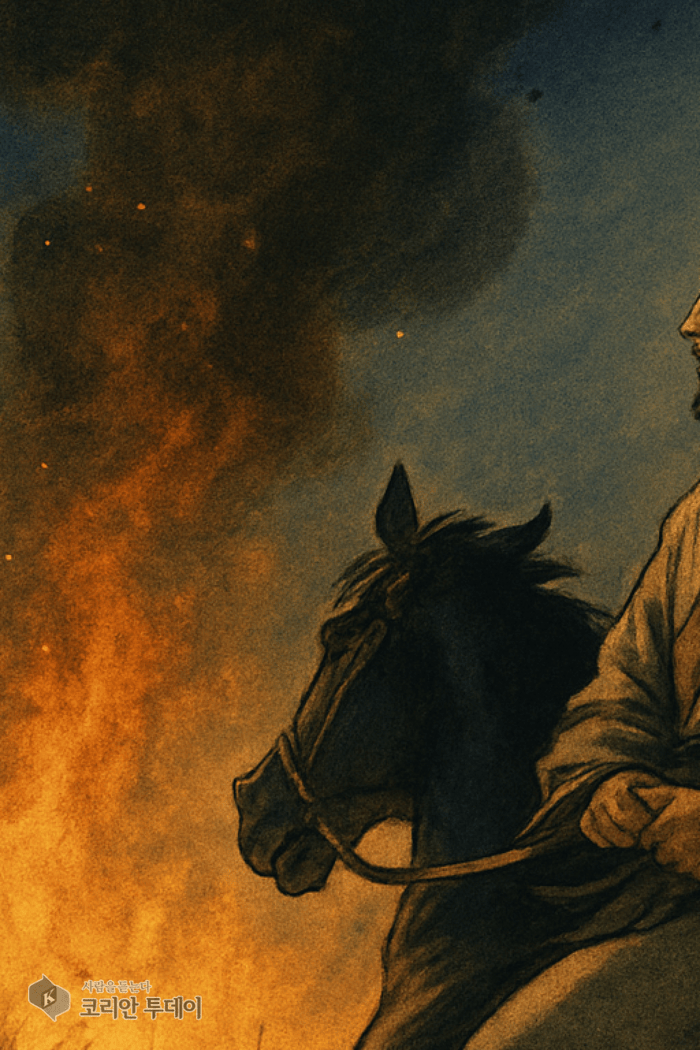
Among the line of the hundred officials, Lü Bu, mounted, stood quietly a step back. From a seat one step withdrawn, he looked down upon the dust of the carriage. The carriage began to move slowly. At a breath’s distance, Diaochan’s eyes crossed through a gap of the silk blind toward Lü Bu. Inside those eyes, a tear had already come down.
Lü Bu’s gaze met those eyes beyond the half-blind. Diaochan, without a word, raised a scented silk (香羅) to her face. Her shoulders shook shallow. Seen from a distance, it looked like tears shed in the dust; read up close, it was a single sentence of farewell directed at Lü Bu.
“Take me out from within this dust.”
That single sentence traveled, at the same speed as the carriage, toward Lü Bu’s ear upon the dust outside the western gate of Chang’an.
From within the silk blind, Diaochan’s hand rose again. The scented silk at her fingertips extended one cun beyond the carriage’s window. That distance of one cun was the last distance of this morning outside the western gate of Chang’an. Lü Bu’s two eyes read that distance of one cun. Yet his hand did not move from the seat upon the reins. This morning’s wind crossed the breath between the two men, then returned first toward the western mountain road.
As the carriage’s speed grew, the grain of dust grew thicker. Soon the carriage entered the first turn of the western mountain road. In that moment, Diaochan’s face vanished entirely behind the silk blind. Lü Bu’s hand settled quietly upon the reins.

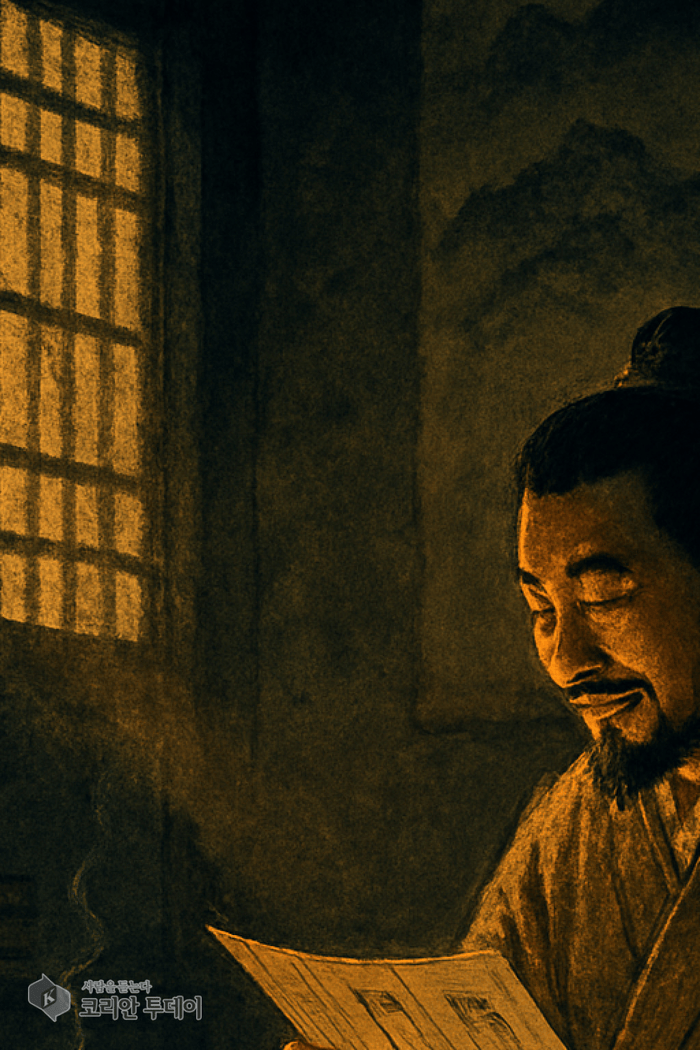
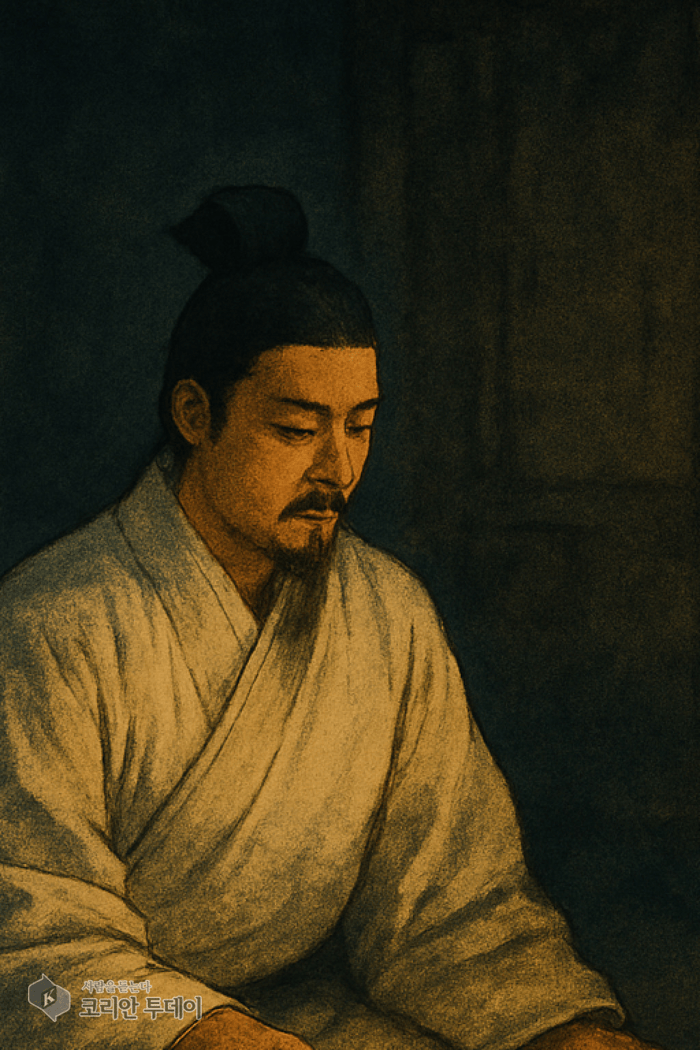
Upon a hillock outside the western gate of Chang’an, Wang Yun stood and looked upon the retreating carriage. Behind Wang Yun stood an elder minister. His name was Huang Wan (黃琬), one of the anti-Dong faction close to the Minister. Beside Huang Wan, two other elder ministers waited quietly in simple grey robes — Yang Zan (楊瓚) and Shisun Rui (士孫瑞), whose names had been held in the pocket of the plan for some months, kept out of the sight of Dong Zhuo’s informers, brought out today only to watch a dust settle. Wang Yun whispered a low line to Huang Wan.
“Lord Huang. This morning His Grace has opened the gate of Meiwu with his own hand and set Diaochan within that gate with his own hand. From now, the eye of His Grace is divided between the two seats of Meiwu and Chang’an. One eye split in two is the weakest posture of one person. We must wait for that weak posture.”
Huang Wan bowed his head deeply. “I shall bear the Minister’s will. I shall wait for the next seat’s signal.” The other two ministers bowed too, one by one. Not one of the four had spoken, in all these months of preparation, the name of the Grand Preceptor aloud in a public street. Even this morning, upon a public hillock, they spoke only in low lines of wind against wind. That silence was part of the plan; for a plan too loud before its hour is a plan that never sees its hour.
When the dust of the western mountain road had settled entirely, Lü Bu turned his horse and began to return to the interior of Chang’an. The tip of the halberd at his waist remembered the grain of this morning’s dust. That grain would, in a day to come, change into a grain of blood. This morning Lü Bu had set that seed of change more deeply into the shaft of the halberd at his waist.
On his way back he passed the gates of the palace where, on other days, he would stand one step behind the Grand Preceptor with his halberd. He rode past those gates without dismounting. Children in the lanes did not know that a seed of blood had just been set beside a seed of dust. They saw only a captain upon a red horse, returning alone from a morning escort. The common life of Chang’an went on in its ordinary grain. That grain carried today, without knowing, the weight of the two seats of Meiwu and Chang’an inside it.
The sixth morning of Book 2 opened quietly above the dust outside the western gate of Chang’an. The three characters Mirojin (郿路塵, the dust of the road to Meiwu) were planted as a seed: the breath on which the two eyes of the Grand Preceptor became divided between the two seats of Meiwu and Chang’an. The seed of decision in Day 35’s Jeolyeonghu had crossed, this morning, into the grain of a dust.
—

“✒️ A Word from the Commentator — Dr. Yeon Samheum
There is a morning behind the dust of a carriage on which a hand is laid one cun beyond a silk blind. The distance of that single cun becomes the weight upon a shoulder. Upon your own seat this morning, is there perhaps a hand laid out the width of a single cun beyond some blind? Might you look, once more and quietly, into the weave of that single cun?


Leave a Reply